


Unique & Non-Traditional Engagement Rings: The Complete Guide to Alternative Styles
Fifteen ideas for non-traditional engagement rings beyond the diamond solitaire, and how to pick one that lasts.

Put ten engagement rings on a tray and most of them will be the same ring: a round white diamond on a plain or pavé band. Unique engagement rings are the other ones. A teal sapphire where the diamond usually sits. A kite-cut moss agate with a green forest trapped inside it. A garnet held between two gold leaves, or two stones sitting side by side instead of one. Non-traditional engagement rings are no longer a niche choice, and the couples who come to us rarely want the default; they want a ring that looks like the person wearing it. This guide is the conversation we have with them, written down.
Unique Engagement Rings at a Glance
- Definition: any ring that visibly departs from the colorless diamond solitaire on a plain band, through its stone, cut, setting, metal or meaning. One change is enough.
- Hardest stones for non-diamond engagement rings: moissanite (Mohs 9.25), sapphire and ruby (9), alexandrite (8.5), spinel (8).
- Beautiful but softer: moss agate and black onyx (6.5 to 7), moonstone (6 to 6.5), opal (5.5 to 6.5). They want a bezel or another protective setting.
- Unusual cuts: kite, coffin, hexagon, fireworks and fantasy cuts, geometric shapes and east-west settings. Pointed tips are the weak spot, so look for protective prongs or a bezel.
- Budget: ignore the three-months-salary rule; the stone and metal move the price far more than the style does.
- Metals: solid 925 sterling silver with a rhodium finish, 14K gold vermeil, solid gold and platinum, with a limited lifetime warranty on solid gold and platinum.
- Start here: the unique engagement rings and non-traditional engagement rings collections.
What Makes Non-Traditional Engagement Rings Different?
One change to the default is enough. Most of the rings people call unique make two or three.
Whether you are looking at unique engagement rings for women or for men, there are five places a ring can move away from the classic round diamond solitaire, and each one changes the character of the piece in a different way.
- The stone. A colored gemstone such as sapphire, alexandrite or morganite; a diamond alternative such as moissanite; or a natural material with a pattern of its own, like moss agate or a salt-and-pepper diamond.
- The cut. A kite, coffin, hexagon, marquise or pear instead of a round, or an elongated stone turned sideways in an east-west setting.
- The setting. A bezel, a toi et moi pair, a three-stone line, a hidden halo, or metalwork shaped into leaves, vines, stars or cathedral arches.
- The metal. Rose gold, two-tone, a black ruthenium finish, or an alternative metal such as tungsten or Damascus steel for a men's ring.
- The meaning. A birthstone, a symbol, an engraving, or a design that exists only because of the two people it was made for.
The words unique and non-traditional overlap, but they are not quite the same. Non-traditional describes what a ring is not. Unique describes how it feels. A lab-grown diamond solitaire is non-traditional in origin and completely classic in appearance. A round diamond on a yellow gold band with a hidden halo tucked under the stone breaks no rules at all, yet it feels personal every time the wearer tilts a hand and catches the sparkle underneath. The rings in our unique engagement rings collection run across that whole spectrum, from quiet to unmistakable. The non-traditional engagement rings and alternative engagement rings collections take the widest view, with classic shapes and bold designs side by side, for anyone who wants to see the whole range before narrowing it down.
The "traditional" ring is younger than you think
For most of history, betrothal rings carried garnets, pearls, emeralds or whatever a family found meaningful; diamonds became the default only after De Beers' 1947 slogan "A Diamond Is Forever." When Lady Diana Spencer chose an oval sapphire ringed with diamonds in 1981, she was, in the long view, being entirely traditional. The full story, era by era, is in our guide to vintage engagement rings.
Why More Couples Are Choosing Unique Engagement Rings
Personal, often better value, and simpler to source responsibly.
The Knot's 2026 Real Weddings Study is the latest in a run of annual surveys tracking how couples buy rings, and those surveys now show lab-grown diamonds chosen for more engagement rings than mined ones. Once the most traditional part of the ring, the diamond itself, has changed, it becomes much easier to question the rest. When couples tell us why they want unusual engagement rings, their reasons usually fall into five groups.
- It reflects one person's taste. A favorite color, a birth month, a love of forests, old novels or the night sky can all be turned into a ring. The ring becomes a portrait of one person rather than a symbol of a category.
- The budget goes further. A moissanite or lab-grown diamond costs a fraction of a mined diamond of the same size, and many colored stones are priced below both. That freedom can go into a larger stone, a solid gold band, better craftsmanship, or simply a smaller bill.
- It is easier to buy responsibly. Lab-grown stones involve no mining, and a maker who uses recycled precious metals where possible, conflict-free gemstones and disclosed treatments can tell you what went into the ring. Our ethical sourcing page explains how we approach it.
- It stands out in a room full of solitaires. A kite-cut alexandrite in a vine setting is not the ring anyone expects to see at the reception.
- It can carry meaning a white diamond cannot. The GIA birthstone list is a starting point for many couples. Others choose a stone for its color, its symbolism, or the memory it brings back: the blue of the lake where they met, the green of the woods where they got engaged.
The one real risk with unconventional engagement rings is choosing novelty over taste. Engagement ring fashions move in cycles, and a look that is everywhere this year can feel dated in ten. The rings that age well are rooted in something the wearer has loved for years: the color they always wear, the jewelry already in their box, the books on their nightstand. Our look at engagement ring trends separates the passing moments from the shifts that are here to stay.
Ideas 1–4: Center Stones Beyond the White Diamond
Changing what sits in the middle of the ring is the fastest route to unique gemstone engagement rings.
The center stone sets the color, the sparkle, the price and the care routine of the whole ring. Everything else, from the prongs to the band, is designed around it. These are the four stone-led unique engagement ring ideas couples choose most often, running roughly from the most familiar to the most unusual.
1. Colored gemstone centers
Swapping a white diamond for a colored gem is the classic non-traditional move, and the one with the longest history. Each stone brings its own color, its own hardness and its own price logic.
- Sapphire. Sapphire is corundum, rated 9 on the Mohs scale, and it comes in every color except red, which the trade calls ruby. Royal blue is the classic, but teal, pink, yellow, white and the pink-orange padparadscha are all engagement ring favorites. Most sapphires are heated to improve color, a permanent and accepted treatment that should always be disclosed. Browse sapphire engagement rings or, for red corundum, ruby engagement rings, and compare colors and prices in our sapphire engagement ring guide and the broader sapphire gemstone guide.
- Alexandrite. A chrysoberyl rated 8.5, famous for shifting from green or bluish green in daylight to purple or purplish red under warm light. Fine natural alexandrite is among the most expensive colored gems per carat, so most alexandrite at accessible prices is lab-created, and true lab-grown alexandrite has the same chemistry as natural, though lab stones most often shift green to purple; color-change simulants also exist, so ask which you are buying. See alexandrite engagement rings and the alexandrite engagement ring guide.
- Emerald. Beryl colored by chromium or vanadium, 7.5 to 8 on the Mohs scale but naturally full of inclusions the trade calls jardin, French for garden. Those inclusions make emerald brittle, and most stones are oiled to improve clarity. It wants a bezel or protected corners and a wearer who takes it off for hard work. See emerald engagement rings and our emerald engagement ring buying guide.
- Aquamarine and morganite. The gentler siblings of emerald in the beryl family, both 7.5 to 8 and usually far cleaner. Aquamarine runs from icy to sea blue and comes in generous sizes at reasonable prices; morganite is a soft peach pink that glows in rose gold. Explore aquamarine engagement rings and morganite engagement rings.
- Garnet and amethyst. Two of the most affordable ways to put strong color on the hand. Garnet ranges from wine red to raspberry and rates 6.5 to 7.5 depending on the variety; amethyst is purple quartz at 7. They are the January and February birthstones. Shop garnet engagement rings and amethyst engagement rings.
To compare stones in one place, the gemstone engagement rings collection gathers centers from moissanite to moss agate, the wider gemstone rings collection shows each stone in everyday designs, and our best gemstones for engagement rings page ranks the options for daily wear.
2. Diamond alternatives that still sparkle
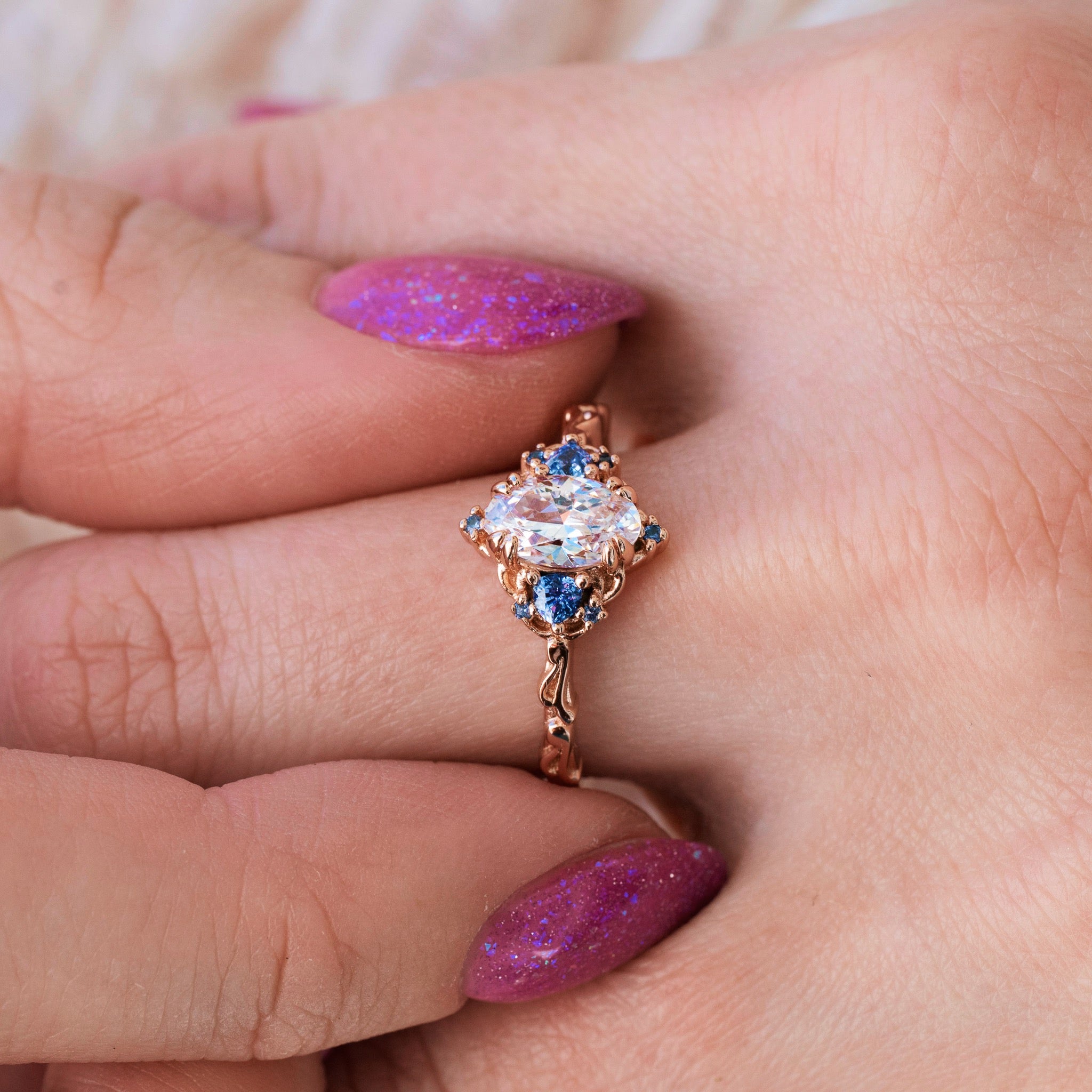
Some people love the look of a white diamond and simply want a different origin, a different price or a little more fire. These options deliver brilliance without a mined diamond.
- Moissanite. Silicon carbide. Natural moissanite is vanishingly rare, so gem moissanite is created in a lab. At 9.25 it is the hardest popular diamond alternative, and with a higher refractive index and more than twice the dispersion of diamond, it throws noticeably more rainbow fire, especially in larger stones and bright sun. It is not a lab-grown diamond; it is a different mineral entirely. Browse moissanite engagement rings and see the side-by-side comparison in moissanite vs diamond.
- Lab-grown diamond. A real diamond: pure carbon, Mohs 10, with the same chemical, physical and optical properties as a mined stone, grown in weeks by the CVD or HPHT method rather than over billions of years underground. Independent labs report on them: IGI grades lab-grown diamonds on the 4Cs, while GIA issues a simpler Premium or Standard quality assessment. The trade-off is resale, since lab-grown diamonds have little secondhand value, so buy one because you love it rather than as an investment. Shop lab-grown diamond engagement rings.
- Herkimer diamond. Not a diamond at all but a double-terminated quartz crystal from Herkimer County, New York, water-clear and naturally faceted by its own crystal faces, which is how it earned the diamond nickname. Rated 7, it suits careful daily wear in a bezel or protective prongs and has a raw, just-found character. See Herkimer diamond engagement rings.
- Salt-and-pepper diamond. A natural diamond packed with black and white inclusions that make every stone a one-off pattern, like a tiny galaxy. Hardness is still 10, but heavy inclusions can reduce toughness, so a bezel or protective prongs make sense. Our explainer on what a salt-and-pepper diamond is covers durability, the best cuts and why it costs less.
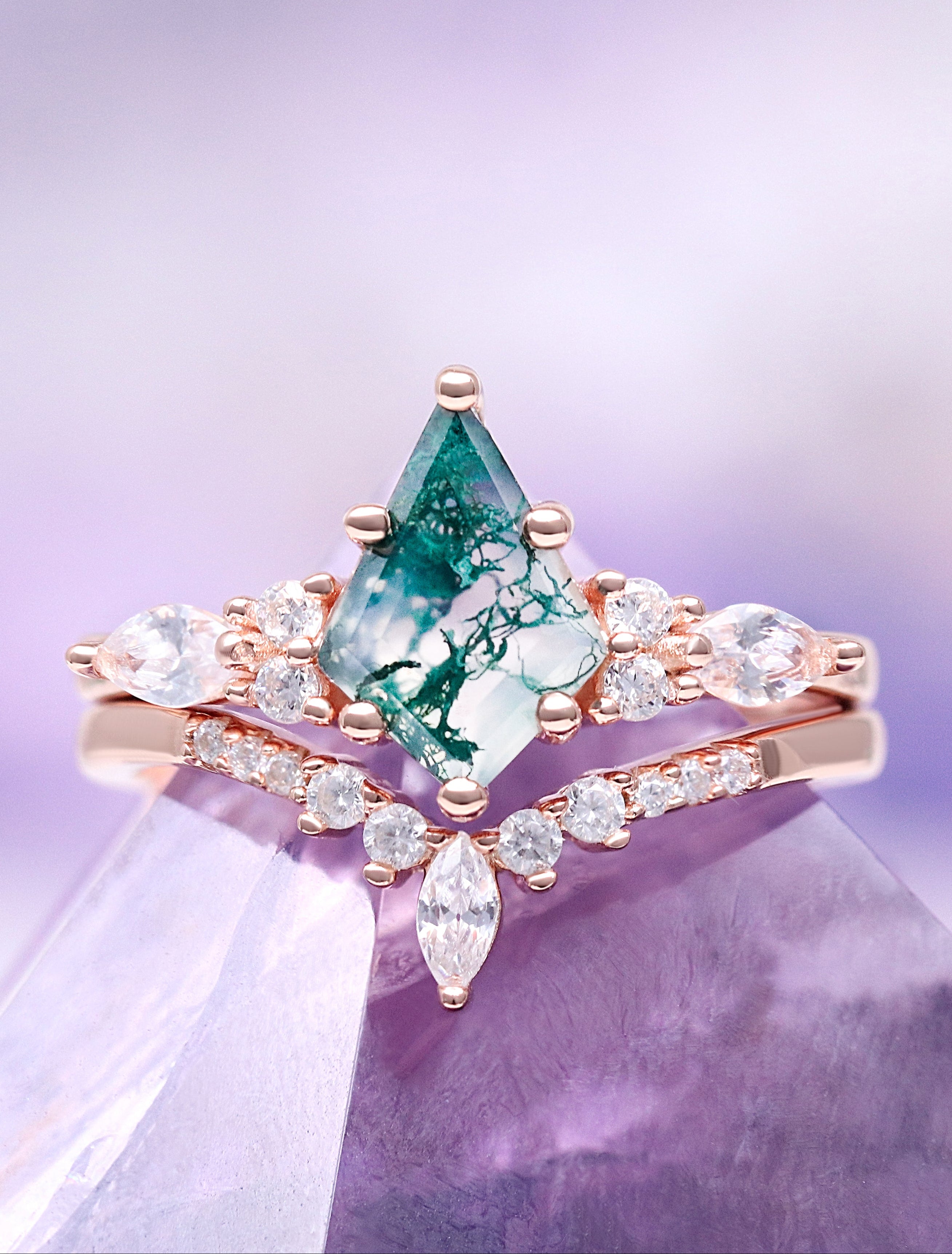
Moss Agate Engagement Rings
Green moss agate centers in kite cuts and nature-inspired settings, where every stone carries its own branching pattern.
Shop moss agate engagement rings3. Stones with a pattern of their own
Some couples want a stone that is not merely uncommon but literally unrepeatable. Natural inclusion patterns deliver exactly that, because no two pieces of the rough ever grow the same way.
Moss agate is clear-to-milky chalcedony threaded with green mineral growth, and every slice shows a different landscape: one reads as pine woods, the next as pond weed or a single fern frond. That is why it has become a favorite for unique engagement rings. It rates 6.5 to 7, so it wears best in a bezel or sturdy prongs, and elongated kite and oval cuts give the pattern room to show. Browse moss agate engagement rings and read the complete moss agate engagement ring guide before you buy. For the stone in a sharper outline, kite cut moss agate engagement rings pair it with our Skye Kite® shape.
Rutilated quartz traps golden or silvery needles of rutile inside clear quartz, so the stone looks as if it has been threaded with light. At 7 it handles careful daily wear in a protective setting; see rutilated quartz engagement rings. Salt-and-pepper diamonds belong in this family too, as does any opal with a play-of-color pattern you fall for on sight. When you buy a patterned stone, ask to see the actual stone rather than a representative photo; with these materials, the pattern is the whole point.
4. Moonstone and opal: glow instead of sparkle
Diamonds and moissanite throw light back as sparkle. Moonstone and opal do something softer: they glow from inside, and the glow moves as the hand moves.
- Moonstone is a feldspar whose thin internal layers scatter light into a floating blue-white sheen called adularescence. It is one of June's birthstones and a natural fit for ethereal, fairy-tale designs. It is also soft, at 6 to 6.5, with cleavage planes that can split on a hard knock, so a bezel and some care on hands-on days are essential. Shop moonstone engagement rings and read our guide to moonstone durability and settings.
- Opal is hydrated silica, and its play-of-color flashes every shade of the rainbow across a white, black or crystal body; fire opal adds warm orange and red. At 5.5 to 6.5, and with water held inside the stone, opal dislikes sudden temperature changes, ultrasonic cleaners and long spells of very dry heat. It is October's birthstone. See opal engagement rings and the opal engagement rings guide.
A practical tip we give almost everyone choosing one of these stones: pair the engagement ring with a plain, sturdy wedding band. On days that are hard on the hands, such as moving day, a weekend of gardening or a camping trip, wear the band alone and let the softer stone rest at home.
Idea 5: Unusual Cuts and Shapes
The outline of a stone changes the character of a ring before anyone notices its color.
Shape is the silhouette of a stone seen from above; cut is the arrangement of facets that decides how it handles light. A round brilliant is engineered for maximum sparkle, which is a large part of why it became the default. Fancy shapes trade a little of that brilliance for personality, and elongated ones bring a bonus: because their weight is spread across a longer face, an oval, marquise or pear looks larger than a round of the same carat weight and makes the finger look longer. A diamond, a sapphire and a moss agate can each become non-traditional simply by changing outline.
| Cut | What it looks like | Setting notes | Explore |
|---|---|---|---|
| Kite | Four sides with one long point and one short point, like a kite in flight | Protect both tips with V-prongs or a bezel; our Skye Kite® line is built on this outline | Kite cut rings |
| Coffin | An elongated six-sided shape with angled shoulders that taper toward one end | Reads vintage or gothic; the narrow end and corners need protection | Coffin cut rings |
| Hexagon | Six sides, from an even honeycomb to a stretched, elongated hexagon | Modern or Art Deco; flat edges suit bezels beautifully | Hexagon rings |
| Fireworks & fantasy | Unconventional facet patterns that break light into bursts | Best in open settings that let plenty of light reach the stone | Fireworks & fantasy cuts |
| Geometric | Trapezoids, shields, triangles and other angular outlines | Sharp corners want bezels or corner prongs | Geometric rings |
| East-west | Any elongated stone turned sideways across the finger | Often set low for a sleek profile; a modern twist on a familiar shape | East-west rings |
| Marquise | A boat shape with two pointed ends | The most elongating shape per carat; V-prongs at both tips | Marquise rings |
| Pear | A teardrop, rounded at one end and pointed at the other | The point traditionally faces the fingertip; protect the tip | Pear shaped rings |
Points are the weak spot of every fancy shape. The tip of a kite, marquise, pear or coffin is the thinnest part of the stone and the first place a knock lands, so look for a V-shaped prong cradling each point or a bezel wrapping the edge, especially on softer stones like moss agate and opal. With its tips protected, a pointed stone holds up to daily wear nearly as well as a round. Our coffin cut engagement rings guide covers meaning and styling for that shape, the marquise guide explains why it is the most elongating outline, and our pear shaped engagement rings guide walks through orientation and proportions.
Proportions matter as much as outline. A kite or pear that is too short looks stubby; one that is too long looks thin and fragile. Most people prefer ovals at roughly 1.35 to 1.5 times as long as they are wide, pears at 1.5 to 1.7, and marquise closer to 2 to 1; kite cuts vary by design. In the end, the right answer is the one that suits the wearer's finger length and the width of the band beneath it. If you want an outline softer than these but still not round, the cushion sits comfortably between classic and unusual; our cushion cut engagement rings guide compares square and elongated versions.
Ideas 6–15: Unique Engagement Ring Settings and Styles
Where the metalwork does the talking, whatever stone sits in the middle.
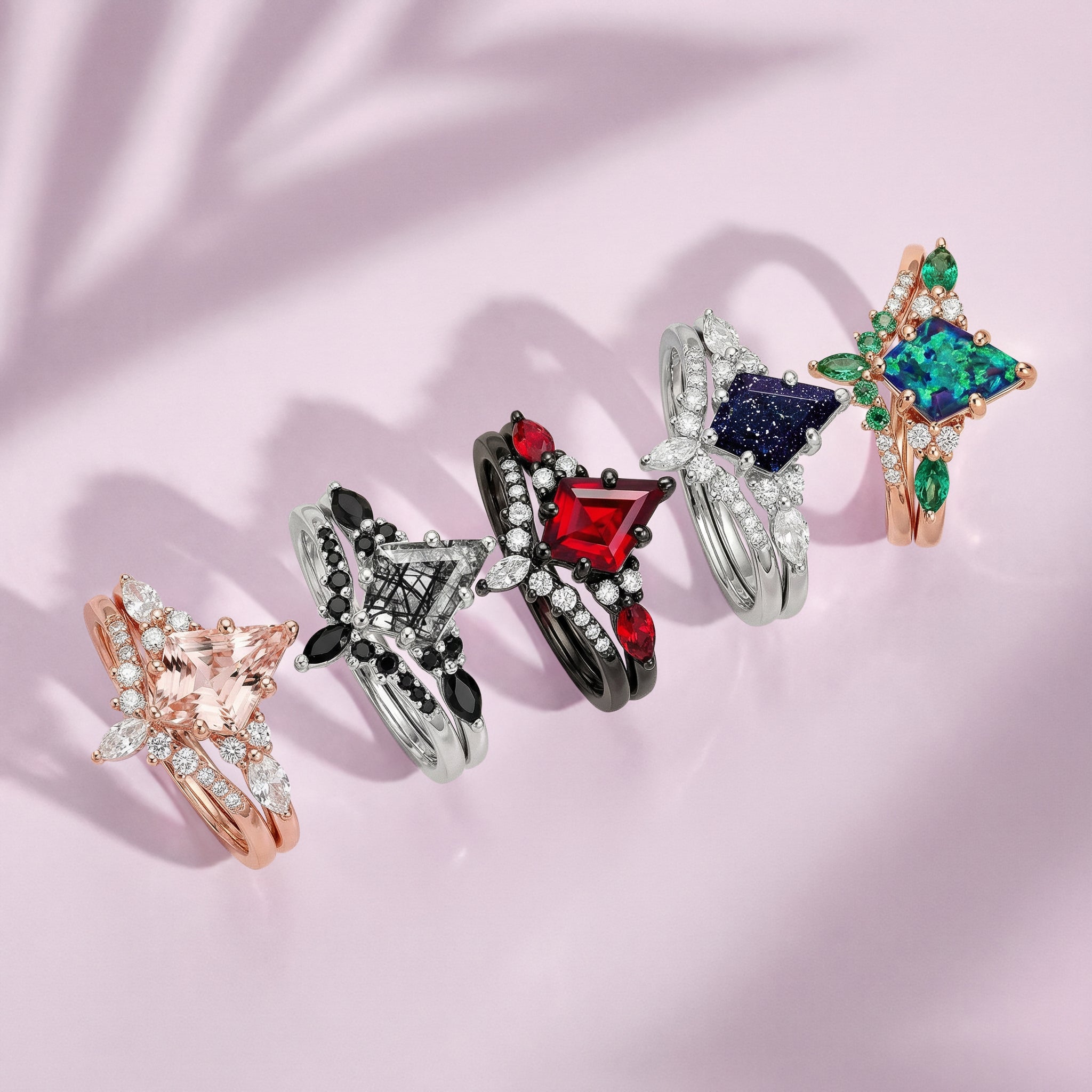
A setting is the architecture of a ring. It decides how much light reaches the stone, how well the stone is protected, how the ring sits beside a wedding band and, just as much as the gem itself, what story the ring tells. These ten ideas can be combined with any of the stones and cuts above, and the most memorable rings usually combine two: a moss agate in a leaf setting, a coffin-cut garnet on a black band, a sapphire and diamond toi et moi with milgrain edges.
6. Nature-inspired settings
Leaves curl along the shoulders, vines wrap the band, branches cradle the stone, and tiny accent stones sit like dew on a petal. Nature-inspired rings are the heart of what we make, and they pair especially well with green stones, moss agate and warm rose or yellow gold. When you compare them, look for smooth, well-finished leaf tips that will not catch on knitwear, and for a band shape that leaves room for a wedding ring or comes with a matching one. Browse the focused leaf engagement rings and floral engagement rings, or Celtic engagement rings if knotwork and interlaced lines feel closer to your roots.
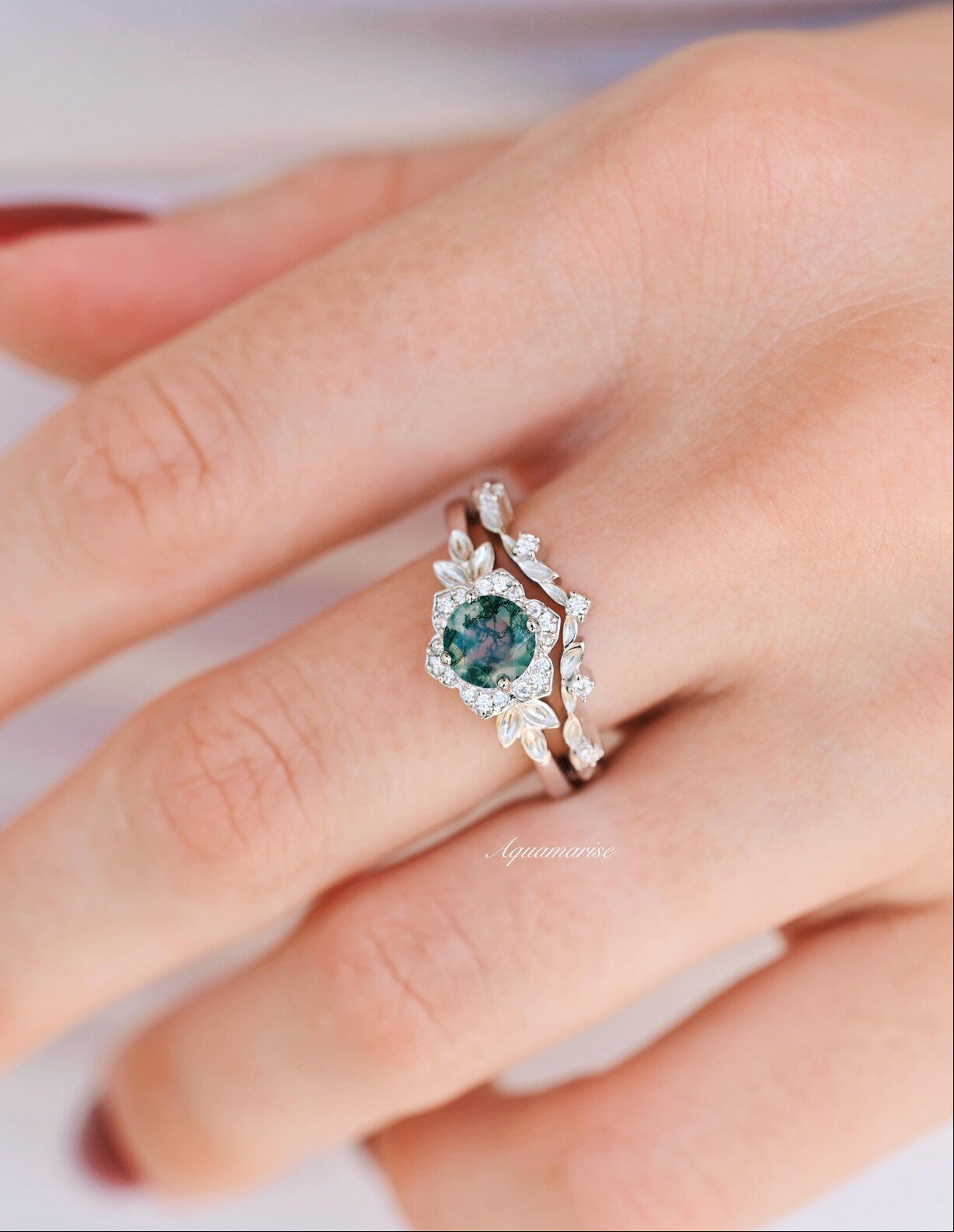
Nature-Inspired Engagement Rings
Leaf shoulders, vine bands and branch-like settings around colored gemstones, moss agate and diamond alternatives, for a ring that looks as if it grew.
Shop nature-inspired rings7. Fantasy and celestial designs
For couples who met over a shared bookshelf or spent their first date under the stars, fantasy and celestial rings turn a story into metal. Fairy rings borrow wings, woodland vines and dewdrop stones. Designs inspired by fantasy romance series use stone color to stand for a season or a realm, the way readers of ACOTAR pair a color with each court. Celestial rings scatter stars, moons and galaxies across the band. Start with fantasy-inspired engagement rings, then narrow to fairy engagement rings or ACOTAR-inspired jewelry. Our fairy engagement rings guide and fantasy engagement rings guide cover the styles and stones in more depth.
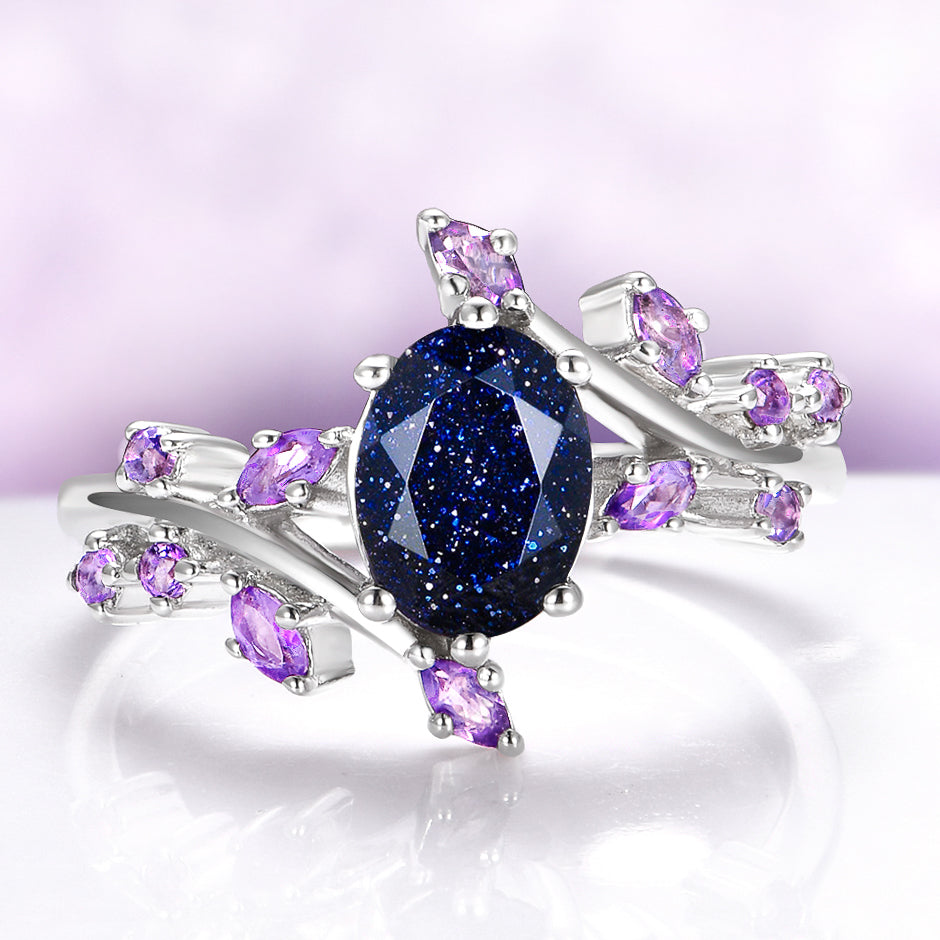
Our celestial lines are built around blue sandstone. The Starry Night® engagement rings and Orion Nebula Rings® use it because it looks like a clear night sky caught in a stone: deep cobalt blue glittering with tiny metallic crystals. Blue sandstone, also called blue goldstone, is a man-made glass rather than a mined gem, and at 5.5 to 6 it is one of the softer stones in this guide, so choose a protective setting. The full range is in blue sandstone engagement rings.
8. Gothic and dark romance
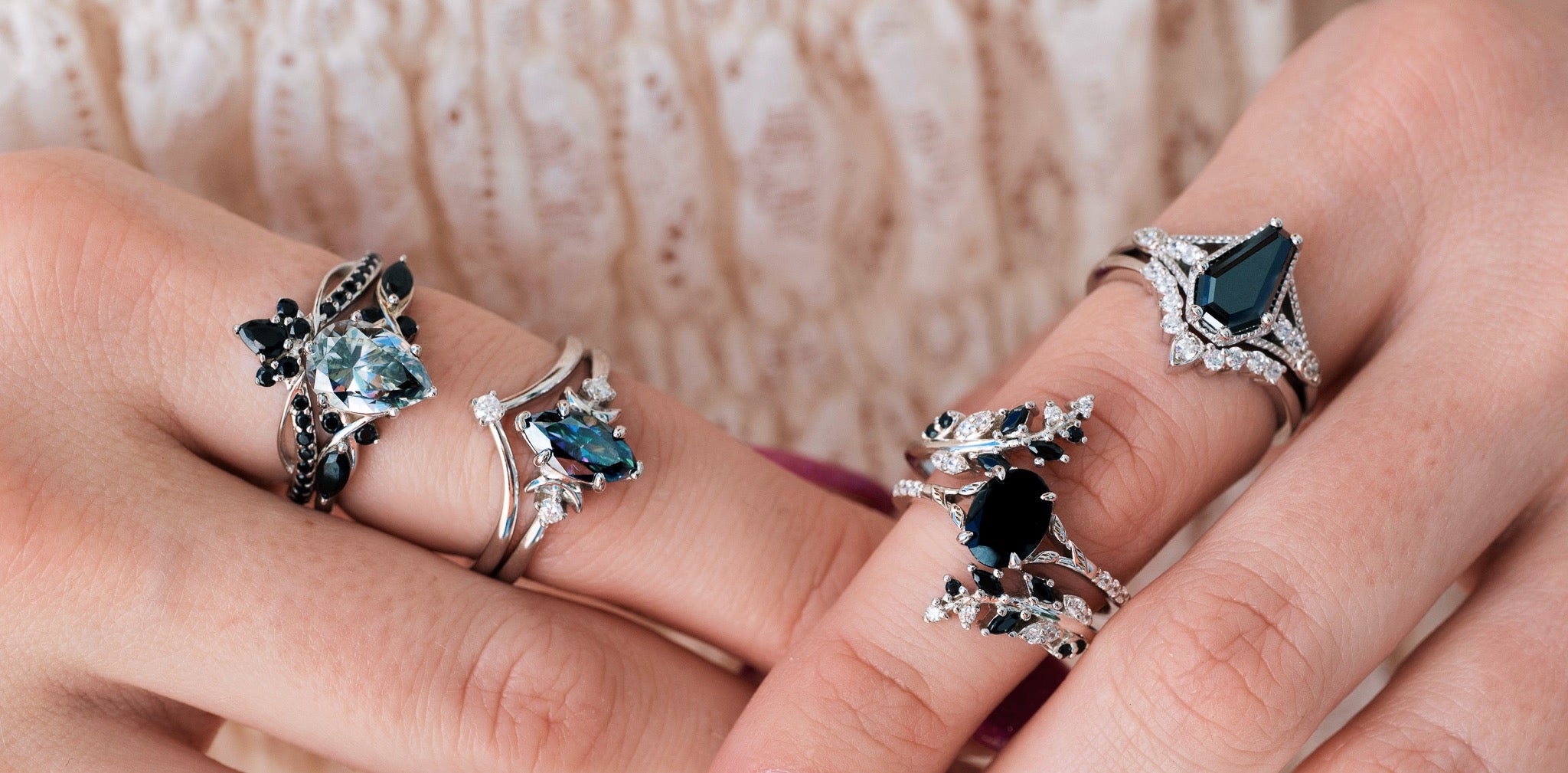
Gothic rings replace brightness with depth: a black stone that absorbs light instead of throwing it, a dark metal finish, pointed cuts borrowed from cathedral windows, and motifs like thorns, ravens and crescent moons. The look runs from a single black spinel in a bezel on a black ruthenium band to full Victorian drama. Black onyx and black spinel give the deepest blacks, and if all-black feels too severe, a wine-red garnet or deep amethyst on a black band keeps the mood while adding color. Browse gothic engagement rings, the Lovers of the Dark™ black engagement rings from our gothic line, and black onyx engagement rings. Our black gemstones guide compares every dark stone, and the full story, from memento mori to modern black finishes, is in our gothic engagement rings guide.
9. Vintage-inspired designs
Milgrain beading, pierced filigree, engraved shoulders and the geometric symmetry of Art Deco give a new ring the soul of an old one. The advantage of vintage-inspired over genuine antique is practical: a new ring is made in your size with sound prongs and a warranty, while a century-old ring may need re-tipping, resizing through fragile engraving, or replacement of worn stones. See vintage-inspired engagement rings, and read our vintage engagement rings guide for the design cues of each era, from Georgian to mid-century.
10. Toi et moi
French for "you and me," a toi et moi ring sets two stones side by side, one for each partner. The most famous example is the ring Napoleon Bonaparte gave Joséphine in 1796, with a pear-shaped diamond and a pear-shaped sapphire facing each other on a slim gold band. Modern versions mix a diamond with a colored gem, pair two birthstones, or combine two different cuts, such as a pear with an oval. The design looks best with a clear contrast in color, shape or size, so the ring reads as intentional rather than crowded. Our toi et moi engagement rings show the pairings side by side, and our explainer on what a toi et moi ring means covers its history and how to choose your two stones.
11. Three-stone rings
Three stones in a row are popularly read as past, present and future. The non-traditional twist is color: a sapphire flanked by diamonds, a moissanite between two emeralds, or three birthstones for a partner and two children. Side stones also make a modest center look larger and add visual weight across the finger without the cost of a bigger center. Shop three-stone engagement rings.
12. Hidden halos and bezel settings
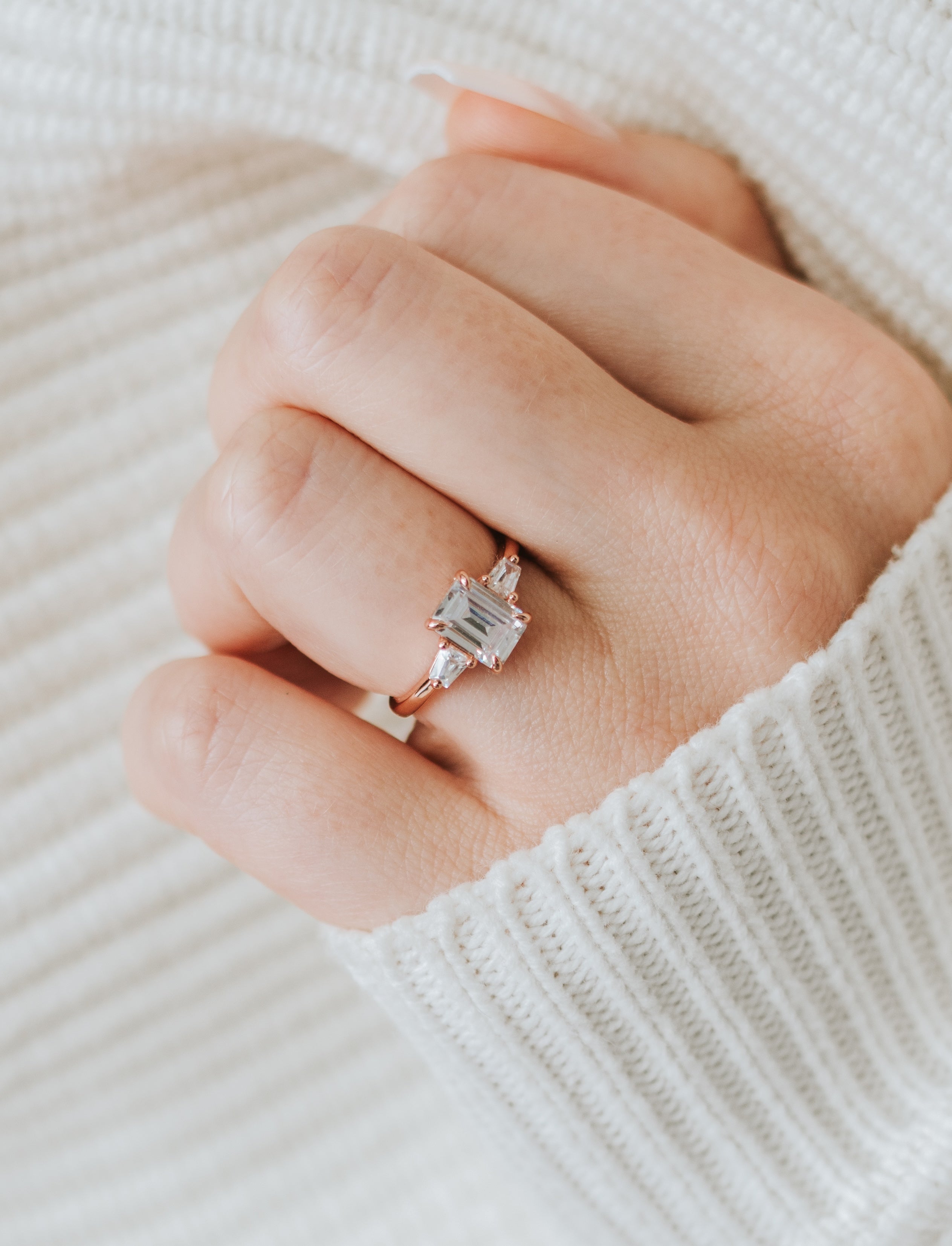
Two settings that change a ring quietly. A hidden halo places a circle of small stones beneath the center, at the gallery, where they are invisible from above and flash into view from the side: a private detail for the wearer. A bezel wraps the stone in a continuous rim of metal. It looks clean and modern, sits low, rarely snags, and is the best protection there is for softer stones like opal, moonstone and moss agate. See hidden halo engagement rings and bezel set engagement rings, and compare every setting type in our engagement ring styles and setting types guide.
13. Black rings and two-tone metals
Changing the metal is one of the simplest ways to make a familiar design unfamiliar. A white stone on a black band looks graphic and modern. A two-tone ring, with a white metal head on a yellow or rose gold band, keeps a colorless stone icy while warming the hand. Rose gold softens everything it touches and flatters pink, peach and green stones. Explore black rings, two-tone wedding bands and rose gold rings.
14. Stacking rings and bridal sets
Many unique engagement rings are not flat-sided solitaires, and that affects the wedding band. A kite, pear or nature setting often will not sit flush against a straight band, which is why contour, chevron and curved bands exist. The simplest solution is a set designed together, where the engagement ring and band nest as one piece. For a stack that grows over time, with an anniversary band or a birthstone ring for each child, picture the finished stack before you choose the first ring. If the engagement ring is classic, unique wedding rings, such as a chevron or leaf band, can carry the personality instead. See wedding ring sets for women, stacking rings and curved wedding bands.
15. Men's and gender-neutral engagement rings
Engagement rings are no longer only for one partner. Men's engagement rings tend to be bands rather than solitaires: flush-set stones, crushed gemstone inlays, hammered or matte finishes and alternative metals. Tungsten carbide is extremely scratch resistant but cannot be resized, so the size has to be right from the start. Damascus steel shows a flowing, wood-grain pattern. Sterling silver and solid gold bands can generally be resized by a jeweler as fingers change. Gender-neutral designs keep proportions balanced and ornament minimal so either partner can wear them. Browse men's engagement rings, gender-neutral rings and Damascus steel wedding bands, read how to choose a men's engagement ring, and see matching couples rings for sets made to be worn together.
Durability by Stone: A Mohs Hardness Table
Hardness decides how a ring looks after ten years, not how it looks on the day you propose.
The Mohs scale ranks minerals from 1 to 10 by which will scratch which. It is a ranking rather than an even ruler: diamond at 10 is several times harder than sapphire at 9, even though the numbers sit one step apart. The number that matters most for everyday wear is 7, because ordinary household dust contains particles of quartz at about that hardness. A stone harder than 7 resists that grit. A stone at 7 or below slowly loses its crisp polish and sharp facet edges over years of wiping, brushing and bumping against surfaces. Hardness is also different from toughness, which is resistance to chipping and breaking. Emerald is hard but brittle, and moonstone can split along internal cleavage planes, which is why the setting matters as much as the number.
| Stone | Mohs | Daily wear | Best setting |
|---|---|---|---|
| Diamond | 10 | Very durable, natural or lab-grown; a hard knock can still chip a thin edge or point | Any; protect points |
| Moissanite | 9.25 | Very durable for daily wear | Any |
| Sapphire & ruby | 9 | Very durable for daily wear | Any |
| Alexandrite | 8.5 | Excellent for daily wear | Open prongs show off the color change |
| Spinel | 8 | Excellent for daily wear | Any |
| Aquamarine & morganite | 7.5–8 | Good for daily wear; clean often, because beryl looks dull when oily | Prongs or halo |
| Emerald | 7.5–8 | Hard but brittle and included; careful daily wear | Bezel or protected corners |
| Garnet | 6.5–7.5 | Careful daily wear; remove for hard work | Bezel or sturdy prongs |
| Amethyst | 7 | Careful daily wear; take it off for the gym and garden | Bezel or protective prongs |
| Herkimer diamond | 7 | Careful daily wear; it is quartz, not diamond | Bezel or protective prongs |
| Moss agate | 6.5–7 | Careful wear; remove for chores and sport | Bezel or V-prongs |
| Black onyx | 6.5–7 | Careful wear; surface scratches can be repolished | Bezel |
| Moonstone | 6–6.5 | Gentle wear; cleavage makes it prone to splitting | Bezel |
| Opal | 5.5–6.5 | Gentle wear; avoid heat, sudden temperature changes and ultrasonic cleaners | Bezel |
| Blue sandstone | 5.5–6 | Gentle wear; the glass scratches over time | Bezel or protected setting |
How to read the table: if the ring will be worn every day by someone who works with their hands, lifts weights, gardens or climbs, stay at 8 and above, or plan to switch to a plain band for those activities; 8 and above is also the choice for a ring that will never come off. Stones from 7.5 to 8 are comfortable daily wear for most office and home lives with sensible habits, which mostly means taking the ring off for the gym, cleaning and yard work. A rating of 7 or below is not a reason to give up a stone you love. It is a reason to choose a bezel or another protective setting, to wear the ring with some awareness, and to accept that in ten or fifteen years it may want a professional repolish. Plenty of opal and moonstone engagement rings are still beautiful decades later because their owners understood that from the start. If moss agate is on your shortlist, our deep dive on whether moss agate is durable answers the most common worries.
Metals and Finishes for Alternative Engagement Rings
The metal sets the color temperature of the whole ring and decides how it ages.
Metal is rarely the first thing anyone notices about a ring, but it shapes everything: how warm or cool the stone looks, how the ring feels against the skin, how often it needs attention, and which warranty stands behind it. Here is how the options compare for a unique ring.
- Solid yellow gold. Warm, classic and flattering to green, red and yellow stones and to warm skin tones. It comes in 10K, 14K and 18K: 14K balances durability and color for everyday wear, while 18K has a richer yellow and higher gold content but is softer. Solid gold is made to order.
- Rose gold. Copper in the alloy gives it a soft pink that suits morganite, moonstone, pink sapphire and moss agate, and it reads especially romantic in nature-inspired designs.
- White gold. A cool, neutral frame that keeps diamonds, moissanite, sapphire and aquamarine crisp, finished with rhodium for its bright white color.
- Platinum. Naturally white, dense and hypoallergenic for most people. When platinum is scratched, most of the metal is displaced rather than lost, so it develops a soft patina and wears very slowly. That makes it the strongest choice for holding small accent stones over a lifetime. It is made to order.
- Solid 925 sterling silver. The most accessible precious metal, finished with rhodium for a bright white surface. It is softer than gold, so it suits designs with sturdy settings, and it lets you try a bold style at a gentle price.
- 14K gold vermeil. 14K gold over solid sterling silver, giving the warmth of gold on a sterling silver core at a price well below solid gold.
- Black ruthenium. A plated black finish that makes white stones look brighter and colored ones deeper. Clean it with mild soap and a soft brush rather than an ultrasonic cleaner.
- Alternative metals for men's and gender-neutral bands. Tungsten carbide, titanium and Damascus steel are tough and contemporary. Remember that tungsten cannot be resized.
Warranty coverage differs by metal. Aquamarise® covers sterling silver, vermeil, ruthenium, tungsten, titanium and Damascus steel with a 100-day warranty, and solid gold and platinum with a limited lifetime warranty; full terms are on our warranty page. The precious metal guide compares karats, alloys and colors in more detail, and if you are torn between the two top-tier metals, platinum vs gold sets out the trade-offs. For the most accessible starting point, browse sterling silver engagement rings.
How Much to Spend on Unique Engagement Rings
Forget the salary formula. Put the money where the wearer will see it every day.
The "three months' salary" rule is not a tradition. It grew out of De Beers advertising, which suggested one month's salary in 1930s America, two months in the 1980s and three months in its campaigns in Japan. It was written to sell diamonds, not to fit anyone's finances, and it is especially meaningless for non-traditional engagement rings, where the same design can cost ten times more or less depending on the stone and metal inside it. For context, The Knot's engagement ring spending research has put the average U.S. engagement ring at about $4,600 for couples married in 2025, down from $5,200 a year earlier, and a great many couples spend far less. A sensible budget is simply the amount you can pay without debt that lingers past the wedding.
Where the money actually goes
- The center stone. Natural diamond costs the most per carat. Lab-grown diamond and moissanite cost a fraction of that for the same size. Colored gems range from very affordable, such as amethyst, garnet, moss agate and morganite, to very expensive: a fine untreated sapphire or a natural alexandrite with a strong color change can rival a diamond.
- The metal. Roughly from least to most expensive: sterling silver, 14K gold vermeil, 10K and 14K gold, then 18K gold and platinum, whose order shifts with metal prices. The move from vermeil to solid gold is the biggest single step in most ring prices.
- The handwork. Sculpted leaves, milgrain, hand-set pavé and hidden halos all add hours at the bench. Detail is usually what makes a ring look unique, so this is where extra budget shows most.
| Budget | What it typically buys | Where to look |
|---|---|---|
| Under $500 | Solid sterling silver or 14K gold vermeil with a colored gemstone, moss agate or moissanite; bold designs at a gentle price | Sterling silver engagement rings |
| $500–$1,500 | Solid 10K or 14K gold settings with moissanite or colored gemstones, and gold bridal sets | Bridal ring sets |
| $1,500–$5,000 | Solid 14K or 18K gold or platinum with moissanite, a lab-grown diamond, or a good sapphire, emerald or aquamarine | Lab-grown diamond rings |
| $5,000 and up | Larger lab-grown or moissanite centers, solid gold or platinum and elaborate handwork | Request a custom design quote |
What a $15,000 ring looks like, for comparison
At the top of the market the trade-off is carat weight against design. A big natural-diamond budget mostly buys size; the same money in moissanite or lab-grown buys a very large stone or a modest one wrapped in bench work. A moss agate ring in solid gold at a small fraction of that price can be more distinctive than either, because uniqueness comes from design rather than spend.
If you would rather spread the cost, financing offers interest-free Pay in 4 with Shop Pay or Klarna, plus 3-, 6- and 12-month plans from $150. For solid gold and platinum pieces, an independent appraisal add-on is available for $175 and adds 2–4 days, which makes insuring the ring straightforward. If the proposal date is close, ready-to-ship engagement rings leave in 1–4 business days, while solid gold and platinum are made to order in 3–6 weeks. Our full guide to how much to spend on an engagement ring works through budgets by lifestyle and priority.
How to Choose a Non-Traditional Engagement Ring
Start with what they already wear; finish with the ring size.
- Gather evidence, not guesses. Look at the jewelry they wear every day, not the pieces saved for special occasions. Note the metal color, the scale, dainty or bold, and any motifs that repeat. Saved boards, screenshots and the rings they point out on other people are the best clues you will get, and a trusted friend can often confirm a hunch.
- Name the one thing that makes it theirs. A color, a cut, a motif or a meaning. One strong idea carried out well beats five ideas competing on one finger. If they love green and forests, a moss agate center covers both, and the setting can stay simple.
- Match the stone to their hands. Use the Mohs table above. A nurse, chef, climber or gardener needs a stone of 8 or higher or a very protective setting; a softer stone suits a gentler routine.
- Choose a setting that protects the stone. Bezels for soft stones, V-prongs for points, and a lower profile for anyone who pulls gloves on and off all day.
- Pick the metal for the stone and the skin. Warm golds for green, red and peach stones; white metals for blue, white and icy stones; black finishes for drama.
- Plan the wedding band now. Many unique settings need a curved or notched band to sit flush, and buying a designed set avoids an awkward gap later.
- Get the size right. Use our find your size guide, with a printable ring sizer and a US, UK and EU conversion chart. Rings come with a free one-time size exchange, and tungsten bands cannot be resized.
If the proposal is a surprise, read the returns and refunds policy first: eligible pieces can be returned within 14 days of delivery using a prepaid U.S. return label, made-to-order gold and platinum have separate terms, and engraved or personalized pieces are final sale. Our engagement ring buying guide covers the fundamentals for first-time buyers, and the FAQ page answers most order and delivery questions.
Designing a Custom Unique Engagement Ring
When the ring you are picturing does not exist yet, build it.
Custom is the surest way to own a ring designed around one person. It makes sense when you have a family story to build around, a motif that means something specific, a combination no collection offers, or a partner with very clear ideas. It is also far less intimidating than most people expect, and the process is the same whether the finished ring is sterling silver or platinum.
- Share the idea. Send sketches, inspiration photos, your metal preference and a budget through the build your custom ring page. Rough is fine; a phone photo of a napkin drawing is a perfectly good start.
- Get a free quote in 1–2 days. Custom pricing starts at $100 for sterling silver, $375 flat for tungsten, and $1,000 for solid gold and platinum.
- Refine the design. Review the design and fine-tune proportions, stone sizes, band width and details before production.
- Allow time for production. Solid gold and platinum pieces are made to order in 3–6 weeks, so plan backward from the proposal date.
- Personalize it. Complimentary laser engraving is available inside most rings: up to 16 characters on women's rings and 25 on men's, plus symbols, with custom fonts for $25. Engraving adds 1–4 business days and works on bands 1.4 mm and wider.
One policy is worth knowing before you commit: solid gold, platinum and custom orders can be canceled within 8 hours of purchase, as the cancellation policy explains. For a walkthrough of the process, read how to build a custom engagement ring, check the stages in how long custom jewelry takes, or browse custom engagement rings for inspiration.
Caring for Alternative Stones and Finishes
A unique ring needs slightly different habits, not more work.
- Everyday cleaning: warm water, a drop of mild dish soap and a soft toothbrush, then rinse and pat dry with a lint-free cloth. It won't harm any stone or metal mentioned here, opal and vermeil included.
- Ultrasonic and steam cleaners: generally fine for diamond, moissanite and untreated or heat-treated sapphire and ruby in solid gold or platinum; never for fracture-filled or glass-filled stones. Skip them for opal, emerald, moonstone, moss agate, black onyx and blue sandstone, and for rhodium-finished sterling, vermeil and black ruthenium finishes.
- Take it off for: the gym, gardening, cleaning with chemicals, chlorinated pools and hot tubs, and moving furniture. This matters most for stones at Mohs 7 or below.
- Lotions and hair products: put the ring on last. Oils film the back of a stone and dull its sparkle, which is especially noticeable on aquamarine, morganite and moissanite.
- Storage: keep each ring in its own pouch or compartment. Diamond and moissanite will scratch every softer stone they touch.
- Opal and moonstone: avoid sudden temperature changes, such as going from a hot car straight into cold water, and keep opal out of very dry heat for long periods.
- Sterling silver: the rhodium finish keeps it bright; wipe it with a soft cloth and store it dry.
- Checkups: have prongs checked once or twice a year, paying special attention to the tips of kite, marquise, pear and coffin cuts.
The stone-by-stone routine is on our jewelry care page, and ring-specific habits are in how to care for your engagement ring. If something does go wrong, the warranty page explains coverage for each metal.
Unique & Non-Traditional Engagement Rings FAQ
What is the most unique engagement ring?
What is the divorce ring?
What does a $15,000 dollar engagement ring look like?
Are non-traditional engagement rings a good idea?
What is the difference between unique and non-traditional engagement rings?
What is the best stone for a non-diamond engagement ring?
Are unique engagement rings more expensive than diamond rings?
Are colored gemstone engagement rings durable enough for everyday wear?
Can I design my own unique engagement ring?
How do I choose a unique engagement ring for someone who wants something different?
Find the ring that looks like them
Aquamarise® is a family jewelry studio in Niceville, Florida, making fantasy and nature-inspired engagement rings since 2016. Choose from sterling silver, 14K gold vermeil, solid gold and platinum designs, with free U.S. shipping and a limited lifetime warranty on solid gold and platinum.
Find Your Unique RingShop Unique Rings by Style
Explore More Guides


