


Cushion Cut Engagement Rings: The Complete Buying Guide
How to pick the ratio, faceting, stone, setting and metal that make a cushion look its best on your hand.

Cushion cut engagement rings are what people choose when they want a stone that sparkles like a round but feels softer and a little older. The cushion's square-to-rectangular outline has rounded corners, so it sits on the finger like a small pillow, and its large facets throw broad flashes of light instead of the tight pinpoint sparkle of a round brilliant. The shape has been on hands since the 1700s, it is one of the better-value shapes per carat, and it looks as good in a plain solitaire as it does under a halo or in a vintage setting.
Cushion Cut Engagement Rings at a Glance
- Outline: square or rectangular with rounded corners and large brilliant-style facets; often called the pillow cut.
- Origins: descended from the old mine cut, the hand-cut brilliant of the 18th and 19th centuries.
- Ratios: square cushions run 1.00 to 1.05 length-to-width; elongated cushions run 1.15 to 1.30.
- Faceting: crushed ice (many small pavilion facets, glittery) or chunky (fewer large facets, broad flashes, the antique look).
- Face-up size: about 10 percent smaller than a round of the same carat; a 1-carat square cushion measures roughly 5.5 mm.
- Value: one of the more affordable shapes because cutters keep more of the rough; in diamond, typically 20 to 30 percent less per carat than a round.
- Durability: rounded corners resist chipping; suits solitaire, halo, hidden halo, bezel, three-stone and vintage settings.
What Are Cushion Cut Engagement Rings?
A soft-cornered brilliant cut with centuries of history behind it.
A cushion cut engagement ring is built around a center stone whose outline is a square or slightly rectangular shape with rounded corners. Look at one from above and the name explains itself: a softened square with gently curved, slightly puffed sides. Under that outline sits a brilliant-style facet arrangement, usually somewhere between 58 and 64 facets, with a crown on top and a pavilion below arranged to bounce light back to the eye the way a round brilliant does. The difference is scale. Cushion facets are larger than round brilliant facets, which is why the cushion reads softer and throws more fire, the colored flashes, while a round throws more tight white sparkle.
The cushion is a shape, not a material. You will find it in diamond, in moissanite, and in nearly every colored gemstone worth setting in a ring, which is part of why our cushion cut engagement rings collection ranges from icy moissanite solitaires to morganite halos and blue sapphires.
From the old mine cut to the modern cushion
Any answer to what is a cushion cut diamond starts with its ancestor, the old mine cut, the dominant diamond cut of the 18th and 19th centuries. Old mine cuts were shaped by hand to follow the natural octahedral form of diamond rough, which gave them a squarish outline with rounded corners, a small table, a high crown, a deep pavilion and a large flat culet that you can see as a small window through the top of the stone. They were cut to glow under candlelight and gaslight, and a good one still does; the broad facets catch and release light in slow, chunky flashes rather than a fast glitter. The International Gem Society's history of the cushion cut is a good primer on how those stones were made.
The old mine cut gave way to the rounder old European cut in the late 1800s, and then to the modern round brilliant after Marcel Tolkowsky published his light-return proportions in 1919. Its squarish outline survived, though. Cutters kept that shape and gradually modernized the facet pattern with a lower crown, a smaller or closed culet, and a pavilion arranged for electric light. That is the modern cushion brilliant. A second version, the cushion modified brilliant, adds an extra row of facets to the pavilion, and it is the source of the crushed ice look covered below. Both are cushions on a grading report; they simply sparkle differently.
Antique-style cushions, cut by hand in the old mine manner from modern rough, are now the version many buyers ask for by name; Taylor Swift's 2025 ring, covered in the celebrity section below, is exactly that kind of stone. If you like the idea of an heirloom look with a brand-new stone, our vintage engagement rings guide walks through the settings that go with it.
Square vs Elongated Cushion Cut: Ratios Explained
The length-to-width ratio decides how the stone sits on the hand.
Every cushion has a length-to-width ratio, found by dividing the longer measurement by the shorter one. A stone measuring 6.0 by 6.0 mm has a ratio of 1.00, a perfect square. A stone measuring 7.2 by 6.0 mm has a ratio of 1.20 and reads as a soft rectangle. Ratio changes the character of the ring more than any other single number, so decide it first.
Square cushions (1.00 to 1.05)
A square cushion looks like a rounded square from above. It is the most compact version of the shape, and it gives the most classic, symmetrical look: think of a stone sitting squarely in a four-prong setting or framed by a halo. Square cushions are the traditional choice for halo rings because the halo can follow the outline evenly on all four sides, and they are the version most people picture when they hear the words cushion cut. On the hand, they read slightly larger across than an elongated cushion of the same carat weight but cover less of the finger's length.
Elongated cushion cut engagement rings (1.15 to 1.30)
An elongated cushion stretches the outline into a soft rectangle. It covers more of the finger for the same carat weight, visually lengthens the hand in the same way an oval does, and sits gracefully on a slim band with nothing but four prongs. Interest in elongated cushions, especially antique chunky-faceted ones, jumped after Taylor Swift's engagement in August 2025. If you are weighing an elongated cushion against an oval, our oval engagement rings guide covers the oval side of that decision, and the side-by-side comparison is in the shapes section below.
Two cautions. Ratios between about 1.05 and 1.15 can look like a square that came out slightly wrong rather than a deliberate rectangle, so it is usually better to commit to one side or the other. And above about 1.30 the stone starts to resemble a rounded-corner radiant cut or a soft oval; that is not a flaw, but it is a different look. Elongated cushions can also show a faint bow-tie shadow across the center, the same effect seen in ovals and pears, so always look at a video of the actual stone rather than a stock render.
| Ratio | Reads as | Best for |
|---|---|---|
| 1.00 to 1.05 | Rounded square, the classic cushion | Halos, compact solitaires, symmetrical settings |
| 1.05 to 1.15 | Slightly off-square | Rarely intentional; pick a side |
| 1.15 to 1.30 | Soft rectangle, the elongated cushion | Slim bands, three-stone rings, antique chunky facets |
| Above 1.30 | Long rectangle with rounded corners | East-west settings, very long fingers |
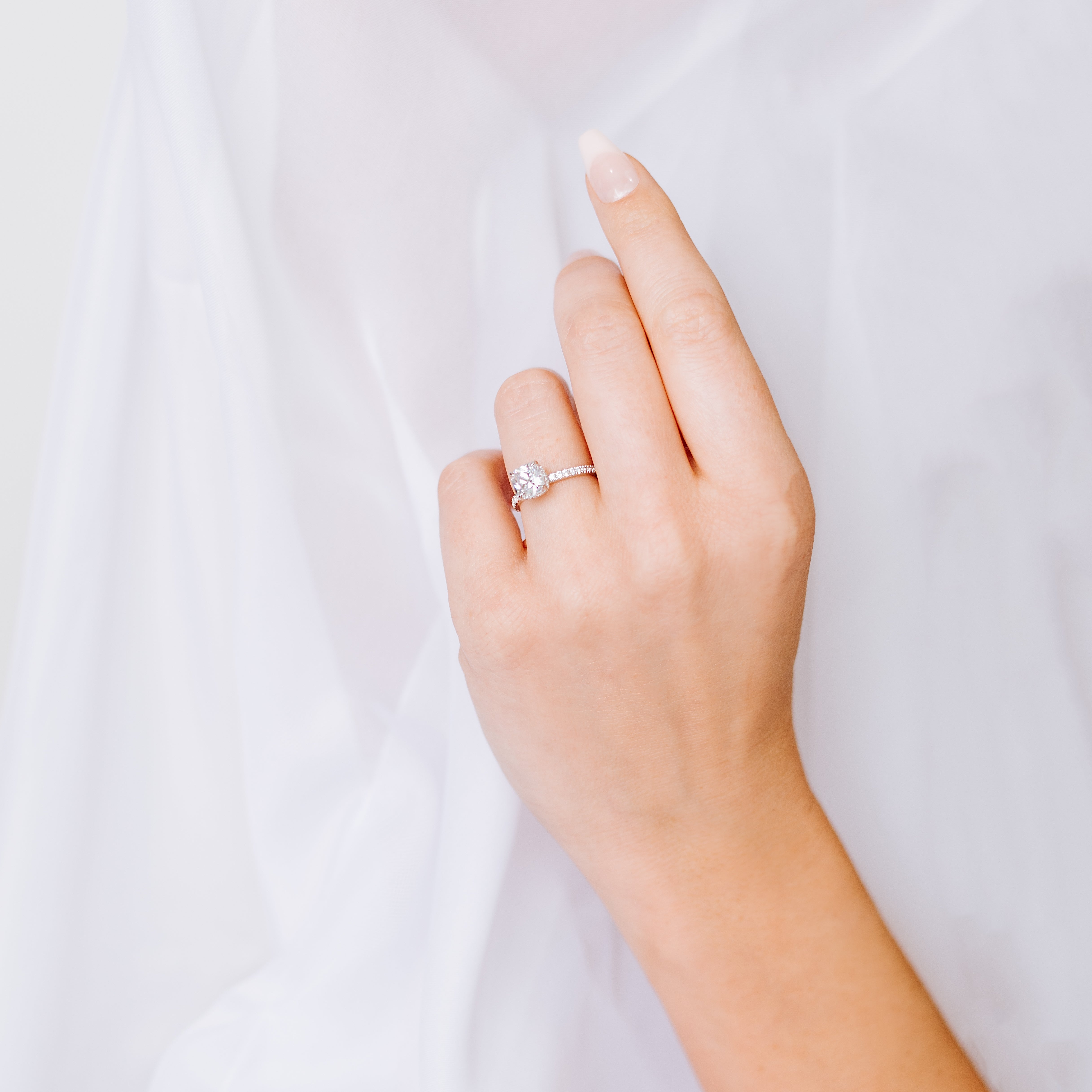
Crushed Ice vs Chunky Cushion Cut
Same outline, two very different kinds of sparkle.
Two cushions can have identical outlines, identical ratios and identical carat weights and still look nothing alike in the light. The reason is the pavilion, the lower half of the stone, and the two main ways it can be faceted.
Crushed ice cushions
A crushed ice cushion is usually a cushion modified brilliant: the pavilion carries an extra row of facets, so light entering the stone is broken into dozens of small reflections. Look into the table and you see a fine mosaic of flashes rather than a clear pattern, like light through crushed ice. From arm's length it reads as a continuous glittery shimmer. Crushed ice faceting is forgiving: the busy pattern hides small inclusions and softens slight body color, which is why it is common in lab-grown diamonds and especially in moissanite, where the extra dispersion turns that shimmer into a rainbow.
Chunky cushions
A chunky cushion, also called an antique cushion or a cushion brilliant, has fewer and larger pavilion facets. Look into the table and you can see a defined pattern, often a cross or a flower of large facets, and the stone flashes on and off in broad blocks as it moves. This is the sparkle of a round brilliant scaled up, and it is also the sparkle of the old mine cut; a hand-cut antique cushion is the chunkiest cushion there is. Chunky cushions show their inclusions a little more readily because each facet acts as a larger window, so they reward a slightly higher clarity grade.
How to tell them apart from a listing photo: if you can trace individual large facets under the table, it is chunky; if the center looks like a field of tiny sparkles with no clear structure, it is crushed ice. Neither is superior. Crushed ice suits buyers who want maximum glitter and a modern feel; chunky suits buyers who want the old-world look and the big, slow flashes that go with it. You will find both styles in moissanite and lab-grown diamond; ask us which faceting a particular stone has before you order. For the grading vocabulary behind cut, color and clarity, our guide to the 4Cs of diamonds is the place to start.
Cushion vs Round, Princess, Oval and Emerald Cut
How the cushion stacks up against the shapes it is most often weighed against.
| Shape | Outline | Sparkle style | 1 ct face-up size | Price vs round | Corners |
|---|---|---|---|---|---|
| Cushion | Square or rectangle, rounded corners | Broad flashes with more fire; crushed ice or chunky | About 5.5 mm square or 6.2 by 5.2 mm elongated | Typically 20 to 30 percent less | Rounded, low chip risk |
| Round | Circle | Maximum brilliance, tight white sparkle | About 6.4 mm | The benchmark; most expensive per carat | None |
| Princess | Square, sharp pointed corners | Crisp, geometric flashes | About 5.5 mm | Less than round, similar to cushion | Pointed; need protective prongs |
| Oval | Elongated ellipse | Brilliant sparkle; bow-tie possible | About 7.7 by 5.7 mm | Less than round; premium for ideal ovals | None |
| Emerald | Rectangle with cut corners | Step-cut hall-of-mirrors flashes; less sparkle | About 7 by 5 mm | Less than round; needs higher clarity | Cut corners, well protected |
Cushion cut vs round
The round brilliant is engineered for one thing: returning as much white light as possible. It wins on raw brilliance, it is the only shape GIA gives an overall cut grade, and it is the most expensive shape per carat because cutting a circle from octahedral rough wastes the most material. The cushion gives up a little brilliance in exchange for more fire, a softer look, and a meaningfully lower price. It also faces up slightly smaller at the same carat weight, which is the trade covered in the sizing section below.
Cushion cut vs princess cut
Both are square brilliant cuts, and they often get confused in photos. The difference is the corners. A princess cut has straight sides and four sharp points; a cushion has slightly curved sides and four rounded corners. Princess cuts look crisp and modern and flash in sharp geometric patterns; cushions look softer and more romantic. The princess cut's points are its vulnerability, since a sharp corner is the easiest place on any gemstone to chip, so princess stones need V-prongs or a protective setting. A cushion's rounded corners are much less prone to chipping, so standard claw or round prongs are enough.
Cushion cut vs oval
The elongated cushion and the oval compete for the same buyer: someone who wants finger coverage and a lengthening effect. The oval has no corners, a slightly larger face-up spread per carat, and a touch more brilliance; the elongated cushion has more fire, a more antique character, and a squared-off look that sits well against a straight wedding band. Both can show a bow-tie, and both look their best on a slim band.
Cushion cut vs emerald cut
The emerald cut is a step cut: long parallel facets that produce a calm hall-of-mirrors effect rather than sparkle, and that show inclusions and body color plainly, so it demands high clarity. The cushion is a brilliant cut whose busier facet pattern masks small inclusions far better than a step cut, especially in crushed ice versions. Choose emerald if you want calm, clean lines and cushion if you want sparkle. Our emerald cut engagement rings guide covers the step-cut side in depth, and for the other elongated shapes see the pear shaped engagement rings guide and our post on marquise engagement rings. A side-by-side of every shape and setting lives in engagement ring styles and setting types.
Best Gemstones for Cushion Cut Engagement Rings
The cushion flatters nearly every stone; hardness and color decide which one belongs on your hand.
Because the cushion's large facets show color so well, it is one of the best shapes for colored gemstones, and because its rounded corners protect the stone, it is also one of the safest shapes for gems softer than diamond. Hardness on the Mohs scale tells you how well a stone resists scratches in daily wear. Anything above 7 resists household dust, which contains quartz; 7.5 to 8 wears comfortably every day with sensible habits; 8 or above suits hands-on daily wear; and a stone at 7 or below wants a bezel or other protective setting. At 9 or above, only a harder gem, such as diamond or moissanite, will leave a scratch.
| Stone | Mohs | Why it works as a cushion | Care note |
|---|---|---|---|
| Moissanite | 9.25 | More fire than diamond; large cushion facets amplify the rainbow flashes. Affordable in 2 to 3 carat sizes. | Ultrasonic and steam safe in solid gold or platinum |
| Lab-grown diamond | 10 | Same crystal as mined diamond; the cushion is one of the best-value diamond shapes. | Ultrasonic and steam safe in solid gold or platinum |
| Sapphire | 9 | The classic colored cushion in blue, teal, pink or white; deep color reads rich in big facets. | Ultrasonic fine in solid gold or platinum if untreated or heat-treated |
| Alexandrite | 8.5 | Green or bluish green by day to purple or purplish red under warm light; a cushion shows both phases across its broad facets. | Soap, water, soft brush |
| Aquamarine | 7.5 to 8 | Pale sea blue reads icy and clean in a cushion; the March birthstone. | Avoid hard knocks; no harsh chemicals |
| Morganite | 7.5 to 8 | Peach-pink beryl; the cushion morganite halo in rose gold is a modern classic. | Clean often; picks up skin oils |
| Moss agate | 6.5 to 7 | Translucent with green dendrites; a cushion frames the tiny landscape inside. | No ultrasonic; bezel or protective prongs |
Moissanite is the go-to cushion stone for maximum sparkle. It rates 9.25 on the Mohs scale, second only to diamond, and its dispersion is more than twice diamond's, so a cushion moissanite throws noticeably more colored flash than a diamond of the same size. It also makes a 2 or 3 carat cushion realistic on an ordinary budget. Our moissanite engagement ring guide covers grading and sizing, and moissanite vs diamond lays out the honest differences. Browse the full range of moissanite engagement rings if you want to compare shapes.
Lab-grown diamond is chemically, optically and physically identical to a mined diamond, reported on by independent labs (IGI grades lab-grown stones on the 4Cs; GIA now issues a simpler Premium or Standard assessment), and priced far lower. A lab-grown cushion cut diamond ring gives the softest, most traditional diamond look for noticeably less per carat than a round. See our lab-grown diamond engagement rings and the lab-grown diamonds complete guide.
Sapphire is the historic partner of the cushion cut; the great colored-stone rings of the Victorian and Edwardian eras were very often cushion sapphires. At 9 on the Mohs scale it is built for daily wear, and it comes in every color but red. Blue, yellow and white sapphire cushions all appear in our sapphire engagement rings collection; the full color and durability story is in our sapphire engagement rings guide.
Alexandrite changes from green or bluish green in daylight to purple or purplish red under warm light, and the cushion's large facets make that change easy to see. The lab-grown alexandrite in our rings most often shows green to purple, and lab-grown is the realistic way to put a vivid color-change stone in a ring at an everyday price; browse our alexandrite engagement rings, and the alexandrite engagement ring guide explains how natural and lab-grown compare.
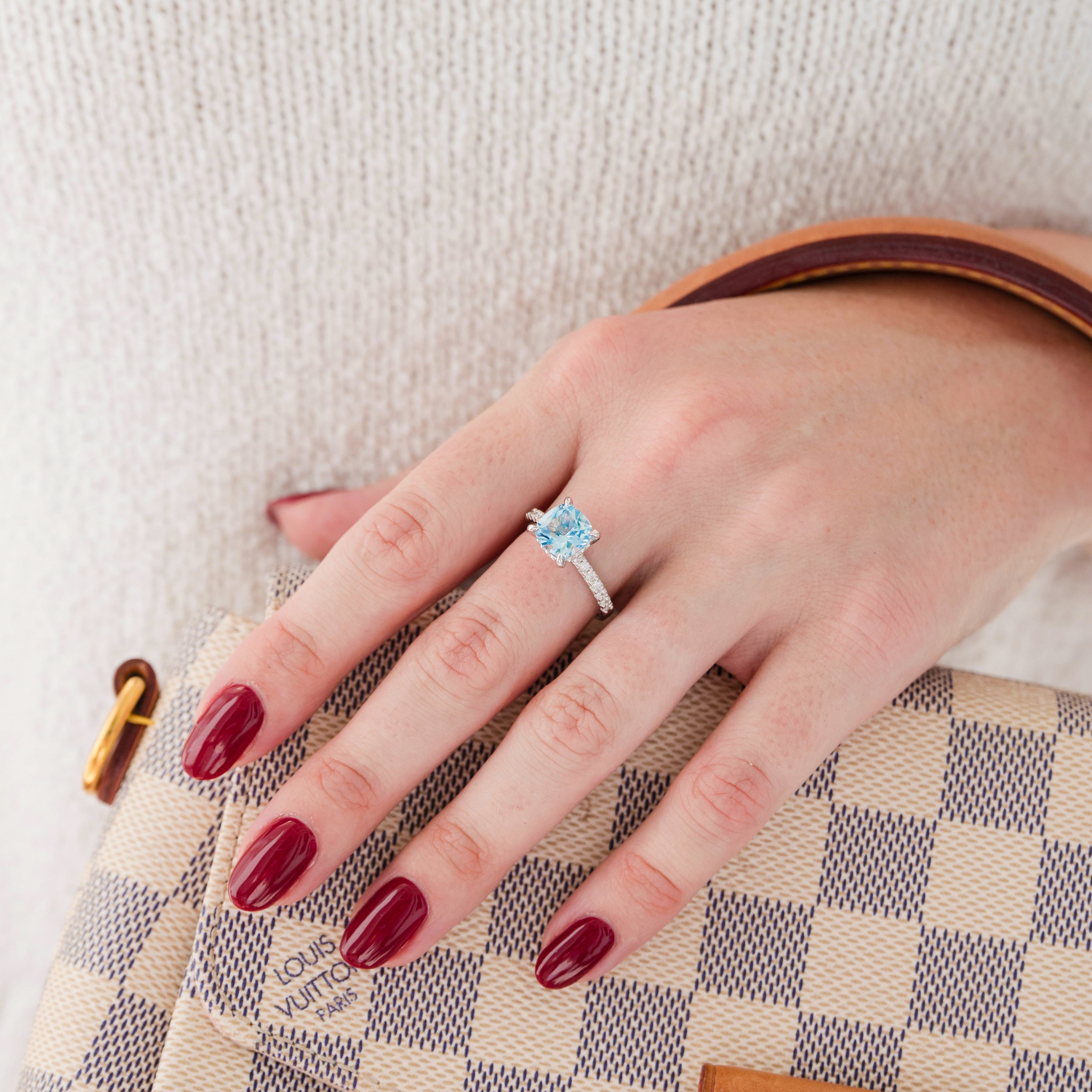
Aquamarine and morganite are sister stones from the beryl family that also gives us emerald, and both sit at 7.5 to 8 on the Mohs scale. Aquamarine's pale sea blue looks its cleanest in a cushion, where the large facets keep the color bright instead of diluting it; see our aquamarine engagement rings. Morganite's peach-pink is the stone behind the rose gold cushion halo that was everywhere in the 2010s, and our morganite engagement rings lean into it; the morganite engagement ring guide covers color and care. Both stones are hard enough for daily wear but benefit from a low or protective setting if you are rough on your hands.
At 6.5 to 7, moss agate needs the most thought of any stone here, and it rewards it: no two stones share the same pattern of green dendrites in translucent chalcedony, and a cushion outline frames each one like a small landscape. Set it in a bezel or low prongs that shield the girdle, and clean it with soap and water only. See our moss agate engagement rings and the moss agate engagement ring guide; if you do not find a cushion among the rings, ask for one through our build your custom ring page. For the whole field of diamond alternatives, ranked by hardness and price, read best gemstones for engagement rings.
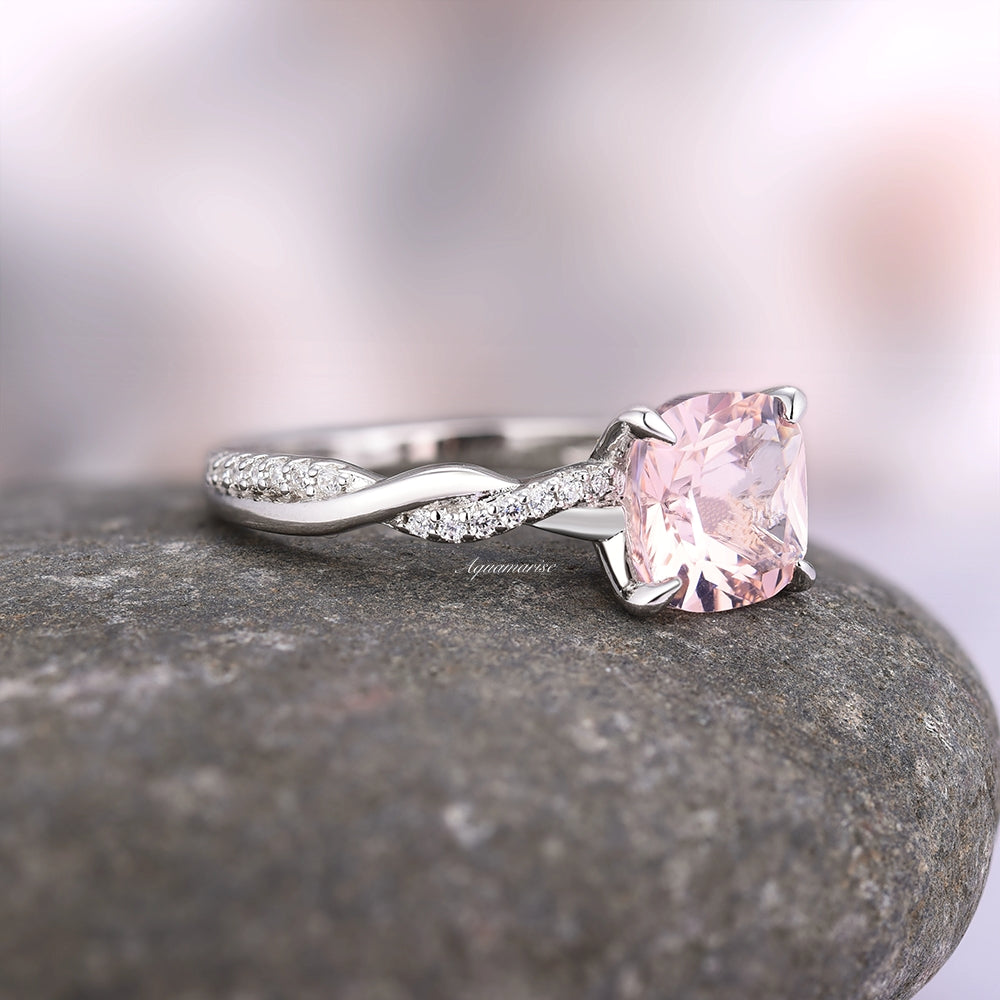
Cushion Cut Jewelry
Cushion cut pieces in morganite, alexandrite, sapphire, aquamarine, tanzanite, moissanite and more, in sterling silver, 14K gold vermeil and solid gold.
Shop all cushion cut jewelryBest Cushion Cut Settings
The rounded corners give you more freedom than almost any other shape.
A princess cut needs its points protected and a marquise needs its tips guarded, but a cushion's rounded corners are far less prone to chipping, so nearly every setting style works. The choice comes down to how much sparkle you want around the stone, how high you want it to sit, and how hard you are on your hands.
- Solitaire. Four prongs set at the corners, or four double-claw prongs for a finer look, and nothing else. A cushion cut solitaire engagement ring shows the outline most honestly and is the setting that makes an elongated cushion look longest. Our solitaire engagement rings include both plain and pavé bands.
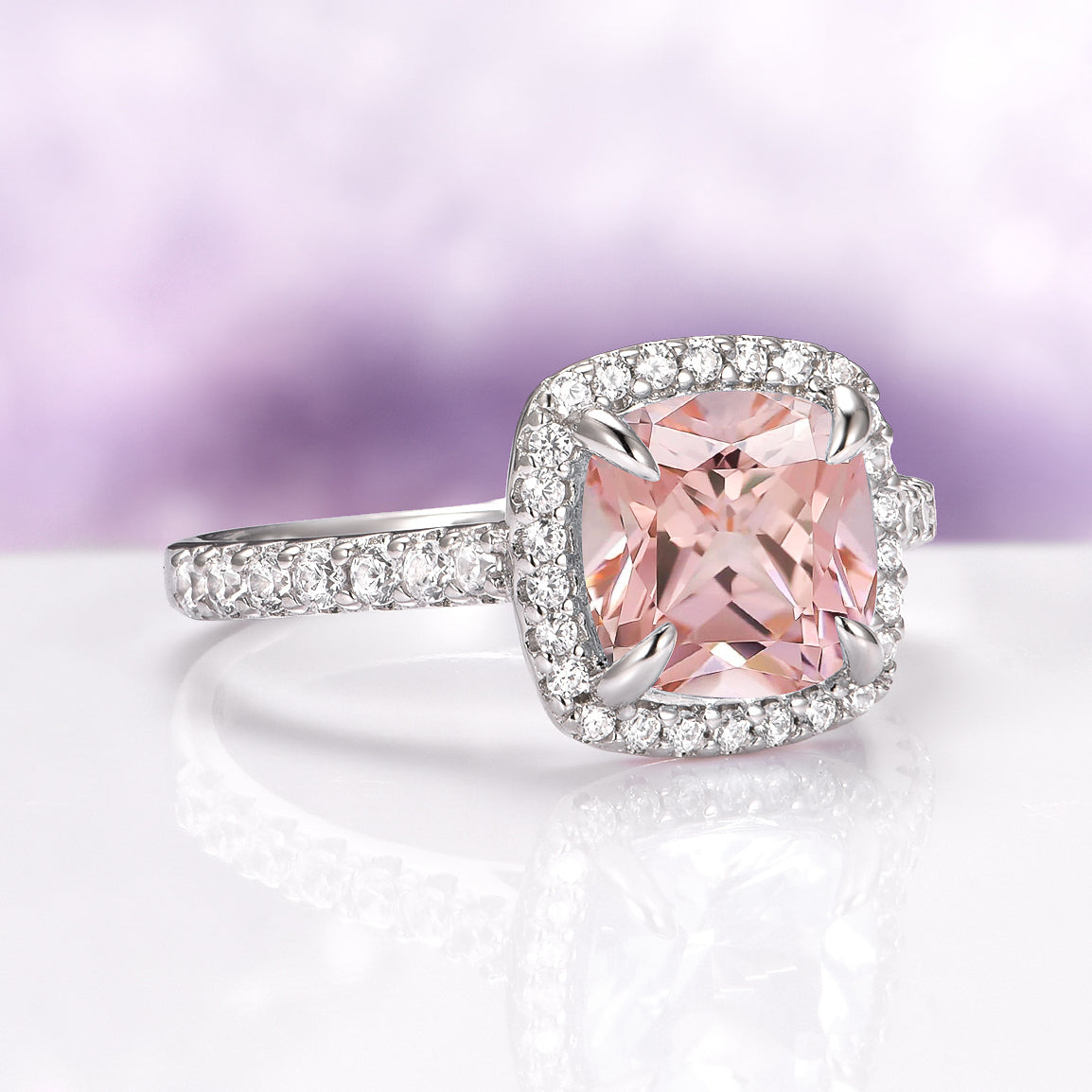
- Halo. A frame of small stones around the center stone. On a square cushion the halo can follow the outline in a cushion-shaped frame or soften it into a round one; either way it adds roughly half a carat of visual size and a great deal of sparkle. A cushion cut halo engagement ring is one of the most familiar ways to wear the shape, and you will find cushion halos among our halo engagement rings.
- Hidden halo. The small stones sit in a ring beneath the center stone rather than around it, so the top view stays clean and the sparkle appears in profile. Choose it if you want a clean solitaire from above and a little extra sparkle from the side. See our hidden halo engagement rings.
- Three-stone. A cushion center with two side stones. Half-moons, trapezoids or tapered baguettes suit an elongated cushion; small rounds or smaller cushions suit a square one. The three-stone cushion has a royal pedigree, covered in the celebrity section below, and our three stone engagement rings show the range.
- Bezel. A rim of metal wraps the entire girdle. It lowers the profile, cannot snag, and is the right choice for moss agate, morganite and anyone who works with their hands. See our bezel set engagement rings.
- Vintage and antique settings. Milgrain edges, filigree galleries, engraved shanks and old-mine-style chunky cushions. Old mine cuts and early cushions filled period settings for well over a century, which is why the shape looks so at home in our vintage and antique inspired engagement rings.
- Pavé band. Not a setting for the center stone, but a band choice that suits a cushion especially well. A thin pavé band makes the center look larger and adds sparkle without a halo; see pavé engagement rings.
If none of the stock combinations is quite right, a cushion is the easiest shape to build around. Tell us the stone, ratio, setting and metal you want on our build your custom ring page for a free quote in 1–2 days, and the engagement ring buying guide walks through every setting decision in order.
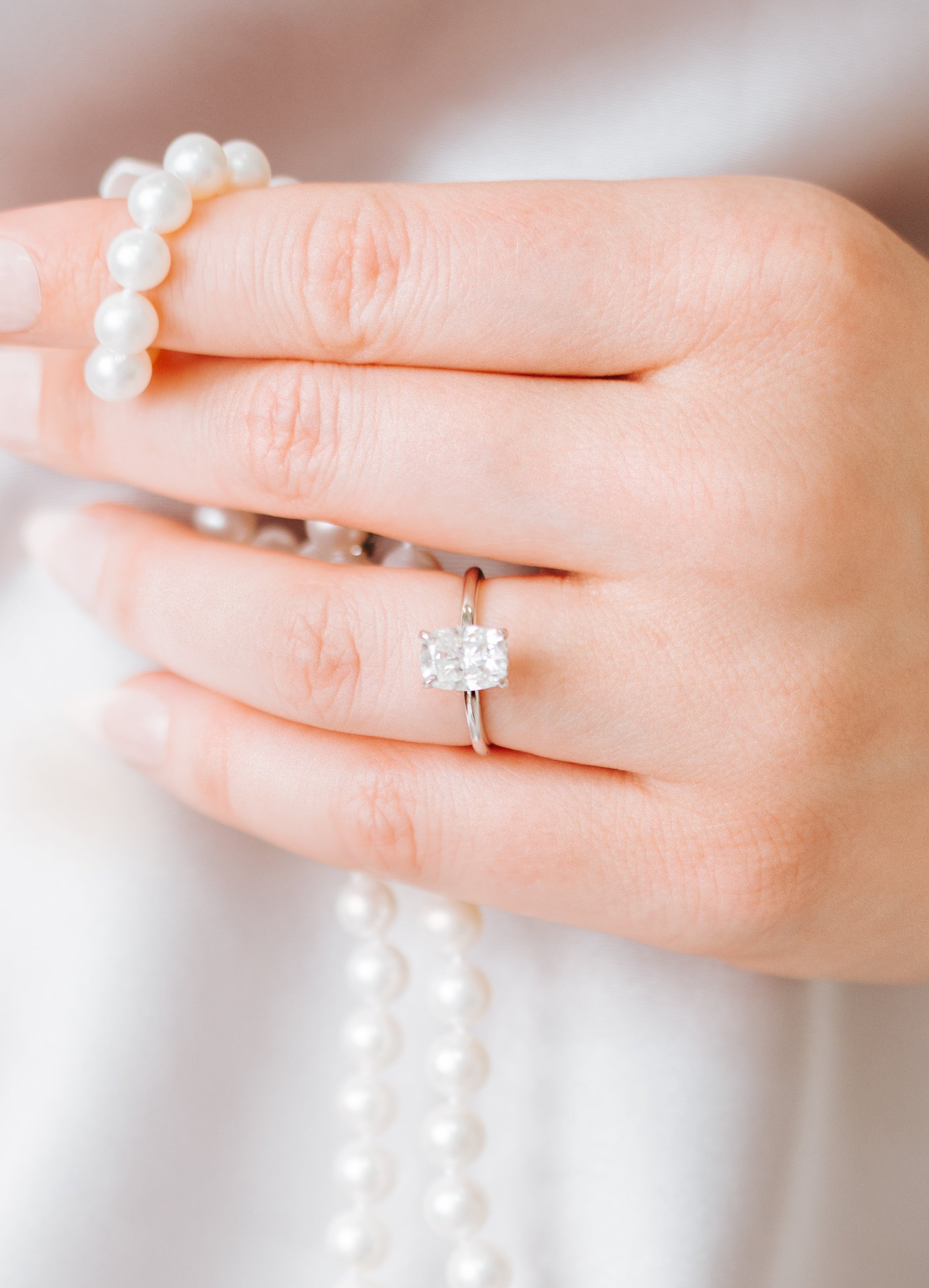
Cushion Cut Engagement Rings
Cushion cut rings in moissanite, lab-grown diamond and colored gemstones: solitaires, halos, hidden halos, Art Deco and vintage-inspired settings, square and elongated.
Shop square and elongated cushionsMetals for a Cushion Cut Ring
Metal color changes how the stone's color reads, and the metal sets the price tier and warranty.
Because cushions hold a little more body color than rounds, the metal you set them in matters more than it would for a round. White metals keep a colorless stone looking colorless; yellow and rose gold add warmth that can either flatter a warm-toned stone or mask a little warmth in a diamond.
| Metal | Effect on a cushion | Good to know |
|---|---|---|
| Sterling silver | Bright white; keeps moissanite, white sapphire and aquamarine icy | Solid 925 silver with a rhodium finish for a clean white surface; the most accessible starting point. See sterling silver engagement rings. |
| 14K gold vermeil | Warm yellow or rose gold color over solid sterling | 14K gold over sterling silver. Rose vermeil is the classic partner for cushion morganite; see rose gold rings and gold vermeil jewelry. |
| Solid 10K, 14K, 18K gold | Yellow gold masks warmth in a diamond and suits antique cushions; white gold stays neutral | Covered by our limited lifetime warranty. See solid gold rings, yellow gold and white gold. |
| Platinum | Naturally white and holds prongs securely | The densest jewelry metal and naturally hypoallergenic; limited lifetime warranty. See platinum jewelry. |
A practical rule for diamond cushions: in white gold, platinum or silver, aim for color grade H or better so no warmth shows through the large facets; in yellow or rose gold you can comfortably drop to J and put the savings into carat weight, because the metal's warmth masks the stone's. For moissanite the same logic applies to the colorless versus near-colorless grades. The full comparison of karats, colors and finishes is in our precious metal guide, and the terms of the limited lifetime warranty on solid gold and platinum are on the warranty page.
Carat, Millimeters and Finger Coverage
Why a 1-carat cushion measures smaller than a 1-carat round, and what to do about it.
Carat is weight, not size, and shapes distribute weight differently. A cushion carries more of its weight in depth, below the girdle, than a round does, so the same carat weight spreads across a smaller area on top. The rule of thumb is that a cushion faces up about 10 percent smaller than a round of equal weight. A 1-carat round brilliant measures about 6.4 mm across; a 1-carat square cushion measures roughly 5.5 mm; a 1-carat elongated cushion runs around 6.2 by 5.2 mm, which covers more finger length but less width.
| Carat | Square cushion (approx.) | Elongated cushion (approx.) | Round, for comparison |
|---|---|---|---|
| 0.50 ct | 4.7 mm | 5.2 by 4.4 mm | 5.1 mm |
| 0.75 ct | 5.2 mm | 5.7 by 4.8 mm | 5.8 mm |
| 1.00 ct | 5.5 mm | 6.2 by 5.2 mm | 6.4 mm |
| 1.50 ct | 6.4 mm | 7.1 by 5.9 mm | 7.4 mm |
| 2.00 ct | 7.0 mm | 7.8 by 6.5 mm | 8.1 mm |
| 3.00 ct | 8.0 mm | 8.9 by 7.4 mm | 9.3 mm |
Two notes on those numbers. First, they are averages; a shallow cushion will measure larger and a deep one smaller at the same weight, which is why depth matters. A depth of roughly 61 to 68 percent and a table of about 58 to 68 percent keep the stone lively without burying weight where nobody can see it. Second, moissanite is about 10 percent lighter than diamond, so moissanite is normally sold by millimeter size with a diamond-equivalent weight; a 7 mm square cushion moissanite is sold as a 2 carat diamond equivalent, because that is what a diamond of that size would weigh (see the table above).
If you want the biggest look for the money, the levers are, in order: choose an elongated ratio, choose a slim band (a 1.6 to 1.8 mm band makes any stone look larger than a 2.5 mm one), add a halo, and keep the prongs small. Ring size matters too, since the same stone reads larger on a size 5 finger than on a size 8. Print a sizer from our find your size page, or read the ring size chart guide for US, UK and EU conversions, before you order.
How Much Do Cushion Cut Engagement Rings Cost?
Why the cushion is one of the better-value shapes, and what moves the cushion cut diamond price.
The cushion is cheaper than the round for a simple reason: its outline follows the natural shape of diamond rough more closely, so the cutter throws away less. A round brilliant can lose half the rough crystal to the wheel; a cushion keeps far more of it. The International Gem Society notes the same value advantage, and in practice a cushion cut diamond of a given color, clarity and weight typically sells for 20 to 30 percent less than a comparable round. In moissanite and colored stones the shape premium is smaller because the rough is less scarce, but a cushion is still never the expensive shape. What actually sets the price is the list below.
- Stone type. Moissanite costs a small fraction of diamond at the same size, lab-grown diamond costs a fraction of mined, and colored gems range from moss agate at the accessible end to fine sapphire at the top. No other choice on this list changes the price as much.
- Carat weight. Prices step up sharply at the round numbers, especially 1.00, 1.50 and 2.00 carats. A 0.90 carat cushion costs noticeably less than a 1.00 and looks the same on the hand.
- Color. Cushions show color more than rounds, so let the metal decide how far down the scale you can go (see the metals section). The GIA color scale runs from D, colorless, to Z.
- Clarity. Crushed ice cushions hide inclusions well, so SI1 is often eye-clean. Chunky cushions show more, so VS2 is a safer floor. Paying for VVS in a cushion buys nothing you can see.
- Proportions and ratio. Well-proportioned elongated cushions carry a premium over square ones because demand is higher. Very deep stones are cheaper per carat but look smaller.
- Certification. For mined diamonds, a GIA or IGI report confirms color, clarity and measurements; for lab-grown, IGI gives full 4Cs grades while GIA gives a Premium or Standard assessment. Our comparison of IGI vs GIA certification explains what each covers.
- Setting and metal. Sterling silver is the accessible starting point, vermeil sits in the middle, and solid gold and platinum are the top tier. A halo or a pavé band adds small stones and labor.
Where to spend and where to save: spend on the stone's cut quality and ratio, because those are what you see every day; save on clarity beyond eye-clean, on color grades the metal will mask, and on carat weight just above a round number. Our guide to how much to spend on an engagement ring puts real budgets against those choices, the lab-grown diamond price guide tracks current stone prices, and the financing page covers paying over time. If you want an independent appraisal for insurance, it can be added to solid gold and platinum orders; see our appraisal page.
Celebrity Cushion Cut Diamond Rings
Three rings that shaped how people picture the cushion.
Taylor Swift, 2025. The ring Taylor Swift revealed in August 2025 is an elongated old mine cushion cut diamond: a hand-cut, antique-style stone with a small table, high crown and broad chunky facets, set in yellow gold with a hand-engraved band. It was designed by Kindred Lubeck of Artifex Fine Jewelry. Within days, searches for old mine cuts and elongated cushions spiked, and the antique cushion moved from a connoisseur's choice into the mainstream.
Meghan Markle, 2017. The Duchess of Sussex's engagement ring centers on a cushion cut diamond from Botswana, flanked by two round diamonds from Princess Diana's personal collection, in a three-stone setting. It was originally set on a plain yellow gold band and was later reset onto a thin pavé band. It remains the reference point for the cushion three-stone, and many buyers who ask for a cushion center with round sides have it in mind.
Kim Kardashian, 2013. Kim Kardashian's 2013 engagement ring was a 15-carat cushion cut diamond by Lorraine Schwartz on a slim pavé band. That ring helped popularize the look of a big cushion on a thin pavé band.
The takeaway is that the same shape produced three completely different rings: an antique solitaire in yellow gold, a three-stone in pavé, and a modern statement on a thin band. If the first speaks to you, start with our vintage-inspired engagement rings; if the second, the three stone collection; if the third, a large cushion from the cushion cut moissanite collection. And if none of them do, and you are drawn to black metal and a darker mood, our gothic engagement rings guide covers black ruthenium settings, dark stones and the pointed cuts that pair with them.
How to Choose a Cushion Cut Engagement Ring
Eight decisions, in the order that keeps you from backtracking.
- Square or elongated. Square for a compact, classic look and the best halo candidate; elongated for finger coverage, a lengthening effect and the antique feel. Decide this before you look at a single stone.
- Crushed ice or chunky. Crushed ice for maximum glitter and forgiving clarity; chunky for big flashes and the old mine character. Look at videos, not stills, because the difference only shows in motion.
- Pick the stone. Moissanite for the most sparkle per dollar and 9.25 hardness; lab-grown diamond for the traditional look; sapphire, alexandrite, aquamarine, morganite or moss agate for color. Check the hardness table above against your lifestyle.
- Set your color and clarity floor. For colorless stones in white metal, H color or better; in yellow or rose gold, J is fine. SI1 for crushed ice, VS2 for chunky. Do not pay for grades you cannot see.
- Check the numbers. Ratio in the range you chose, depth roughly 61 to 68 percent, no visible bow-tie in video, and measurements in millimeters so you know the face-up size rather than just the carat weight.
- Choose the setting for your life. Solitaire or hidden halo if you want a clean top; halo for size and sparkle; bezel if you work with your hands or chose a softer stone; three-stone if you like the royal look.
- Choose the metal. Sterling silver or 14K gold vermeil for the look at the most accessible price; solid gold or platinum for a ring backed by our limited lifetime warranty. Match white metals to icy stones and rose gold to pink and peach ones.
- Confirm size, engraving and timing. Measure with the size guide, see what fits on the engraving page (engraved pieces are final sale), and check shipping times and the returns policy before the proposal date is fixed.
If you are still comparing shapes, our guides hub collects every shape and stone guide in one place, and the FAQ page answers the ordering questions that come up most. The wider women's engagement rings collection is the place to compare a cushion against every other shape side by side, and if you are planning ahead, our wedding ring sets for women pair engagement rings with matching bands.
Caring for a Cushion Cut Ring
Low maintenance, as long as you match the cleaning to the stone.
- Routine cleaning. A cushion's deep pavilion traps lotion under the stone, and that film is the main reason one looks dull. Soak the ring in warm soapy water for a few minutes, brush the underside with a soft toothbrush, rinse and pat dry. Every week or two is plenty for a ring worn daily.
- Ultrasonic and steam. Safe for moissanite, diamond and untreated or heat-treated sapphire in solid gold or platinum. Skip them for vermeil and rhodium-finished sterling, for fracture-filled sapphire and for moss agate, and use them cautiously on morganite and aquamarine, which can carry small internal fractures. When in doubt, soap and water always works.
- Prong checks. A cushion's four corner prongs do all the work. Have them checked once a year, and sooner if the stone ever feels loose or clicks against a hard surface.
- Take it off for the hard stuff. Gym, gardening, pool chlorine, bleach and heavy lifting. The stone will shrug off most of it, but a hard knock can bend a prong.
- Storage. Keep it apart from the rest of your jewelry; a moissanite or sapphire cushion will scratch a morganite, an aquamarine or a gold band it rubs against in a drawer.
- Vermeil and rhodium. Gold vermeil is 14K gold over sterling silver, and rhodium is the bright white finish on our sterling pieces. Clean both with warm soapy water and a soft cloth, put perfume on before your jewelry, and take the ring off before a chlorine pool.
The metal-by-metal routine is in our jewelry care guide, and the daily habits that keep a center stone tight are in how to care for your engagement ring.
Cushion Cut Engagement Rings FAQ
What does "cushion cut" engagement rings mean?
Are cushion cut diamonds more expensive?
What are the disadvantages of cushion cut diamonds?
Is Taylor Swift's ring a cushion cut?
Does a cushion cut sparkle as much as a round brilliant?
What is the difference between a cushion cut and a princess cut?
What is an elongated cushion cut?
What is the difference between crushed ice and chunky cushion cuts?
Do cushion cut engagement rings look smaller?
What is the best setting for a cushion cut engagement ring?
Find the cushion that fits your hand
Pick square or elongated, then your stone and metal. Every Aquamarise® cushion cut ring is handcrafted in our Florida studio in sterling silver, 14K gold vermeil, solid gold or platinum, with free U.S. shipping and a limited lifetime warranty on solid gold and platinum.
Shop Cushion Cut Engagement RingsShop Cushion Cut Rings by Style
Explore More Guides


