


Gothic Engagement Rings: The Complete Style Guide
The styles, dark stones, black finishes and pointed cuts, and how to choose a ring you will still love in thirty years.

Gothic engagement rings are about depth: a black stone that swallows light instead of throwing it, a finish the color of wet slate, a silhouette that borrows its points from a cathedral window or a coffin lid, a raven or a thorn where a jeweler would usually put a flower. The style has real history behind it, from sixteenth-century memento mori rings to the jet and black enamel of Victorian mourning jewelry, and a very current audience, from dark academia to the red carpet. Below is the advice we give customers choosing one, starting with what actually makes a ring gothic.
Gothic Engagement Rings at a Glance
- Four signals: a dark metal finish, a black or deeply saturated stone, an architectural or nature motif, and a pointed cut. Two or more and the ring reads gothic.
- Hardest dark stones: black diamond (Mohs 10), moissanite (9.25), sapphire (9), alexandrite (8.5), black spinel (8). Softer, and happiest in a protective setting: garnet (6.5 to 7.5), amethyst (7), black onyx and moss agate (6.5 to 7), blue sandstone (5.5 to 6).
- Black finishes: black ruthenium (over solid 925 sterling silver in our rings) and black rhodium are platings that wear at contact points and can be re-plated; oxidized silver is a surface patina. There is no solid black precious metal.
- Gothic cuts: coffin, kite, hexagon, pear and marquise. Every point wants a V-prong or a bezel.
- Roots: Victorian mourning jewelry (Whitby jet, black enamel, hairwork) and the earlier memento mori rings it grew from.
- Men's bands: tungsten carbide resists scratches but cannot be resized; sterling silver and solid gold bands usually can.
- Start here: the Lovers of the Dark™ line, our gothic range.
What Makes an Engagement Ring Gothic?
Why a black stone alone is not enough, and how many details make a ring read gothic.
Ask ten people to describe a gothic ring and you will get ten different rings: a black diamond in a plain bezel, a skull with garnet eyes, a filigree cathedral setting in rose gold, a coffin-cut stone on a black band. They are all correct, because gothic is a family of looks, not one design. After years of making and selling these rings, this is the working definition we use, built on four signals.
- A dark metal. Black ruthenium over sterling silver, black rhodium, oxidized silver, or a black tungsten band. The metal stops being a neutral frame and becomes part of the mood. A white stone on a black band is already halfway there.
- A black or deeply saturated stone. Black onyx, black spinel, black or gray moissanite, black diamond, or a colored stone at the darkest end of its range: blood-red garnet, Siberian-purple amethyst, inky blue sapphire, alexandrite that turns purple to purplish red under lamplight, moss agate the color of a forest floor at dusk.
- An architectural or nature motif. On the architectural side: pointed arches, tracery, quatrefoils, pierced cathedral galleries, milgrain that mimics carved stone. On the nature side: thorns, ravens, bats, crescent moons, snakes, bare branches and curled dead leaves. These are the motifs Gothic Revival designers borrowed from churches and Romantic poets, and they still carry the meaning.
- A pointed cut. Coffin, kite, hexagon, pear and marquise all put corners where a classic ring puts curves. Even in bright white gold with a colorless stone, a coffin cut hints at gothic.
The number of signals sets the volume. One signal gives you a ring that is merely dark: a black spinel in a white gold solitaire, for example, which most people would call modern, not gothic. Two signals, say a black stone on a black ruthenium band, is where the style becomes unmistakable while still being quiet enough for an office. Three or four, a coffin-cut garnet in a thorn-and-raven setting on a black band, is a statement, and a beautiful one if that is who you are. Our gothic engagement rings collection runs the full width of that scale, and the Lovers of the Dark™ black engagement rings gather the pieces that lean hardest into the black finish.
One more thing separates gothic rings from rings that are simply on trend: intention. Almost every element in this style started life as a symbol. The skull said remember you must die; the black stone said I am in mourning; the thorn said love has a cost; the moon said I belong to the night. Couples choose these rings because they mean something, and that is a good instinct to follow. Our guide to gothic ring meaning explores the symbolism in depth, and if any of the setting vocabulary in this article is new to you, the engagement ring styles and setting types guide defines bezels, cathedral settings, halos and the rest.
Where Gothic Engagement Rings Come From
A short lineage, from memento mori to Whitby jet to the red carpet.
The word gothic belonged to architecture before it belonged to jewelry. The cathedrals of the twelfth to sixteenth centuries gave Europe pointed arches, ribbed vaults, rose windows and stone tracery so fine it looks like lace. When British and American designers revived that vocabulary in the eighteenth and nineteenth centuries, it moved indoors and shrank: pinnacles on chair backs, trefoils on bookcases, and on rings, pierced galleries and shoulders that rise to the stone the way an arch rises to its keystone. The cathedral setting, with shoulders that arch up to the stone, is named for exactly that architecture.
The darker strand is older. Memento mori rings, from the Latin for remember that you must die, were worn from the sixteenth century onward and carried enameled skulls, coffins, hourglasses and inscriptions. They were not morbid to their owners; they were reminders to live well, and they were often bequeathed to friends and family in wills. Posy rings from the same centuries hid short rhymes inside the band, private messages meant only for the wearer. Both habits, the mortality symbol and the hidden inscription, are alive in gothic rings today.
Then came the Victorians. The mourning jewelry worn after Prince Albert's death in 1861, in jet, black enamel, garnet and hairwork, gave the style its palette, its scrollwork and the idea that a ring can carry a message; the Victoria and Albert Museum's mourning jewelry holds fine examples. For the full story of that era, read our Victorian gothic engagement rings deep dive; this guide treats it as one family among six.
The twentieth century turned an aesthetic into a subculture. Post-punk and the goth scene of the late 1970s and 1980s adopted the Victorian palette, Anne Rice and gothic film gave it a romantic script, and by the 2020s it was mainstream enough for hit streaming series, cinema and the red carpet. Gothic is no longer underground, and that has changed the market: couples now expect goth engagement rings to be made to the same standard as a classic solitaire, in solid metals with stones named for what they are. If you love the period look but want a broader survey, our vintage engagement rings guide walks through every era, and the vintage-inspired engagement rings collection is where the two styles overlap.
The Six Gothic Ring Style Families
Find the sub-style before you find the ring. It keeps a dramatic purchase from turning into a costume.
The fastest way to narrow a search through gothic style engagement rings is to name the version of gothic you actually wear. Look at your wardrobe, your bookshelf and your walls, then find yourself in the six families below. Most people land firmly in one and borrow from a second.
1. Victorian mourning and vintage gothic
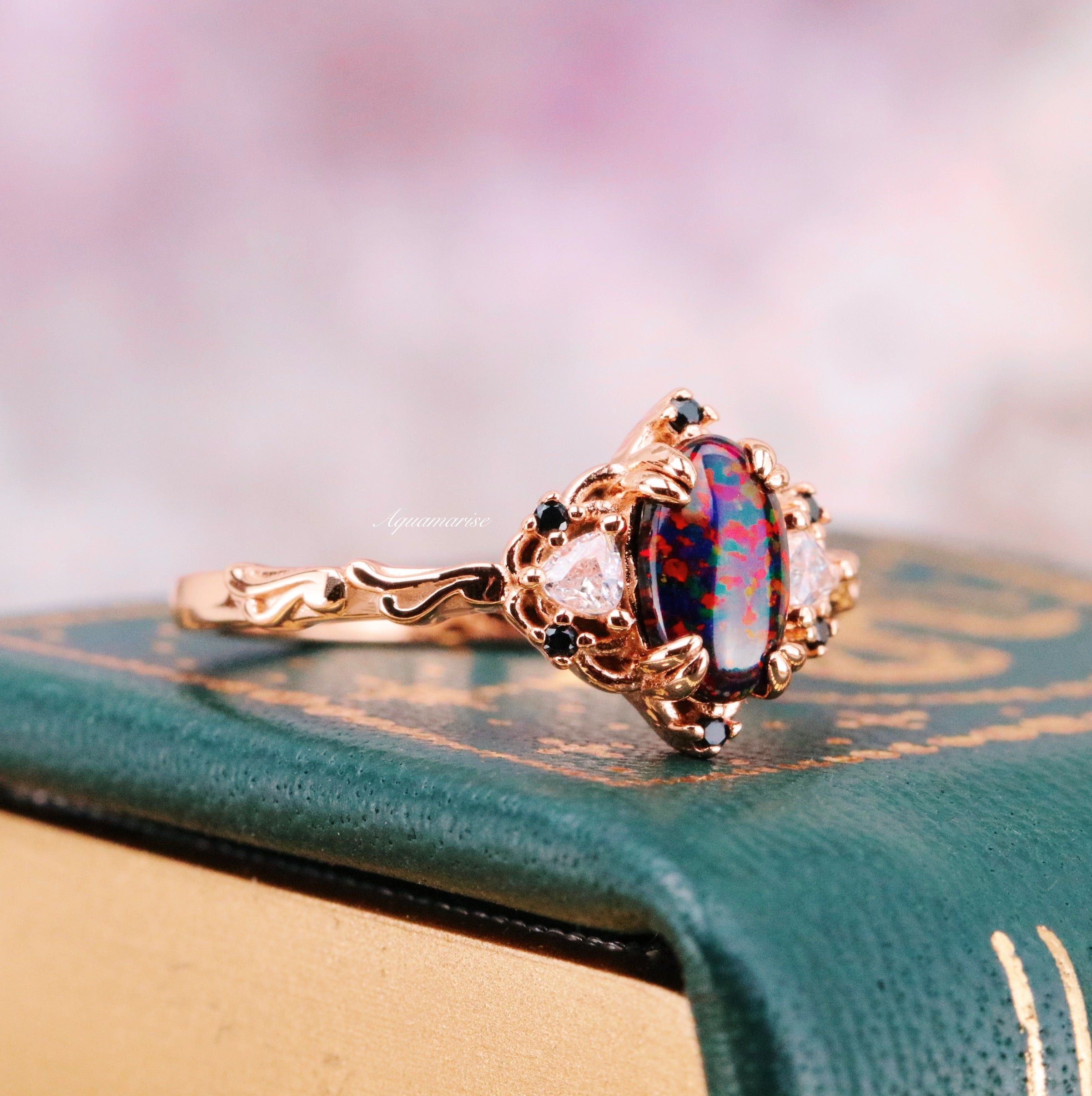
The most historically grounded family, and the one for readers of dark academia novels and fans of period drama. The tells are antique finishes, scrollwork on the shoulders, milgrain edges borrowed from the Edwardian era, and warm metal against dark stones: rose or yellow gold framing garnet, onyx or a dark pearl, or a modern twist such as black opal. Stones tend to be ovals and cushions in low, protective mountings, sometimes with tiny black accent stones in place of white ones. It is romantic and melancholy, never aggressive, and it looks completely at home next to a real Victorian piece. Start with the vintage-inspired engagement rings collection and filter your eye toward the darker stones, or go straight to garnet engagement rings for the most Victorian color of all.
2. Cathedral and architectural gothic
This family takes the architecture literally. Cathedral shoulders rise from the band to meet the stone like flying buttresses; the gallery under the stone is pierced into arches or tracery so the ring looks like a window from the side; the band may carry a knife edge or a stepped profile. Stones are geometric, with hexagons and step cuts favored for their straight lines. The finish can be black or bright, because the structure does the talking. It suits people who love clean drama and hate clutter. See hexagon engagement rings and the wider geometric engagement rings collection.
3. Celestial gothic and dark academia
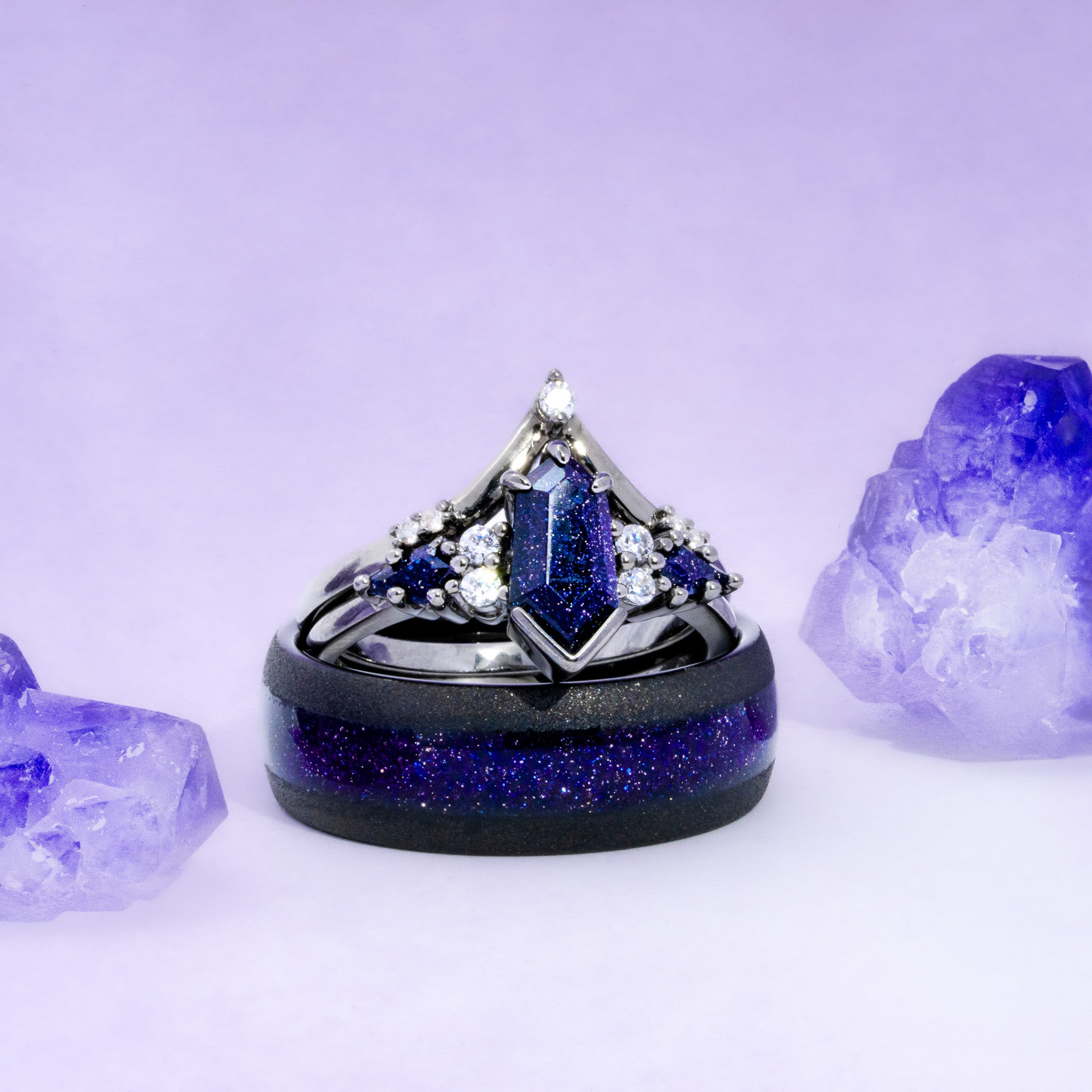
Moons, stars, constellations and night skies, rendered in dark metal so the effect is midnight, not fairy tale. The signature stone is blue sandstone, a deep navy glass shot through with copper glitter that looks like a clear night, followed by black spinel and dark sapphire. Our Starry Night® pieces live here: the Starry Night® engagement rings, the kite cut Starry Night® rings and the Orion Nebula Rings® line. Dark academia is the restrained cousin: one dark stone, a thin band, a geometric point, no motifs at all. It is the version most people can wear to a law firm.
4. Nature gothic, or dark botanical
Nature in the shadows. Bats, ravens, snakes, thorns, crescent moons, bare branches and dead leaves take the place of blossoms, and the settings are sculpted to look grown. The stones tend to look alive: moss agate with its green dendrites like a miniature forest, rutilated quartz with gold rutile or black tourmaline needles frozen inside, and alexandrite, which shifts color with the light. Set in black ruthenium, a leaf setting stops being cottagecore and becomes something closer to a churchyard in October. Browse nature-inspired engagement rings, moss agate engagement rings and rutilated quartz engagement rings, and for two, the moss agate couples rings.
5. Skull engagement rings and memento mori
The oldest symbols in the style: skulls, bones, hourglasses, coffins. In engagement rings they usually hide in the details: a skull carved into the under-gallery, a tiny hourglass engraved inside the band, or the coffin shape of the stone itself. As a full motif they are far more common in men's rings and wedding bands, where a wide band gives a skull room to breathe. Our guide to gothic rings for men covers the bold end, men's black rings collects black tungsten bands with crushed-stone and meteorite inlays in the same dark mood, and the coffin cut engagement ring guide covers the shape's meaning, the best stones for it and how to style one.
6. Minimalist black
No motifs, no filigree, no story on the surface. A single black stone in a bezel on a slim black ruthenium band, or a black band with nothing on it at all. The gothic element is the palette and the restraint. This is the family for people who want dark engagement rings that signal alternative taste without being loud, and it stacks beautifully beside a plain sterling wedding band. See black rings, black onyx engagement rings and our guide to black rings for women.
The Best Stones for Gothic Engagement Rings
Hardness first, then color, then price. A dark stone that scratches in a year is not a bargain.
A gothic engagement ring is worn every day like any other, so the stone has to survive keys, door frames and gym bags. The Mohs scale measures scratch resistance from 1 to 10, and for daily wear we think in three lines: above 7 a stone resists household grit, at 8 and above it shrugs off hands-on wear, and at 7 or below it wants a protective setting and some care. The International Gem Society's hardness ranking lists every gem in order; the ones that matter for this style are below.
| Stone | Mohs | What it looks like | Setting advice |
|---|---|---|---|
| Black diamond | 10 | Opaque black with a metallic sheen; natural or treated | Protective prongs or bezel; more brittle than colorless diamond despite Mohs 10 |
| Black or gray moissanite | 9.25 | Black is opaque with a glossy, near-metallic luster; gray shows rainbow fire; lab-grown | Any setting; ideal for coffin and kite cuts |
| Dark sapphire | 9 | Inky blue, teal or near-black; lab or natural | Any setting |
| Alexandrite | 8.5 | Green by day, purple to purplish red under lamplight; lab-grown in our rings | Open settings so light reaches the stone |
| Black spinel | 8 | Pure natural black with a glassy luster | Any setting; the best value for daily wear |
| Amethyst | 7 | Violet to deep Siberian purple | Prongs with a low profile, or bezel |
| Garnet | 6.5 to 7.5 | Blood red that reads near black in low light | Bezel or six prongs; avoid knife edges |
| Black onyx | 6.5 to 7 | Flat, velvety black chalcedony | Bezel or half bezel; repolishable |
| Moss agate | 6.5 to 7 | Translucent with green dendrites | Bezel or protective prongs |
| Blue sandstone | 5.5 to 6 | Navy glass with copper glitter; man-made | Bezel; take it off for hands-on work |
The true blacks: onyx, spinel, moissanite and diamond
Black onyx is the classic. It is a chalcedony, the same quartz family as agate, dyed black by a treatment jewelers have used for centuries, and it gives the flattest, most velvety black of any stone. At 6.5 to 7 it is the softest of the true blacks, but because it is opaque, small scratches barely show and a jeweler can repolish it. Give it a bezel or a low prong setting and it will last. Read black onyx meaning for its symbolism and shop black onyx engagement rings for the look. Black spinel is the best all-round black stone for daily wear. It is naturally black, almost never treated, has no cleavage to worry about and sits at Mohs 8; the International Gem Society's spinel profile calls out exactly that durability. It is often mistaken for black diamond at a fraction of the cost. Black and gray moissanite are lab-grown silicon carbide at 9.25, second only to diamond. Black moissanite is opaque with a glossy, near-metallic luster, while gray moissanite is translucent enough to show rainbow fire. Black diamond is Mohs 10 and looks like polished gunmetal, but the fractures that make it black also make it more brittle than a colorless diamond, so protect its edges; most on the market are treated to reach an even black, and the GIA's black diamond guide explains how natural and treated stones differ. For the full field, our black gemstones guide compares every option, and black gemstone jewelry collects them across rings, pendants and earrings.
The deep colors: garnet, amethyst, alexandrite, sapphire
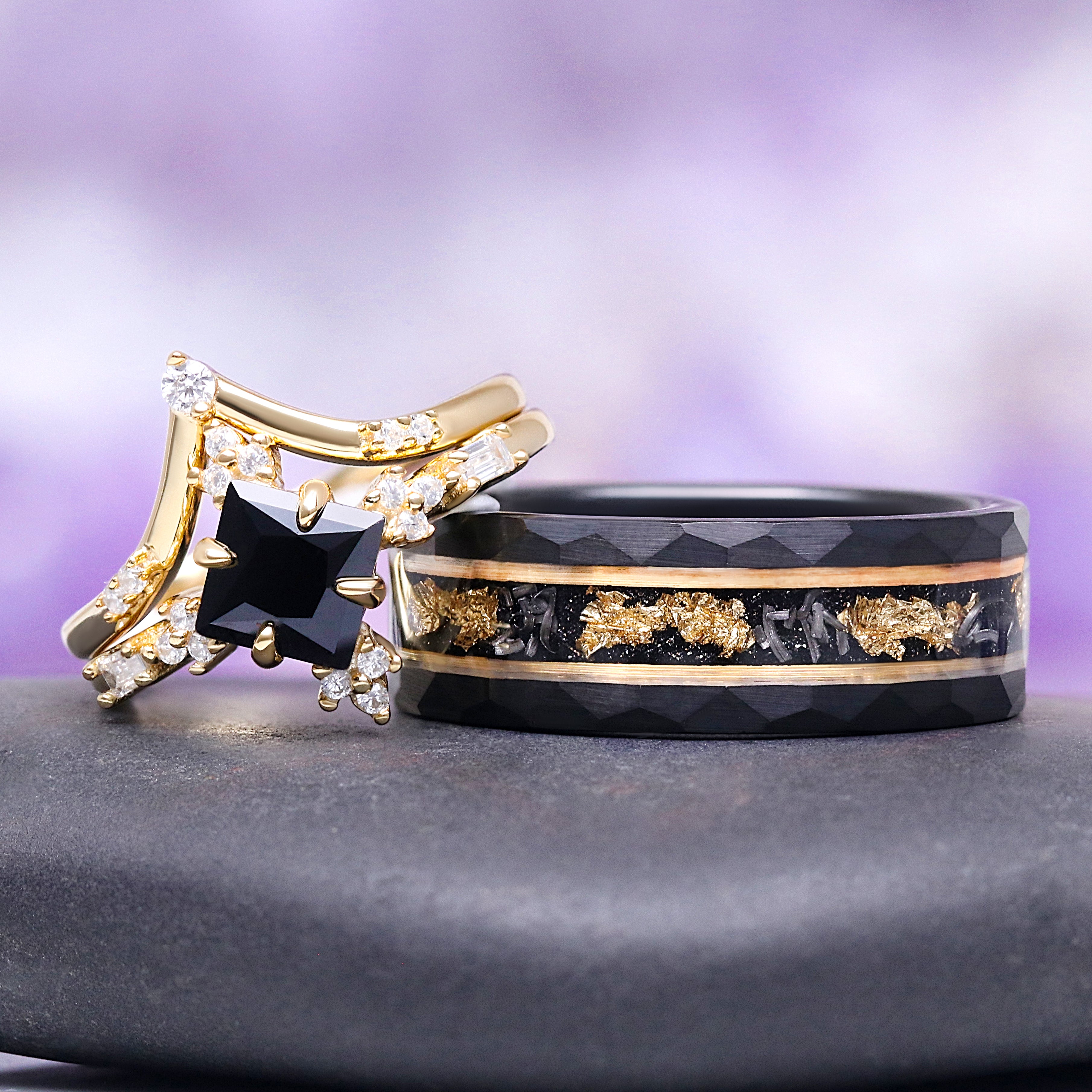
Not every gothic ring is monochrome. Garnet is the most historically gothic colored stone, set in Anglo-Saxon and medieval goldwork and everywhere in Victorian jewelry, and a good almandine or pyrope reads nearly black until light hits it and it ignites into crimson. At 6.5 to 7.5 it wants a bezel or six prongs; garnet meaning covers the symbolism and garnet engagement rings the settings. Amethyst at Mohs 7 gives one of the deepest purples in the gem world when you choose Siberian-grade material, and its violet looks richest against a black finish; our purple gemstones guide compares it with other purple stones, and amethyst engagement rings shows it in kite, leaf and cushion settings. Alexandrite is the most theatrical choice: green under daylight, purple to purplish red under a lamp, Mohs 8.5, and the alexandrite in our rings is lab-grown, which puts a strong color change within reach. In a black leaf setting it looks like something from a Grimm story told by candlelight; see alexandrite engagement rings. Dark sapphire, whether navy, teal or nearly black, is the hardest colored option at 9 and the one to choose if you want color with the least worry about scratches; sapphire engagement rings has the darker shades. Red gemstone jewelry and purple gemstone jewelry gather the two most gothic colors across every style.
The patterned stones: moss agate and blue sandstone
Moss agate is a translucent chalcedony with green mineral dendrites that look like moss, ferns or a forest seen from above. In a black-finish hexagon or kite setting it is the definitive dark-botanical stone. It is Mohs 6.5 to 7 and slightly brittle at thin points, so choose a bezel or well-covered prongs; moss agate engagement rings is the place to look. Blue sandstone, also sold as blue goldstone, is the one material on this list that is glass: a man-made cobalt glass loaded with copper crystals that glitter like stars. It is the heart of celestial gothic and it is the softest stone here at 5.5 to 6, so it belongs in a bezel and comes off for anything hands-on; see blue sandstone engagement rings. If you are still weighing stones, the best gemstones for engagement rings page compares the most durable diamond alternatives by hardness and setting.
Metals and Black Finishes: Ruthenium, Rhodium, Oxidized Silver, Gold and Tungsten
There is no solid black precious metal. Every black ring is a finish, and knowing which one changes how you care for it.
Black finishes are where most gothic ring questions start. Gold, silver and platinum are not black. A black ring is either a bright metal wearing a dark surface, or a hard industrial material such as tungsten carbide with a black coating. None of these is a flaw; each is a different trade between depth of color, longevity and maintenance, and each suits a different person. The comparison below is the one we walk customers through, and the precious metal guide compares sterling silver, vermeil, solid gold, platinum and tungsten.
| Finish or metal | What it is | How it ages | Best for |
|---|---|---|---|
| Black ruthenium | Ruthenium plating over solid 925 sterling silver | Smoky gunmetal to near-black, slightly warm; softens at high-contact points over time and can be re-plated | The signature gothic look in sterling silver |
| Black rhodium | Rhodium plating over silver or white gold | Wears and re-plates the same way as ruthenium | A cooler, darker black, closer to true black |
| Oxidized silver | A surface patina on sterling created with sulfur compounds | Darkest in recesses, bright on high points; polishing removes it; can be redone | Antique, hand-worked textures |
| Sterling silver | Solid 925 silver with a bright rhodium finish | Stays white; rhodium refreshed occasionally | Bright, cool contrast for black stones at the most accessible price |
| Gold vermeil | 14K rose or yellow gold over solid 925 sterling silver | Warm gold color on a solid silver base; wash gently and store on its own | The Victorian warm-metal look on a budget |
| Solid rose or yellow gold | Solid 10K, 14K or 18K, made to order | No plating to renew; covered by our limited lifetime warranty | Warm contrast against black and red stones, for an heirloom |
| White gold or platinum | Solid alloys; white gold is rhodium finished, platinum is naturally white | White gold is re-rhodiumed every year or two on a ring worn daily; platinum needs no plating, only an occasional polish | Bright-metal gothic with minimal upkeep |
| Tungsten carbide | Sintered industrial metal, gray or black-coated | Carbide is extremely scratch-resistant, though a black coating can show wear at the edges; cannot be resized | Men's bands, hands-on lifestyles |
Black ruthenium and black rhodium
Black ruthenium is a signature finish in our Lovers of the Dark™ line. Ruthenium is a platinum-group metal, and electroplated over solid 925 sterling silver it produces an even, slightly warm finish that ranges from smoky gunmetal to near-black. It is a plating, not a solid metal, and it behaves like one: the inside of the shank and the high points of the shoulders, the places that rub against skin and other rings, soften first and show the bright metal beneath. Some owners love the two-tone patina that develops; others have the ring re-plated every few years to bring it back to full black, which is a routine job for any bench jeweler. Black rhodium is the same idea with a cooler, darker tone, usually over white gold. Applied well, neither should chip or flake; they wear, gradually, the way a good pair of boots does. Our explainer on what black ruthenium is goes deeper, and black ruthenium jewelry shows the finish across rings, pendants and earrings.
Oxidized silver
Oxidation is older and more hand-worked. A jeweler treats sterling silver with a sulfur compound that darkens the surface, then polishes the high points back to bright, so the recesses of a carved leaf or a skull stay black while the raised detail shines. It is a surface patina, not a plating, it deepens with age in the recesses and brightens with wear on the edges, and any polishing cloth will strip it. It suits textured, sculptural rings and it can be redone by a jeweler. Where you want a smooth, uniform black on a polished surface, ruthenium wins; where you want shadow inside carving, oxidation wins.
Warm gold as the counterpoint
Do not dismiss rose and yellow gold. Victorian gothic was made in warm gold, and the contrast between a blood-red garnet or a black onyx and a rose gold frame is the palette Victorian jewelers returned to again and again. Our vermeil rings are 14K gold over solid sterling silver, and our solid gold rings come in 10K, 14K and 18K and carry our limited lifetime warranty. Browse rose gold rings and solid gold rings, or start with sterling silver engagement rings if you want a bright white frame for a dark stone at the most accessible price. Sterling silver at Aquamarise® is always solid 925, finished in bright rhodium or black ruthenium, never a plated base metal.
Tungsten and Damascus steel bands
For anyone who works with their hands, a tungsten carbide band is the practical gothic choice: the carbide itself is extremely scratch-resistant, though a black coating can still show wear at the edges over time, and it takes crushed-stone inlays of garnet, onyx or blue sandstone beautifully. The one trade-off is absolute: tungsten cannot be resized, so measure with our ring size guide before ordering and read the returns and exchange terms first. Damascus steel offers a different kind of darkness, with forged layers that etch into a wood-grain pattern. See men's tungsten rings and Damascus steel men's rings. For a matching women's band, women's black ruthenium wedding bands carries the same black finish.
Coffin, Kite, Hexagon, Pear and Marquise: Cuts That Read Gothic
Points are the gothic signature, and every point needs protection.
A round brilliant can be set in a gothic ring, but it never looks gothic on its own. The cuts below do, because they put corners where the eye expects curves. The rule that goes with all of them: a point is the thinnest, most vulnerable part of any stone, so it must sit inside a V-prong that wraps the corner, or inside a bezel that covers it entirely. A bare point in an ordinary prong is a chip waiting to happen.
- Coffin cut. An elongated hexagon with a wide shoulder and a tapered foot, six corners, commonly around 1.3 to 1.7 times longer than it is wide, though cutters vary. It is the most overtly gothic shape in the bridal world and it works in every stone from black moissanite to garnet to salt-and-pepper diamond. The two shoulder corners are wide and safe; the foot and head points want V-prongs. Shop coffin cut engagement rings.
- Kite cut. Four points, a stretched diamond shape with the widest part above center, typically 1.3 to 1.6 to one. It reads as a star, a dagger or an arrowhead depending on the setting, and it sits in a chevron band better than any other shape. Our Skye Kite® rings and the wider kite cut engagement rings collection cover it in every stone.
- Hexagon. Six obtuse corners, so it is the sturdiest of the pointed cuts, and it can be cut squat for an architectural look or elongated toward 1.5 to one for something closer to a coffin. It is the natural home of moss agate and dark sapphire; see hexagon engagement rings.
- Pear. One point, one curve, roughly 1.5 to 1.7 to one. In a dark stone with the point turned toward the fingertip, a pear becomes a drop of blood or a teardrop, both squarely inside the Victorian vocabulary. Browse pear shaped engagement rings.
- Marquise. Two points, long and narrow at 1.8 to 2.2 to one, the shape of an eye or a leaf. Set east-west on a black band it is pure dark botanical; set north-south it elongates the finger. See marquise engagement rings.
Coffin, kite and hexagon stones often cost more than calibrated rounds and ovals of the same material, because they are cut to order in small runs instead of in bulk; pear and marquise, by contrast, are standard shapes usually priced at or below rounds. That is worth knowing when a coffin-cut spinel is priced above an oval one. If you love the mood but want a softer silhouette, a cushion or an oval in a black setting with pointed shoulders gives the gothic frame without the corners; our cushion cut engagement rings guide covers square vs elongated ratios and setting styles for the cushion itself.
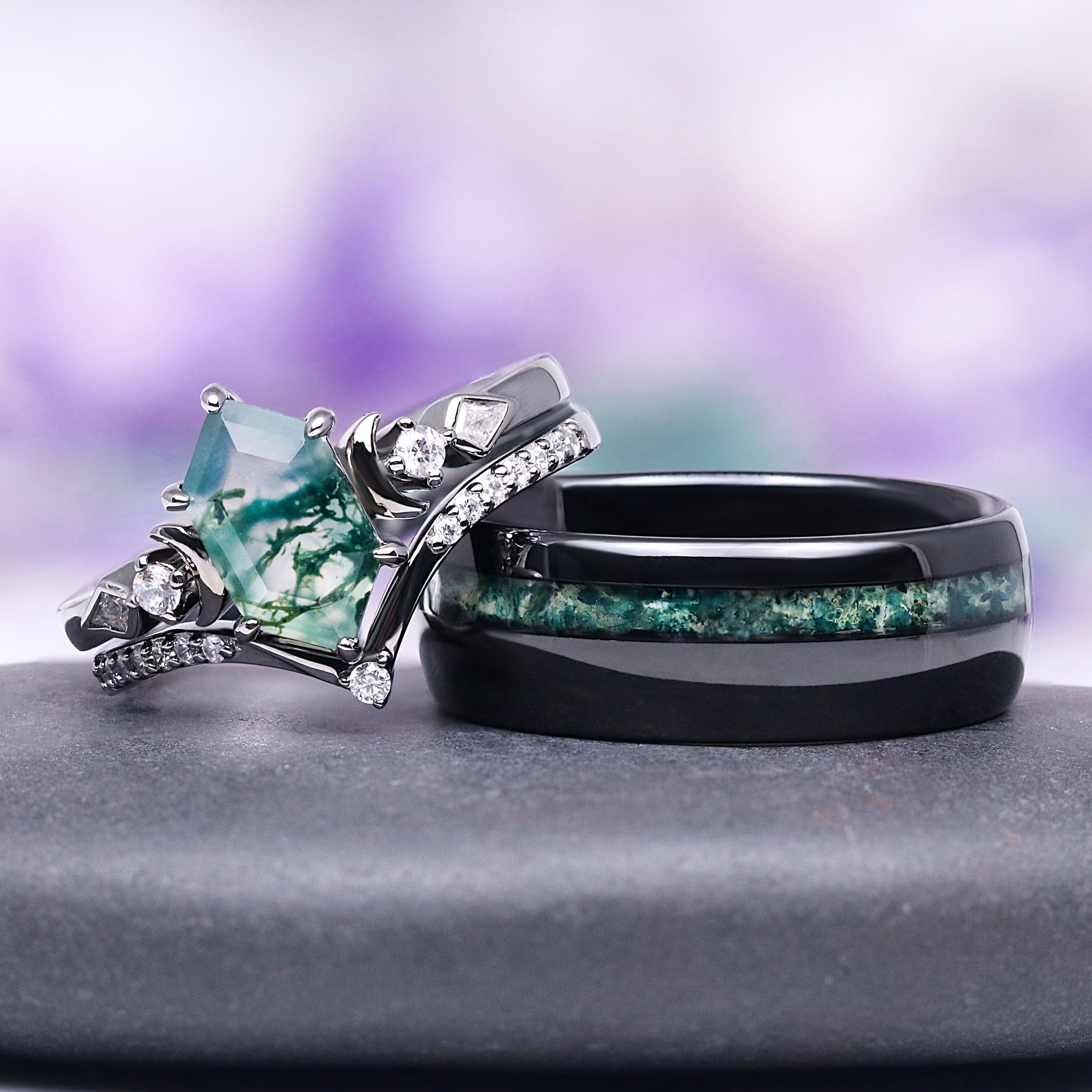
Lovers of the Dark™ Black Engagement Rings
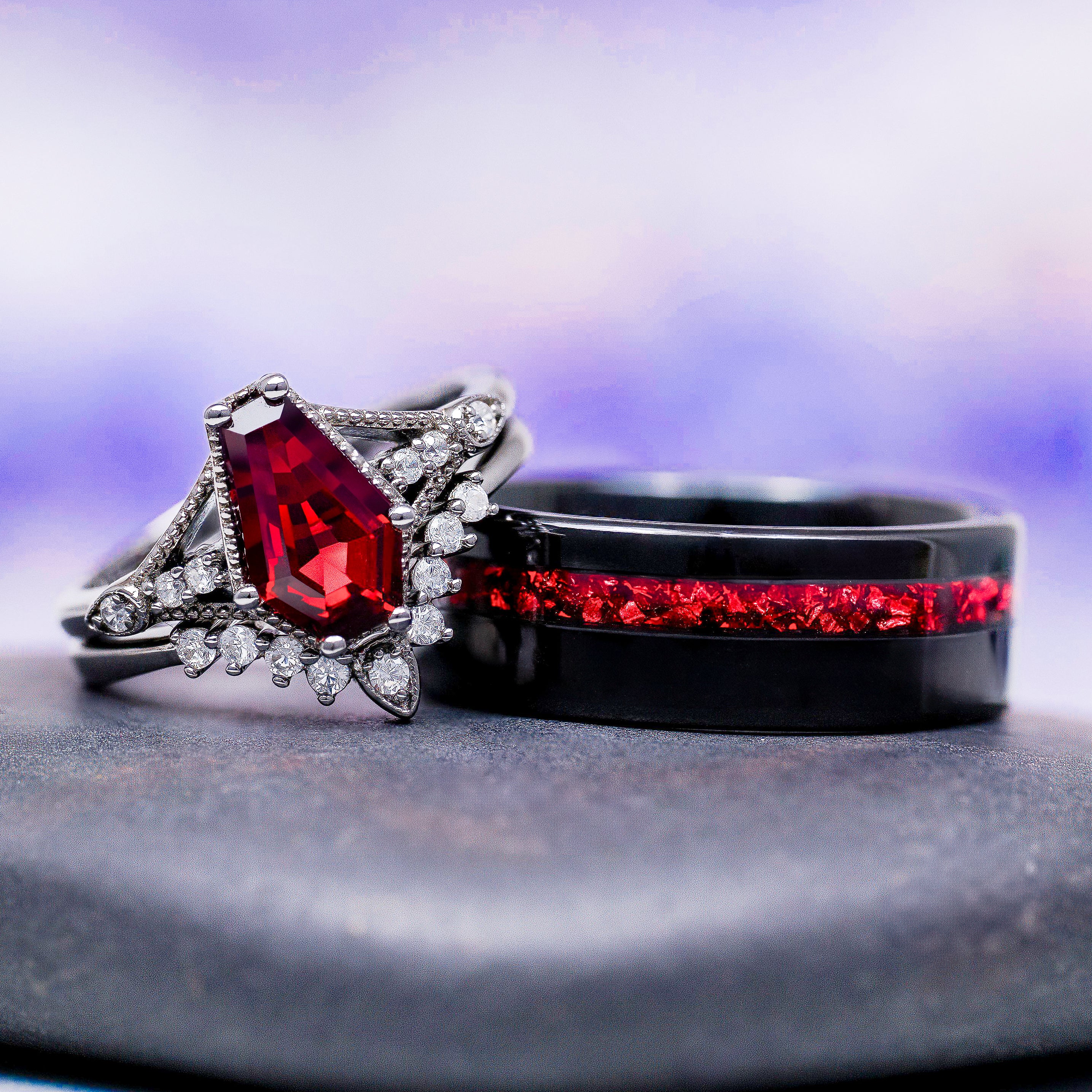
Black ruthenium over solid 925 sterling silver, set with garnet, moss agate, black onyx, alexandrite and sapphire in coffin, kite and hexagon cuts, many as bridal sets with their own band.
Shop Lovers of the Dark™ Black Engagement RingsMatching Bands, Couples Sets and Men's Gothic Rings
The engagement ring is half the picture. Plan the wedding band, and your partner's ring, at the same time.
Gothic settings are more sculptural than a classic solitaire, so a goth wedding ring has to be chosen with the engagement ring, not bought blind later. Two rules keep it simple. First, match the finish: a black ruthenium engagement ring wants a black ruthenium band, and a rose gold one wants rose gold, because a mismatched finish looks accidental. Second, match the shape. A chevron or V band nests under a kite, coffin or pear setting and echoes its point; a straight, thin band suits bezels and hexagons; a curved contour band follows a halo or a wide sculpted head. Many of our engagement rings are designed with their own band, which is why so many of the photos in this guide show two rings together, and the wedding ring sets for women collection shows every pairing. For the bands themselves, and for how black bands carry meaning, read gothic wedding rings and black wedding band meaning.
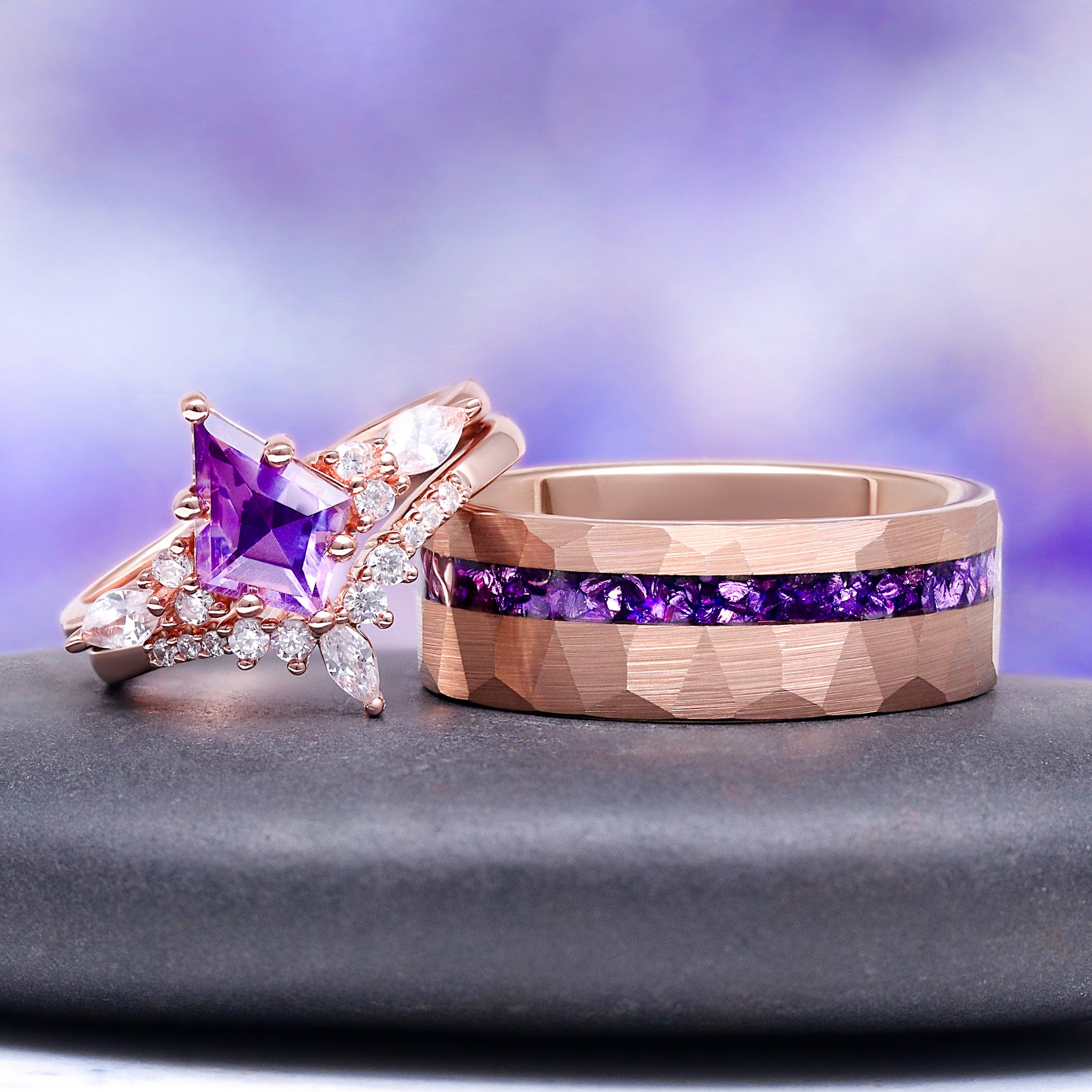
Couples sets
The easiest way to get two gothic rings that belong together is to buy them that way. In a designed set, the engagement ring and the partner band share a stone, a finish or a motif, most often as a crushed-stone inlay running around the band in the same garnet, onyx, amethyst, moss agate or blue sandstone that sits in the engagement setting. See gothic couple rings, celestial couple rings and black onyx couples rings. The his and hers wedding ring sets page shows more matched pairs. Couples who are not ready for an engagement ring often start with a promise ring in the same style, and our gothic promise rings guide covers that step.
Men's gothic rings
Men's gothic rings run wider, flatter and more architectural: bands of 6 to 8 millimeters, hammered or faceted surfaces, black or gunmetal finishes, and inlays instead of raised stones so nothing snags. The stones that work best are the opaque and crushed ones, because they sit flush and hide wear: onyx, black spinel, garnet chips, meteorite, blue sandstone and moss agate. The metal decision is practical: tungsten carbide resists scratches best, while sterling silver and solid gold bands can usually be resized by a jeweler, though inlaid designs may not be. For a full walk through widths, finishes and motifs, read gothic rings for men, then shop gothic men's wedding bands and men's black rings.
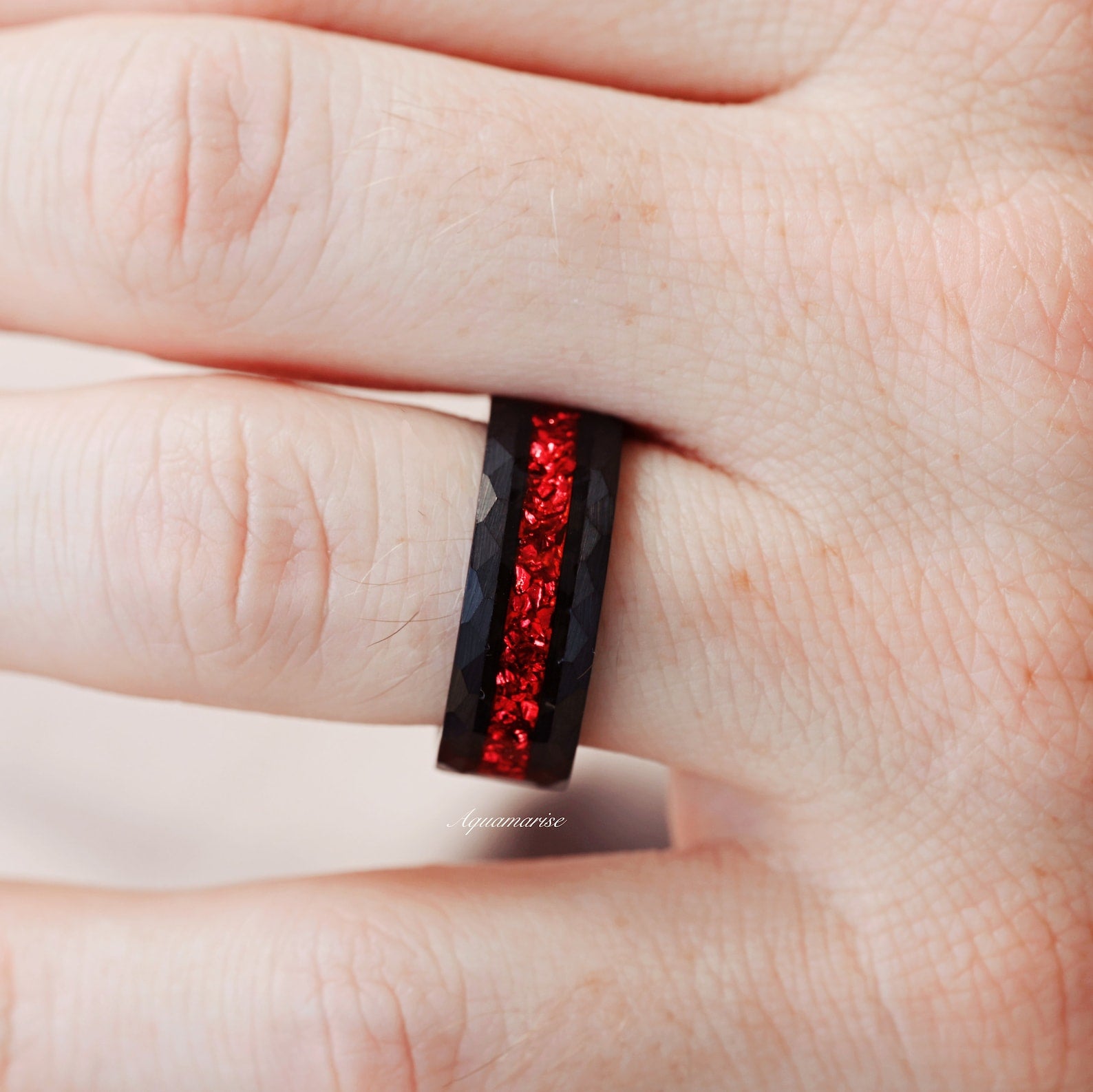
Gothic Couple Rings
A pointed-cut engagement ring and an inlaid black band, designed as a pair in the same stone and finish so the two rings read as one story.
Shop couples setsHow to Choose a Gothic Engagement Ring for Daily Wear
Seven decisions, in the order that prevents regret.
- Name your family first. Victorian, cathedral, celestial, dark botanical, memento mori or minimalist black. Pick the one that matches the clothes you actually wear on a Tuesday, not the ones you wear to a concert. A ring that fits your everyday self never feels like a costume.
- Decide how dark. Full monochrome (black stone, black finish) is the boldest and the easiest to style. One dark element plus one bright one, a black stone in white gold or a garnet in black ruthenium, is the most versatile. Deep color on warm gold is the most vintage.
- Choose the stone by your life, not the photo. If you never take rings off, stay at Mohs 8 and above: spinel, alexandrite, sapphire, moissanite. If you remove your ring for the gym, the garden and the sink, onyx, garnet, amethyst and moss agate are fine in a protective setting. Blue sandstone is for people who treat a ring like jewelry, not a tool.
- Match the setting to the cut. V-prongs or a bezel on every point. A low profile if you type all day or wear gloves. A halo if you want the stone to look larger, a plain bezel if you want it to disappear into the band.
- Pick the finish with open eyes. Black ruthenium and black rhodium are platings that wear at contact points and can be renewed. Oxidized silver is a patina that polishes away. Platinum and bright sterling need no black upkeep at all. Choose the maintenance you are willing to do.
- Get the size right before you fall in love with a band. Wide bands and chevron bands fit tighter than thin straight ones, and a tungsten band cannot be altered later. Use the find your size guide, and if you are proposing with a surprise, borrow a ring your partner already wears on that finger.
- Add the private message. A hidden inscription is the oldest gothic habit of all. Our complimentary engraving service adds a date, initials or a short phrase inside most bands (up to 16 characters on women's rings, 25 on men's), and if nothing in the collection is exactly right, the build your custom ring page walks through the process of designing one from the stone up.
Shopping gothic engagement rings for women and not sure the ring needs the label at all? The wider women's engagement rings collection is worth a scroll for pieces that are gothic in spirit without being labeled that way. The engagement ring buying guide walks through styles, settings and ready-to-ship versus custom, our jewelry and engagement ring guides go deeper on single topics, and the ordering FAQ covers the practical questions.
What Gothic Engagement Rings Cost and Why
Metal, stone, cut and bench time, in that order.
Gothic engagement rings are priced the same way every engagement ring is priced, and knowing the four levers makes it easy to spend well. The metal is the largest single factor. Solid 925 sterling silver is the most accessible; 14K gold vermeil over sterling costs a little more; solid 10K and 14K gold are a real step up; 18K gold and platinum sit at the top. Black ruthenium is a finish on sterling silver, not a separate metal tier. The stone is the second lever, and here gothic buyers have an advantage: the most iconic dark stones are among the least expensive fine gems. Black onyx, garnet and amethyst cost far less per carat than any white diamond, and blue sandstone, a man-made glass valued for its look, costs less still; black spinel is a bargain for its hardness; lab-grown alexandrite and lab sapphire are moderate; moissanite scales with size; natural dark sapphire and natural black diamond are the only options that climb steeply.
| Tier | Metal | Typical pairing | Who it suits |
|---|---|---|---|
| Entry | Solid 925 sterling silver, bright rhodium or black ruthenium | Onyx, garnet, amethyst, blue sandstone, moss agate, lab alexandrite | Engagement rings on a budget, promise rings, and anyone who wants the full gothic look without a gold price |
| Middle | 14K rose or yellow gold vermeil over sterling | Any of the above, plus spinel and moissanite | The Victorian warm-metal look at an accessible price |
| Heirloom | Solid 10K, 14K or 18K gold; platinum | Spinel, moissanite, sapphire, alexandrite; natural black diamond | An heirloom ring, covered by our limited lifetime warranty |
The third lever is the cut: coffin, kite and hexagon stones usually cost more than rounds of the same weight and material, for the reasons in the cuts section above. The fourth is bench time: a sculpted raven, a pierced cathedral gallery or a hand-set halo of accent stones takes hours that a plain bezel does not. When two rings look similar and one is much cheaper, that difference is usually in the metal (plated base metal instead of solid sterling) or in the stone (undisclosed glass or resin sold as a gemstone), so ask.
As for how much to spend, skip salary rules (the FAQ below explains where the three-month rule came from) and spend what fits your life. Every U.S. order ships free, solid gold and platinum rings carry a limited lifetime warranty, and the financing page explains how to split a larger purchase. The shipping, returns and refunds and warranty pages have the fine print, and the appraisal page explains the independent appraisal add-on for solid gold and platinum pieces, completed before your ring ships.
Caring for Black Finishes and Dark Stones
Black rings are low-drama if you follow six habits, and the one that matters most is keeping polishing cloths away from them.
- Wash, don't polish. Warm water, a drop of dish soap and a soft brush reach into carved recesses and under the gallery without touching the black; rinse and pat dry. This is safe for every stone and finish in this guide.
- Skip the ultrasonic and the steam cleaner. Ultrasonics can loosen crushed-stone inlays and accelerate wear on plated finishes, and steam can shock garnet, moss agate and any stone with natural fractures. Save both for solid gold or platinum rings with hard stones.
- Never use a polishing cloth on a black ring. Silver polishing cloths are mildly abrasive and are designed to remove tarnish, which means they strip oxidation quickly and wear down black plating over time. If a black ring dulls, wash it; if it has worn through, have it re-plated.
- Take it off for chemicals and knocks. Chlorine, bleach and household cleaners attack finishes and metal; the gym, gardening and moving furniture chip points. Blue sandstone and onyx in particular deserve this habit.
- Store it in its own pouch. Scuffs from gold and diamonds show more on a black finish than on bright metal, and hardness cuts both ways: a black spinel at 8 will scratch an onyx at 7 if they share a dish, and a sapphire will scratch both.
- Book a yearly check. Have the prongs, especially V-prongs on pointed cuts, inspected once a year by a jeweler, and ask about re-plating at the same visit if the black has softened at the edges.
The full routine, metal by metal, is on our jewelry care page, and the how to care for your engagement ring guide covers the daily habits that keep any ring looking new. Handled this way, a gothic ring ages the way its ancestors did: the finish takes on character, the stone stays whole, and the ring becomes an heirloom.
Gothic Engagement Rings FAQ
What makes an engagement ring gothic?
Are gothic engagement rings a good idea?
What gemstone is best for a gothic engagement ring?
Is black onyx durable enough for an engagement ring?
Does black ruthenium wear off?
Does the 3 month rule apply to gothic engagement rings?
Where can you buy authentic gothic rings?
Can a gothic engagement ring look professional at work?
Can a tungsten gothic band be resized?
What wedding band goes with a gothic engagement ring?
Find the gothic engagement ring that means something
Lovers of the Dark™ is our gothic line, designed in our studio in Niceville, Florida: solid 925 sterling silver and solid gold rings set with dark gemstones and blue sandstone, with black tungsten bands to match. Solid gold and platinum carry a limited lifetime warranty, and every U.S. order ships free.
Shop Gothic Engagement RingsShop Gothic Rings by Style
Explore More Guides


