



Metal Guides
Is Sterling Silver Waterproof? Showers, Pools, the Ocean and Sweat
- Made to order
- Ethically sourced gemstones
- Free US & worldwide shipping
No metal jewelry is waterproof the way a watch is, and sterling silver does not need to be: silver does not react with pure water. What dulls and darkens it is what the water carries: chlorine in pools, hot tubs and bleach, salt in the ocean and in sweat, sulfur from hot springs or the air, and heat, which speeds all of it. A rhodium finish, standard on every Aquamarise sterling piece, shields the silver while it is intact.
Sterling Silver and Water at a Glance
- Pure water: silver does not react with water or oxygen at ordinary temperatures; rain and hand washing do nothing.
- The culprits: chloride (pools, ocean, sweat), sulfur compounds (air, hot springs, rubber), heat, and soap or lotion films.
- Two reactions: chlorine makes silver chloride, a gray-white haze; sulfur makes silver sulfide, the black tarnish on bare silver.
- Worst water: hot tubs (3 ppm chlorine or 4 ppm bromine, up to 104°F), then pools, then the ocean at 3.5 percent salt plus sand.
- At Aquamarise: every sterling piece carries a rhodium finish, and rhodium is one of the least reactive metals known.
- Stones that mind: hydrophane opal, pearl, turquoise and filled emerald. Moss agate, moissanite, sapphire and cubic zirconia do not.
The Short Answer: Water Is Not the Problem
Silver ignores pure water. It reacts to what the water carries.
Sterling silver is 92.5 percent silver and 7.5 percent other metal, almost always copper, and neither is harmed by plain water. Silver does not react with water or oxygen at ordinary temperatures. The real question is whether the water you meet every day is plain, and it almost never is: tap water carries a little chlorine, pools and hot tubs much more plus heat, the ocean about 3.5 percent salt and sand, sweat salt and lactic acid, and hot springs the hydrogen sulfide that blackens bare silver.

Waterproof, water resistant, or simply unbothered?
"Waterproof" is a rating for sealed objects with an inside to protect, such as a watch case, and even there the international watch standard (ISO 2281 in 1990, now ISO 22810) forbids the word in favor of "water resistant" to a stated pressure. A solid ring has no inside and no seal, so the rating does not apply to it at all. When a listing advertises "waterproof jewelry," it is almost always stainless steel, often with a thin colored PVD coating, not silver. Sterling sold as "waterproof" is covered at the end.
What Water Carries, and What Each Thing Does to Silver
Four reactions explain nearly every complaint about wet sterling.
Chloride turns silver into silver chloride. The chlorine in a pool and the chloride ions in seawater and sweat both react with silver to form silver chloride, a white compound that barely dissolves in water and darkens to gray, purple or black in light. On a ring it reads as a dull, chalky haze that a cloth does not fully lift, and because it forms unevenly it can leave fine pits once removed.
Sulfur turns silver into silver sulfide. This is tarnish, the brown-to-black film bare sterling grows in air; hydrogen sulfide in the air is enough, no water required. Water matters because it delivers sulfur faster: hot-spring water carries dissolved hydrogen sulfide, and humidity speeds the reaction. Rubber counts too, since natural rubber is hardened with sulfur. The chemistry is covered in full in What Is 925 Sterling Silver?; this guide stays with water.
Copper is the weak point. Silver sits between copper and gold in reactivity, so the copper in sterling is what salt and acids attack first; table salt is known to corrode silver-copper alloy. Copper is also behind the green mark some bare silver leaves on skin, answered in Does Sterling Silver Turn Green?
Heat speeds everything, which is why a hot tub does more in twenty minutes than a cold pool does in an afternoon. Two things water does not do: it does not rust silver, because rust is iron oxide and sterling contains no iron, and it does not loosen a well-set stone.
The Fact That Changes the Answer: Our Rhodium Finish
Every Aquamarise sterling piece is finished in rhodium, and rhodium takes no part in any of the reactions above.
Rhodium is a platinum-group metal, isolated in 1803 by William Hyde Wollaston, and one of the least reactive metals on the periodic table. It does not normally form an oxide even when heated, it is not attacked by most acids, and it dissolves only reluctantly in aqua regia. It has no interest in chlorine, chloride, sulfur or water at any temperature jewelry will see. Deposited onto silver it forms a very hard, mirror-bright white layer.
So while the finish is intact, pool water, seawater and sweat meet rhodium, not silver, and the copper that chloride attacks is sealed away from it. That is also why we never call it waterproof: the finish is a surface layer, and surface layers wear.
Where it wears is predictable: the inside of a band that rubs the next finger, the high points of a shank, and the tips of prongs. Over years of daily wear those contact points thin, and bare silver can show through as a faintly warmer tone. Three things speed that up: chlorine, which attacks exposed silver at any pinhole; abrasive silver polishes and dips, which strip metal and rhodium alike; and grit. We do not put a number of years on the finish; when it thins, a bench jeweler can refinish the piece and return it to white.

Care is simpler than for bare silver: warm water, a drop of mild soap, a soft brush around the stone, a rinse and a thorough dry. The routine is in How to Clean Sterling Silver; storage is in our jewelry care guide.
Activity by Activity: What Happens and What to Do
The same ring, thirteen kinds of wet.
| Activity | What the water carries | Bare sterling | Rhodium-finished sterling | What to do |
|---|---|---|---|---|
| Hand washing | Tap water (chlorine up to 4 ppm), soap | Safe; soap film dulls over time | Safe | Rinse off soap, pat dry |
| Shower | Warm water, shampoo, body wash | Low risk; residue dulls; humidity speeds tarnish | Low risk; residue only | Fine occasionally; better off |
| Bath | Warm water, bath salts, oils | Bath salts are salt; oils leave film | Film only | Off; drains eat rings |
| Swimming pool | Free chlorine, 1 ppm minimum, often more | Silver chloride haze; pitting with repeated swims | Shielded; chlorine finds any worn spot | Off; rinse at once if forgotten |
| Hot tub | 3 ppm chlorine or 4 ppm bromine, up to 104°F | Worst case: fast dulling and pitting | Holds; heat and halogen find worn edges | Always off |
| Ocean | 3.5% salt, sand, sun | Chloride film; corrosion in crevices | Chloride cannot reach silver; sand still scratches | Off to swim; fresh-water rinse after a splash |
| Lake or river | Fresh water, silt; sulfur near hot springs | Mostly harmless; dry it | Harmless; dry it | Dry; check under the stone for grit |
| Gym, sweat | Salt (about 0.9 g sodium per liter), lactic acid | Dull or dark line inside the band | Shielded; trapped sweat dulls | Rinse and dry after; off for weights |
| Dishes | Hot water, detergent, sometimes bleach | Detergent film; bleach attacks directly | Film; bleach attacks worn spots | Off; gloves trap it against skin |
| Cleaning with bleach | Sodium hypochlorite, which releases chlorine | Gray silver chloride film in minutes | The finish's one real enemy | Never; rinse at once if splashed |
| Hand sanitizer | Alcohol, glycerin, fragrance | Alcohol does nothing; gel leaves film | Same | Let hands dry, then ring back on |
| Lotion, sunscreen, perfume | Oils, silicones, fragrance | Film in crevices; traps sweat | Film only | Apply first, jewelry last; wipe |
| Sleeping | Skin oils, fabric friction | Harmless; friction only | Friction wears the finish slowly | Off is kinder to prongs |
Pools, Hot Tubs and the Ocean: Why They Rank Worst
Numbers, because "avoid chlorine" is advice without a scale.
Tap water is treated with chlorine or chloramine at up to 4 milligrams per liter (4 parts per million), the level the CDC considers safe to drink, and far too little to mark silver during a hand wash. Pools must hold at least 1 ppm of free chlorine under CDC guidance for public pools, often more, present as hypochlorous acid, the oxidizer that does the sanitizing. An hour of laps is a long soak in dilute oxidizer.
Hot tubs are the worst case on every axis. Public hot tubs must hold at least 3 ppm of free chlorine or 4 ppm of bromine, three to four times the pool minimum, at temperatures allowed up to 104°F (40°C). Bromine, a sanitizer popular in spas, is a halogen like chlorine and forms silver bromide the same way, and heat speeds the reaction. Bare sterling should never go in, and a rhodium-finished piece should sit it out too, because hot halogen water finds the thinnest spot of any finish.
The ocean holds about 35 grams of dissolved salt per liter, and sodium and chloride make up more than 90 percent of those ions. Chloride works on silver and copper slowly. The faster damage is mechanical: sand is largely quartz, harder than either metal, and it scratches both. A fresh-water rinse the moment you leave the beach removes the salt before it concentrates. Lakes and rivers are the easy case, fresh water and a little silt; dry the ring and check for grit under the stone. Water that smells of eggs carries hydrogen sulfide and darkens bare silver.
Showers, Sweat, Sanitizer and Sleep
The questions people actually type, answered without hedging.
Can you shower with sterling silver?
Yes, occasionally, and nothing dramatic happens: shower water is tap water for a few minutes. Showers leave shampoo and body-wash film in the crevices of a setting, which is what makes a ring look tired after a month of them. A daily habit is worth breaking, if only because a soaped finger is exactly how rings go down drains.
Can sterling silver be worn every day?
Yes. Regular wear slows tarnish on bare silver, as our care guide notes, and our rhodium-finished sterling is made for it. Most of our sterling silver rings are bought as promise rings or couples rings and worn around the clock; the habits that keep them bright are taking them off for the pool, the gym and the dishes, and drying them when they get wet.

Sweat, sanitizer, lotion and sleep
Sweat is mostly water carrying dissolved salt (about 0.9 grams of sodium per liter), lactic acid and urea. Trapped under a band for an hour it leaves a dull or dark line on bare sterling. Rhodium is indifferent to it, but the band still fills with sweat and skin cells, so rinse and dry after training. Hand sanitizer is alcohol, which does not react with silver or rhodium and evaporates in seconds; the glycerin and fragrance left behind are a film, nothing more. Lotion, sunscreen and perfume are the "last on, first off" group: on metal they are only a film that dulls shine; on porous stones they are a different matter, covered next. Sleeping in silver costs nothing chemically; the only wear is fabric friction and the occasional knock, which dull a high polish over time and can catch a prong.
Gemstones and Water: Which Stones Mind
Most of our sterling rings hold a stone, and some stones care about water more than the metal does.
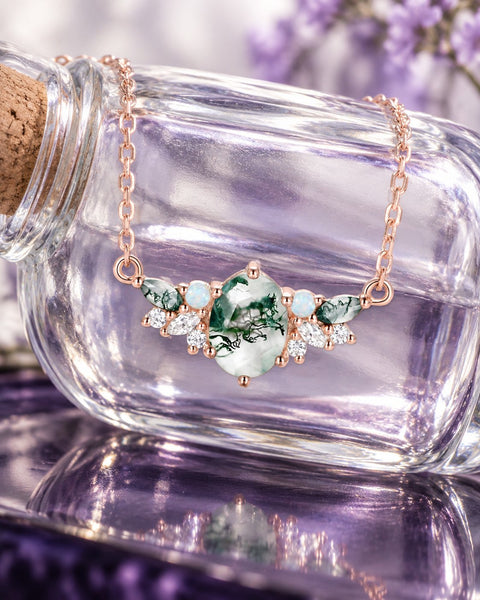
Unbothered. Moss agate is chalcedony, a dense form of quartz at 6.5 to 7 on the Mohs scale, and soap, salt and chlorine do nothing to it, which makes our moss agate engagement rings the easiest to care for (see Can You Shower With a Moss Agate Ring?). Moissanite is silicon carbide, just below diamond in hardness; lab-created sapphire is corundum, 9 on the Mohs scale and stable to heat, light and common chemicals; cubic zirconia, the simulated diamond accent in many of our sterling settings, is a ceramic that resists chemical and thermal attack. None of them is a care concern in water.

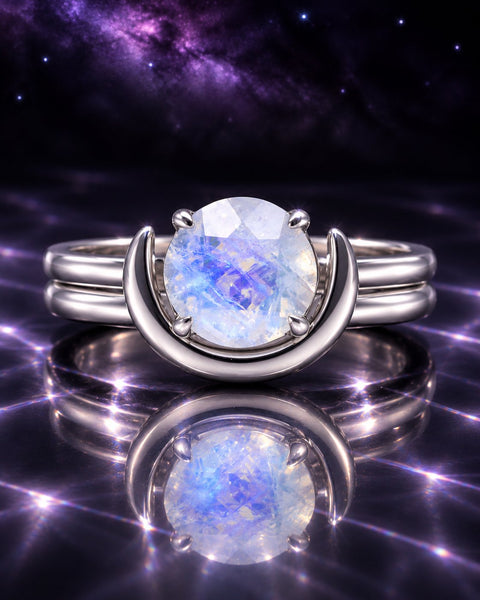
Mind the temperature. Opal is hydrated silica, usually 6 to 10 percent water by weight, and GIA notes that high heat or sudden temperature change can fracture it. The stone itself is fine in water (GIA's only recommended cleaning for opal is warm soapy water); a hot tub followed by a cold plunge is the risk. Our opal jewelry uses natural Australian opal, named as such in the title, and lab-created opal. Blue goldstone, the glittering stone in our Starry Night rings, is a man-made glittering glass, and glass follows the same rule. Moonstone, an accent in several of our sterling sets, has two cleavage directions and breaks from sudden temperature change as well as from knocks.
Keep dry, or nearly. Hydrophane opal, the Ethiopian material, is porous enough to drink water: in a GIA lab test, slices gained 5 to 13 percent of their weight in water, turned more transparent, and took about a week to return to their original look. Pearl is 2.5 on the Mohs scale and, in GIA's words, damaged by many chemicals and all acids, including perfume, cosmetics and perspiration. Turquoise is porous and discolors from cosmetics, skin oils and perspiration. Natural emerald is almost always fracture-filled with oils or resins (GIA cites estimates of 90 percent or more), and heat and chemicals degrade the filler. Any doublet, triplet or glued stone has an adhesive layer that soaking and heat eventually find. Pearl and turquoise are rare in our sterling line; emerald is common in it, so if yours is natural, assume it is filled and keep it out of hot or chemical-laden water. Wherever these stones appear, the stone sets stricter rules than the silver does.

Aquamarine Fairy Leaf Ring in Sterling Silver
A leaf-and-vine band in solid 925 sterling silver with a rhodium finish, made for everyday wear.
Shop Sterling Silver Aquamarine JewelryYour Ring Went in the Pool or the Sea. Now What?
Ten minutes of attention undoes almost all of it.
- Rinse in fresh water right away. Lukewarm tap water, drain closed, to carry off chlorine or salt before it dries and concentrates in the setting.
- Wash gently if there was sunscreen or sand. A drop of mild dish soap and a soft toothbrush around the prongs and under the stone, then rinse again. Skip the brush on pearl and opal; use a soft cloth.
- Dry completely, including under the stone. Pat with a lint-free cloth, then leave the piece on the cloth for an hour. No hair dryer on opal, moonstone or goldstone.
- Look at it in daylight. On a rhodium-finished piece nothing should have changed. A faint gray, chalky haze that a soft cloth does not lift is silver chloride on exposed silver, which means the finish has a worn spot.
- Store it dry. A closed pouch or box with an anti-tarnish strip or a silica gel packet keeps humidity and airborne sulfur away from any exposed silver. Never in a rubber-lined or rubber-banded container; rubber is a sulfur source.
- Know when a refinish is the answer. If haze keeps returning at the same spots, or the inside of the band has turned warm-toned, the rhodium has worn through there; a refinish by a bench jeweler returns the piece to bright white. For an Aquamarise piece, send photos through our repairs page and we will advise.
"Waterproof Sterling," Coatings, and the Metals That Truly Shrug Off Water
How to read a claim, and what to buy if you live in the water.
Sellers who advertise waterproof sterling silver usually mean one of three things, and asking "what is the finish, and what is under it?" sorts them in one question:
- A rhodium finish like ours, described loosely. It protects, but it wears, so "waterproof" overpromises.
- An e-coat or clear lacquer. A thin polymer film over the silver; see below.
- Not sterling at all. Stainless steel, often PVD-coated, sold under a "silver" color name.
E-coating is a clear resin deposited electrically, and it does keep water, sweat and air off the silver for a while. Conservators who care for silver professionally do not recommend lacquering it, because an even, pinhole-free coat is hard to achieve, and silver under a flawed coating darkens in streaks and spots. A resin is also soft next to metal: it scratches, and no jeweler can polish, resize or solder through it. That is why fine jewelry uses rhodium, a metal harder than the silver beneath it that survives a jeweler's bench, rather than a plastic skin.
If you live in pools, surf and hot tubs, buy a metal that does not care. Tungsten carbide does not tarnish. Titanium is light, corrosion resistant and nickel-free. Platinum, about 95 percent pure, resists tarnish and chemical damage exceptionally well, and solid gold in 14K and up is close behind, though repeated hot-tub chlorine is unkind to gold alloys over the years. Two finishes follow the rhodium logic: black ruthenium is a platinum-group finish over sterling, and gold vermeil is a layer of gold over sterling, so both are better kept out of the pool; vermeil has its own care guide. Skin reactions are a separate subject from water, answered in Is Sterling Silver Hypoallergenic?

Sources for the chemistry in this guide: the Royal Society of Chemistry's rhodium page and the GIA opal care and cleaning guide.
Sterling Silver and Water FAQ
Is sterling silver waterproof?
Can I wear sterling silver in the shower?
Can water damage sterling silver?
Can you swim with sterling silver in a pool or the ocean?
Can sterling silver be worn every day?
Does sterling silver turn green when wet?
Can 925 silver turn black, and does it tarnish?
Can I sleep in sterling silver?
How can I tell if it is real sterling silver?
Does hand sanitizer damage sterling silver?
Sterling Silver Made for Daily Wear
Handcrafted in solid 925 sterling silver with a rhodium finish. Free US shipping, a free one-time size exchange, engraving available and 30-day returns.
Shop Sterling Silver Rings

