


Opalite vs Opal: What Opalite Is, How to Tell Them Apart, Which to Buy
What opalite is (man-made glass), why it glows blue and then orange, how it differs from opal in hardness, density and play-of-color, six home tests, and which one belongs in a ring.

Opalite is a trade name for man-made opalescent glass: not opal, not a mineral, not a crystal. Opal is hydrated silica, and precious opal flashes play-of-color from ordered silica spheres that no glass can copy. Opalite glows one milky blue against dark and peach-orange against light, every bead alike; opal shows moving patches of color, every stone different. Opal rates 5 to 6.5 on the Mohs scale, opalite about 5.5 to 6.
Opalite vs Opal at a Glance
- Opalite: man-made opalescent glass sold under a trade name, also as sea opal, opal moonstone or argenon. No play-of-color, no geological history.
- Opal: hydrated amorphous silica with 3 to 21 percent water; precious opal flashes because of ordered silica spheres about 150 to 300 nanometers across.
- Hardness: opal 5 to 6.5 on the Mohs scale (GIA); glass about 5.5 to 6. Both scratch in daily wear.
- The glow: opalite is blue against dark and orange against light because tiny particles scatter blue light, the physics of sky and sunset. Opal's colors come from diffraction and move as it turns.
- Quick tests: moving play-of-color, the two-background flip, bubbles under a loupe, identical beads, price. Warmth to the touch tells you nothing.
- Lab-created opal is opal; opalite is not. At Aquamarise we sell no opalite; our opal rings use lab-created opal and, in named designs, natural Australian opal.
Opalite vs Opal: The Short Answer
One is a factory glass with a trade name. The other is a mineraloid made of silica, water and time.
Opalite is man-made glass; opal is hydrated silica. "Opalite" is a trade name for opalescent glass sold as beads, spheres, pendants and tumbled "crystals," also under the names sea opal, opal moonstone and argenon. It contains no opal. Opal is amorphous silica with water locked into its structure, laid down where silica-bearing water seeped into rock and dried. Precious opal shows play-of-color, moving patches of spectral color produced by diffraction from ordered silica spheres; common opal does not; opalite cannot. Our opal meaning guide covers what opal has meant across cultures; this one covers the material.

| Property | Opal | Opalite |
|---|---|---|
| What it is | Hydrated amorphous silica, SiO2·nH2O, a mineraloid | Soda-lime-type glass with an opacifier, man-made |
| Water content | 3 to 21 percent, usually 6 to 10 | None |
| How it forms | Silica-bearing water drying in rock; also grown in a lab since the early 1970s | Melted in a furnace and cooled; every batch alike |
| Mohs hardness | 5 to 6.5 (GIA) | About 5.5 to 6 |
| Specific gravity | About 2.15, lower in porous stones | About 2.5 |
| Refractive index | About 1.45 (1.37 to 1.47) | About 1.52 |
| Luster | Subvitreous to waxy; milky to pearly in white opal | Glassy |
| Play-of-color | Yes in precious opal, no in common opal | Never |
| Color behavior | Bodycolor fixed; the flashes move as the stone turns | Blue against dark, peach-orange against light or when backlit |
| Under a loupe | Natural inclusions, host rock; lab-created shows a regular mosaic | Gas bubbles and swirl lines typical of glass |
| How it breaks | Conchoidal to uneven; sensitive to heat and dryness | Conchoidal, like any glass; chips at edges |
| Price band | Modest for small white or common opal, high for fine black opal | Inexpensive and widely available |
What Opalite Actually Is
A trade name, not a mineral name. Here is everything the name has been attached to.
Opalite is a trade name for synthetic opalescent glass, and for the opal and moonstone simulants sold under it. The glass is ordinary: silica melted with soda and lime, the family of window and bottle glass, roughly 70 to 74 percent silica. What makes it opalescent is an opacifier. Adding sodium or calcium fluoride to a soda-lime batch gives a translucent rather than transparent glass, known in the glass trade as opal glass, because the fluoride comes out of the melt as countless tiny particles suspended in the glass. Those particles make opalite glow (next section). It is sold as tumbled stones, spheres, beads and cabochons, mainly for decoration.
It has no history as a gem. Glass sold as "opalite" was on the market by the mid-1970s, competing with Slocum stone and the first lab-created opals, and the crystal-shop meanings attached to it are younger still. The word is now searched far more often than the glass deserves because of a 2025 Taylor Swift song titled "Opalite"; this guide is about the material, not the song.
Two older uses of the word
- Impure common opal. Mineral references record "opalite" as a name used to promote impure, variously colored common opal: natural material with no play-of-color. Sellers of green or lavender "natural opalite" or "opalite cat's eye" mean this. It is real opal, just not precious opal, and it looks nothing like the blue glass.
- Tiffany Stone. A few gem-trade pages also hang the name on Tiffany Stone, the trade name for a purple-and-white lapidary rock, mostly fluorite with some opal and a little bertrandite, found only at the Spor Mountain beryllium mine in Utah; the U.S. Geological Survey describes that ore as fluorite, bertrandite and opal. It is a natural rock, and calling it opalite or bertrandite is loose at best.
Is opalite a real stone, a real crystal, or fake?
It is real glass: not a mineral, because it is manufactured, and not a crystal, because glass has no ordered lattice; it is a solid with the atomic arrangement of a liquid. Sold as opalite or sea opal at a glass price it is an honest decorative material; sold as opal, or as moonstone, it is a fake. It is also no one's birthstone. October's birthstone is opal, and opalite does not inherit that by borrowing the name.
Opalite Color: Why It Glows Blue, Then Orange
The same physics as a blue noon sky and an orange sunset, in a piece of glass the size of a thumbnail.
Against black cloth, opalite looks pale sky blue; against a white page or a lamp, the blue drains out and a peach-to-orange glow takes over. Nothing in the glass is blue or orange. The colors come from scattering by the tiny particles suspended in the glass. Small particles scatter short wavelengths far more strongly than long ones: for particles much smaller than the wavelength of light this is Rayleigh scattering, whose strength rises with the inverse fourth power of wavelength; for particles nearer the wavelength in size it is the Tyndall effect, and blue is still scattered more than red. Light bounced sideways out of the glass toward your eye is enriched in blue, which is what you see against a dark background. Light that passes through the glass has lost that blue on the way and arrives enriched in red and yellow, which is what you see against a light background or in transmission. The daytime sky is blue for the first reason and sunsets are orange for the second. Because the effect depends only on particle size, every piece from a batch glows the same way, and the glow does not move when you tilt it: one even color that flips with the background.
Why opal flashes instead
Precious opal is built from sub-microscopic silica spheres stacked in a regular grid, like layers of ping-pong balls in a box, in GIA's image. When the spheres are uniform in size and packing, the stacked layers act as a diffraction grating: light bends as it passes between the spheres and interferes, and the wavelength that emerges depends on sphere size. GIA gives the scale: spheres about 0.1 micron across produce violet, about 0.2 micron produce red; the range usually quoted is 150 to 300 nanometers. Because the geometry changes with the viewing angle, the colors change as the stone turns, which is why no two opals look alike. Where the spheres are irregular there is no grating and no flash: that is common opal, and some milky common opal looks like opalite until you check it against two backgrounds. Opal's bodycolor comes from impurities, not scattering, so a white opal stays white whatever you set it on.

How to Tell Opalite From Opal at Home
Six checks in order of usefulness, one popular check that does not work, and what a gemologist does instead.
- Look for play-of-color. Turn the piece slowly under a single light. Opal shows patches or pinpoints of color that move, change and go dark as the angle changes; opalite shows one glow that stays put. Pliny the Elder gave the same test around 75 AD for the glass fakes of his day: held up to the sun, a false opal shows one transparent tint throughout, while the genuine stone "offers various refulgent tints in succession."
- Do the two-background test. Set the piece on black, then on white, then hold it to a lamp. Opalite goes blue, then peach, then orange. Opal's bodycolor stays the same on either background; only the flash changes. A piece that turns orange when backlit is glass.
- Use a loupe. Under 10x magnification, glass gives itself away with round gas bubbles, curved swirl lines and a featureless body. Natural opal shows irregular inclusions or bits of host rock; lab-created opal shows a regular mosaic of color cells. Bubbles are the single most reliable home sign of glass.
- Check for uniformity. Opalite beads from one strand are interchangeable in color, glow and clarity. Opals, even a matched suite, differ in pattern and bodycolor. Twenty identical "opals" is a strand of glass.
- Read the price. Opalite costs little and is usually the cheapest thing in the case. Precious opal with real play-of-color is never that cheap: small white opal is affordable, and black opal from Lightning Ridge is the most prized kind.
- Weigh it, properly. Opal's specific gravity is about 2.15, glass about 2.5, a gap no hand can feel but a kitchen scale can: weigh the loose stone in air, then suspended in water, and divide the first by the difference.
What does not work: temperature and feel. "Opal feels cooler, opalite warms quickly" is repeated on page after page with no measurement behind it; how fast a stone warms depends on its size, its setting and your hand, not on which it is.
What a gemologist does. A refractometer reads opal at about 1.45 and soda-lime glass at about 1.52, which separates them in seconds; hydrostatic weighing confirms the density gap. A microscope distinguishes gas bubbles and swirls (glass) from the "lizard skin" or "chicken wire" mosaic and columnar structure of older lab-created opal, and from the inclusions of natural stone. For porous opal, GIA's laboratory places a single drop of water on the surface and watches it soak in, a safer check for hydrophane opal than immersing a stone that might crack. So yes, a jeweler can tell whether an opal is real, and natural from lab-created, usually within minutes.
Opalite vs moonstone
Opalite is also sold as "opal moonstone," and the two are confused for the same reason: a soft blue sheen. Moonstone is a natural feldspar whose glow, adularescence, floats and shifts inside the stone as it turns, and it does not flip from blue to orange with the background the way opalite does. Our moonstone meaning guide covers the real thing, and the moonstone collection shows the natural stones we set.

Lab-Created Opal, Doublets and the Other Things Sold as Opal
Lab-created opal is opal. Opalite is not. Here is the whole cast, with the honest label for each.
The word "synthetic" causes most of the confusion. In gemology a synthetic has the same chemistry and structure as the natural material, so lab-created opal, silica spheres grown and ordered in a laboratory, is real opal with real play-of-color, usually in a more regular pattern than nature's. Pierre Gilson brought a true synthetic opal to market in the early 1970s, one that needed no polymer impregnation, and makers such as Kyocera followed. An imitation only looks like the gem: opalite glass, Slocum stone and the opal-like plastics. Assembled and treated stones sit between: opal, but less of it than they appear.
| Sold as | What it is | Play-of-color | Honest label |
|---|---|---|---|
| Natural precious opal | Hydrated silica with ordered spheres, mined | Yes; irregular, unique | Opal |
| Natural common opal, incl. "natural opalite" | Hydrated silica without ordered spheres | No | Common opal |
| Lab-created opal | Ordered silica spheres grown in a lab; some grades polymer-impregnated | Yes; often a regular "lizard skin" mosaic under magnification | Lab-created (synthetic) opal; disclose any polymer |
| Opal-like plastic | About 80 percent plastic, 20 percent silica | Yes | Imitation opal |
| Doublet / triplet | A slice of opal glued to a dark backing; a triplet adds a clear quartz or plastic cap | Yes, from the opal layer | Assembled opal; keep out of water |
| Slocum stone | Glass with thin metal-foil flakes, early 1970s | Imitated by thin-film interference | Imitation opal (glass) |
| Opalite / sea opal / opal moonstone | Opalescent glass | No; a uniform milky glow | Glass |
| Treated opal | Natural opal darkened by sugar or smoke treatment, dyed, or impregnated with oil, wax or plastic | Yes | Opal, treated (disclose) |
Most opal from Ethiopia's Wollo fields is hydrophane, porous enough to soak up water like a sponge, which also means it soaks up dye; GIA notes that a hydrophane opal with a bodycolor other than white may be artificially colored, and that smoke treatment gives the same material a dark bodycolor. Our black opal guide explains how genuine black opal differs.
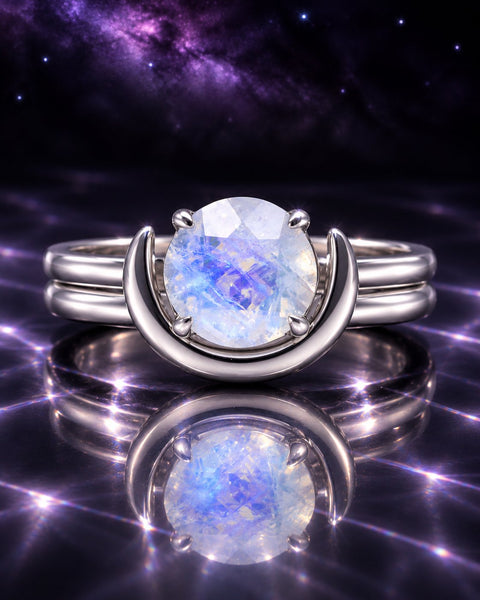
Where we stand: Aquamarise sells no opalite. Most of our opal engagement rings are set with lab-created opal, chosen for strong, consistent play-of-color; the designs that carry natural Australian opal say so in the title. Our opal wedding bands for men set crushed opal in a channel sealed under resin in tungsten carbide.

Natural Australian Opal, Vintage Frame
An oval opal with blue, green and pink play-of-color in a scrolled frame, in sterling silver with a rhodium finish or 14K gold vermeil.
Shop Opal Engagement RingsOpalite Meaning and "Healing Properties"
Reported, not endorsed. There is no tradition here older than the glass.
Opalite has no folklore, because there was nothing to have folklore about until a factory made it. The meanings now attached to it come from modern crystal practice and the sellers who stock it: calm, communication, easing transitions, help with sleep, a "stone" for new beginnings. These describe how people choose to use a decorative glass, not properties the glass has; no physical, medical or psychological effect of wearing it has been demonstrated. The symbolism of opal itself, its ancient history, the bad-luck rumor that began with an 1800s novel and the meanings given to each color belong to a material with a real past; our opal meaning guide covers it in full, and the October birthstone guide covers opal's place among the birthstones.

Which to Buy: Opalite or Opal, and for What
Buy opalite as glass, at glass prices, in glass settings. Buy opal with its care sheet in hand.
Opalite is fine for what it is: beads, a pendant on a cord, a sphere on a desk. It is cheap, consistent and pretty. Where it fails is a ring worn every day. At about 5.5 to 6 on the Mohs scale it sits below quartz at 7, and quartz is the grit in household dust and sand, so a glass cabochon in a ring collects fine scratches that dull the glow, and glass chips at the edge when it meets a door frame. A daily opalite ring is a disposable ring.
Opal is a ring stone with conditions. GIA puts it at 5 to 6.5, so it shares the scratch problem and adds two of its own. It is sensitive to heat and dryness: heat from intense light can cause crazing, a fine web of cracks, and sudden temperature changes can fracture it. Hydrophane opal, which includes most Wollo opal from Ethiopia, should not be soaked; it absorbs water, can crack as a result, and changes appearance while wet. GIA's cleaning advice is blunt: warm, soapy water is the only safe method, which rules out ultrasonic and steam cleaners, and doublets and triplets should not soak, because water can weaken the glue. That means a low, protective setting, taking the ring off for dishes, gym, garden and swimming, and storing it away from heat. Our opal engagement rings guide goes through settings, cuts and the natural-versus-lab decision, and how to care for your engagement ring covers the routine.
On price, opal runs from affordable, for small white opal and lab-created stones with vivid flash, through crystal and boulder opal, to fine black opal. Which is "better" depends on the job: for a strand of beads or a worry stone, opalite does the work; for anything meant to carry meaning, be worn for years or mark an October birthday, only opal is opal. Fire opal, the orange-to-red Mexican stone and, in retail, the name for lab-created opal with strong flashes, has its own notes in our fire opal engagement rings guide.

If you want opal's look in a ring that forgives daily wear, there are two routes we build. A kite-cut opal or oval cabochon set low in sterling silver with a rhodium finish, 14K gold vermeil or solid gold; or an inlay band, where crushed opal sits in a sealed channel and the tungsten takes the knocks, as in our couples ring sets. Both appear across our gemstone engagement rings and alternative engagement rings. Another man-made glass sold as a stone, blue goldstone, gets the same honest treatment in our blue goldstone meaning guide.
Sources for the science in this guide: GIA's description of opal and play-of-color and Encyclopaedia Britannica on the Tyndall effect.
Opalite vs Opal FAQ
Is opalite fake opal?
Is opalite a real stone or a real crystal?
What color is opalite?
How can you tell opal from opalite?
Can a jeweler tell if an opal is real?
Which is more expensive, opal or opalite, and is opalite worth anything?
Which is better, opal or opalite?
What is the meaning behind opalite, and what is it good for?
What birth month is opalite?
Who should not wear opal?
Opal, Set to Catch the Light
Opal engagement rings, couples sets and men's inlay bands, handcrafted in sterling silver with a rhodium finish, 14K gold vermeil, solid gold and tungsten carbide. Free US shipping, a free one-time size exchange, engraving available and 30-day returns.
Shop Opal Engagement Rings

