


Blue Goldstone Meaning: Symbolism, History and Properties
What the glittering blue stone sold as blue sandstone really is, where its symbolism comes from, how Venice invented it, and whether it belongs in a ring.

Blue goldstone is a deep blue glass filled with tiny copper crystals that glitter like a night sky. In modern crystal practice it stands for ambition, confidence and calm, and couples wear it as a shared sky. It is man-made: the brown original dates from Venice around 1600 and the blue from 1885, so its symbolism is modern too. Aquamarise sells the same material as blue sandstone.
Blue Goldstone at a Glance
- What it is: man-made aventurine glass, copper crystals suspended in cobalt-blue glass. Not a mineral.
- Also sold as: blue sandstone, galaxy sandstone, aventurine glass; Starry Night® at Aquamarise.
- Origin: Murano, Venice, around 1600 for the brown glass; the blue variety in 1885.
- Meaning: ambition, confidence and the night sky in modern crystal practice; no ancient lore exists.
- Hardness: about 5.5–6 on the Mohs scale; no cleavage, but faceted edges can chip.
- Natural look-alikes: sunstone (feldspar) and aventurine (quartz), both named after the glass.
What Blue Goldstone Actually Is
A glass, not a mineral, sold under at least four names.
Blue goldstone is man-made glass. A deep cobalt-blue glass holds thousands of flat copper crystals, each one a tiny mirror, so the flecks flash gold, silver or pale blue as the stone tilts under light. No part of it is mined. The Venetian glassmakers who invented the material called it pasta stellaria, "starry paste," and venturina, from the Italian a ventura, "by chance," because the recipe failed so often. The English word goldstone translates the German Goldstein, first recorded in 1634.
In jewelry the same material is sold as blue sandstone, galaxy sandstone and aventurine glass, and at Aquamarise as the Starry Night® stone in our blue sandstone jewelry. "Blue sandstone" is the most common trade name and the least accurate: sandstone is a porous, matte sedimentary rock of cemented sand grains, and the glittering faceted gem resembles it in no way. This guide uses blue goldstone, the name that is at least honest about the material, and treats blue sandstone as its synonym.
In gemological terms the stone is not a synthetic, which is a laboratory copy of a natural mineral with the same chemistry, as a lab-grown diamond is to a mined one. Goldstone has no natural twin. It is a man-made material in its own right; the natural stones that resemble it, aventurine quartz and sunstone feldspar, took their shared name from the glass, and the mineral term appeared only in the late 18th or early 19th century.

How Blue Goldstone Is Made
About a week in the furnace, then days of airless cooling while copper grows into stars.
The chemistry explains both the sparkle and the old name. Copper dissolved in molten glass only tints it blue-green; the trick is to pull it back out as metal, in flakes large enough to see, without letting it melt or re-oxidize.
- Melt the base. Recycled glass is melted with roughly 4 to 6 percent copper oxide, plus lead oxide to help the copper dissolve and iron or tin oxides as reducing agents. For the blue variety, cobalt is added to color the glass itself.
- Reduce the copper. The reducing agents and a low-oxygen furnace atmosphere strip oxygen from the copper ions. The melt turning red tells the glassmaker that metallic copper has begun to form at nanometer scale.
- Cool slowly, sealed from air. Heating stops and the melt cools over several days under reducing conditions, by limiting air intake or burning organic material inside the furnace. The copper now grows into flat microcrystals, almost visible to the naked eye.
- Break out and cut. The cooled block is broken up and the glittering portions are faceted like any opaque gem.
Too few crystals and the glass looks plain; too many and they crowd one another and dull the effect. That narrow window is why the earliest known recipe called the batch "unpredictable and deceptive," and why Murano guarded the formula for generations. Green goldstone, a later invention, grows chromium oxide crystals instead of copper.
History: A Venetian Invention, Not a Monastic Accident
The paper trail starts in 1614. The monks arrive centuries later.
The parent material, cinnamon-brown copper goldstone, was developed in Murano, Venice, at the end of the 16th century or the very start of the 17th. It is absent from Antonio Neri's L'Arte Vetraria of 1612, the first printed glassmaking manual, which suggests it was not yet widely known. The first documented mention is a 1614 letter describing "a sort of stones with golden stars inside" sold by Luca Trono, a former goldsmith. A 1626 inventory of a Venetian jeweler's shop lists earrings and buttons of pasta venturina, and in 1634 an inventory used the German term Goldstein for two "goldstone necklaces."
The first known recipe was set down by the glassmaker Giovanni Darduin, who began transcribing his father's formulas in 1644. Through a marriage in 1638 the recipe book is thought to have passed into the Miotti family, who copied it in 1669 and kept the secret for more than a century; Stefano Miotti, the last glassmaker of the line, was still being granted the privilege to make aventurine in 1793. Production lapsed in the early 1800s and was revived around 1825 by Pietro Bigaglia. The chemist Théophile-Jules Pelouze added the green chromium version in 1865.
The blue variety is younger than most buyers assume. In 1885 Vincenzo Moretti, described in the sources as the foremost technician in Murano, created a dark blue aventurine by adding cobalt to the mix, with "stars" that read gold, silver or light blue depending on the light; a black version followed, made with more iron and manganese. Blue goldstone is therefore about 140 years old.
The popular story that Italian monks tipped copper filings into molten glass by accident, the source of the nicknames monk's gold and monkstone, appears in none of these records. A version of the accident, with an anonymous workman instead of monks, was already being retold in the 1911 Encyclopaedia Britannica, but no period document supports either telling. The documented history runs through goldsmiths, jewelers' inventories and guarded recipe books.
Blue Goldstone Meaning and Symbolism
Modern meanings for a modern material, reported as practice rather than fact.
Because the blue glass dates from 1885 and the brown from about 1600, blue goldstone has no ancient lore. No classical author, medieval lapidary or birthstone list mentions it, and pages that attach it to ancient Egypt or China are describing a material that did not yet exist. Every meaning below comes from the crystal movement of the past few decades.
- Ambition and drive. Brown goldstone is widely called the "stone of ambition," and the blue inherits the title, along with confidence, perseverance and the nerve to start something.
- The night sky. Copper against cobalt reads as stars, so writers tie it to clear thinking after dark, to wishing on stars and to keeping a sense of wonder. This is the meaning most couples actually buy it for.
- Calm communication. Many sellers assign it to the throat chakra and to speaking with composure. Others place it at the third eye, the heart or the crown, which shows how unsettled the system is; one widely copied guide calls it an "ideal stone for empaths" and gives it to Sagittarius.
None of this is a property of the glass. Copper and cobalt in a silicate matrix have no measured effect on mood, luck or health, and no page that claims otherwise cites a study. Wear it for what it is: a small, permanent night sky.
For a ring, the symbolism is simpler and easier to defend. A shared sky; a love "written in the stars"; a stone that looks different every time the light moves, so it never quite becomes familiar. That is the idea behind our Starry Night® rings and the reason the stone anchors so many celestial couples rings and Night Court–inspired pieces. Couples who choose a stone for its story rather than its rarity will recognize the impulse from why couples choose moss agate.

Blue Goldstone vs Sunstone, Aventurine, Lapis and Real Sandstone
The look-alikes are natural; the sparkle comes from different places.
The confusion runs in every direction. Shoppers file blue goldstone under "blue sunstone," sellers call it sandstone, and natural aventurine borrowed its name. One table settles it.
| Material | What it is | Color and glitter come from | Mohs | Natural? |
|---|---|---|---|---|
| Blue goldstone (blue sandstone) | Man-made glass | Copper crystals in cobalt-blue glass | About 5.5–6 | No |
| Brown or red goldstone | Man-made glass | Copper crystals in cinnamon-colored glass | About 5.5–6 | No |
| Green goldstone | Man-made glass | Chromium oxide crystals | About 5.5–6 | No |
| Sunstone | Feldspar mineral | Copper or hematite platelets in feldspar | 6–7.2 | Yes |
| Aventurine | Quartzite rock | Fuchsite mica (green), hematite or goethite (orange), dumortierite (blue) | About 6.5 | Yes |
| Lapis lazuli | Metamorphic rock | Lazurite blue with brassy pyrite flecks | 5–6 | Yes |
| Sodalite | Mineral | Royal blue with white veining; no glitter | 5.5–6 | Yes |
| Sandstone, the rock | Clastic sedimentary rock | Cemented sand grains; porous and matte | Varies | Yes, but not a gem |
Sunstone is the closest natural analogue: its glitter also comes from metallic copper, grown as the feldspar crystallizes from cooling magma rather than in a furnace. But sunstone runs yellow, green or red, never deep blue, and the Gemological Institute of America (GIA) rates its toughness Poor because it cleaves in two directions, recommending protective settings and pendants or earrings over rings. Aventurine quartz glitters from mica; its blue form takes its color from dumortierite and shows a mica sheen rather than metallic stars. Lapis and sodalite give the deep blue without the glitter; lapis's pyrite shows as brassy flecks. Our blue gemstones guide covers the natural blues; lapis lazuli rings are the nearest natural match for the color alone.
As for "natural blue sandstone": the sedimentary rock is porous, dull and never cut as a gem. Any sparkling blue "sandstone" ring, bead or cabochon is goldstone, and "natural blue goldstone" is a phrase without a referent. If a seller uses either, ask what the material is.
Hardness, Durability and Care
Softer than quartz, free of cleavage, and inexpensive to replace, which changes the calculation.
Glass sits at about 5.5 to 6 on the Mohs scale. Quartz is 7, and household dust and grit are largely quartz, so a goldstone table facet will collect fine scratches over years of daily wear. Because glass is amorphous it has no cleavage planes and cannot split along one the way topaz or sunstone can, but it is brittle: a sharp knock on a faceted edge can chip it, leaving a shell-shaped fracture.
Does that rule out a ring? No, with two conditions. Choose a setting that shields the edges: a bezel, a halo or low prongs on a faceted stone, or, on a men's band, a channel inlay sealed under resin. And accept that the stone is the least expensive part of the ring, so a chipped center is a small repair for a bench jeweler rather than a loss. Our honest guide to moonstone rings covers the opposite case, where the soft stone is also the costly one.

Cleaning Blue Goldstone
- Wash. Warm water, a drop of mild dish soap and a soft brush, then rinse and pat dry.
- Skip ultrasonic and steam cleaners. To protect the accent stones, resin-set inlays and finishes around the glass.
- Take it off for swimming, showering, lotions and heavy work, and store it apart from harder gems, which will scratch it.
- Men's inlay bands. The crushed goldstone is set in resin and sealed under a protective coating, so the one real hazard is a hard direct impact on the channel.
General ring habits are in how to care for your engagement ring and on our jewelry care page; for the band metal, do tungsten rings scratch? answers the other half of the question.
Blue Goldstone Jewelry: How the Stone Is Used
Faceted centers for her, crushed inlay for him, and sets that pair the two.
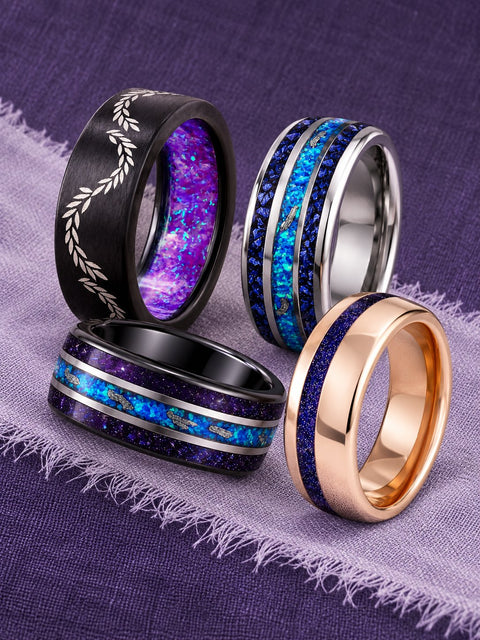
Because goldstone is opaque, most of the trade cuts it as cabochons and beads. We facet it, in emerald, pear, kite, round, hexagon and coffin cuts, which multiplies the angles that catch the copper. Starry Night® centers are set in sterling silver with a rhodium finish, in a black ruthenium finish, in 14K rose or yellow gold vermeil and in solid gold, with accents that range from simulated diamonds to amethyst, sapphire, black onyx and opal; each product page says which accents are natural, lab-created or simulated.
- Engagement and promise rings. Hidden halos, crescent-moon contour bands and the geometric kite cut Starry Night® rings, all within blue sandstone engagement rings. The same designs serve as promise rings.
- Men's bands. Crushed blue goldstone set in resin in a tungsten carbide channel, alone or beside meteorite fragments, gold or silver leaf, or tree, wolf and deer silhouettes: men's blue sandstone wedding bands, part of our wider inlay rings and meteorite bands.
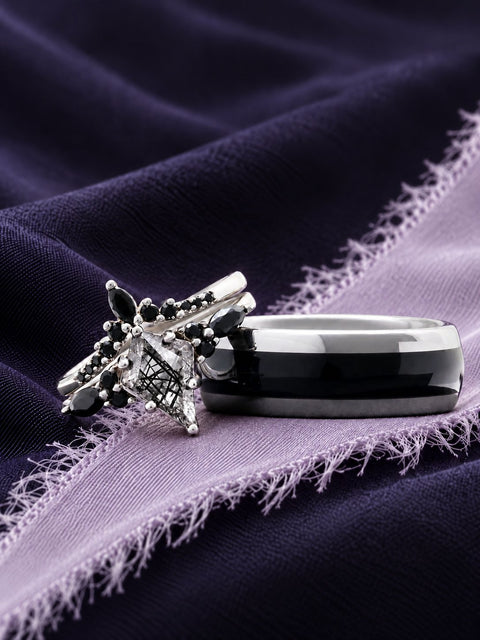
- Couples sets. Her faceted stone and his inlay band, bought together: Starry Night® couples rings, within the full range of couples rings.
- Necklaces and earrings. Crescent-moon and kite pendants and kite stud earrings, among our gemstone necklaces and gemstone earrings; see the celestial earrings guide.
- Dark styling. In a blackened setting the blue deepens and the flecks read brighter, which is why it recurs in gothic engagement rings, Lovers of the Dark™ black engagement rings and men's black rings.

What to pair with blue goldstone. In jewelry the question is color, not energy. Violet amethyst sits beside it as a neighbor on the color wheel; white sapphire or simulated diamond accents frame it without competing; black onyx deepens it; opal sets flash against glitter; meteorite puts two sky stones on one hand. The stone also appears beside Herkimer diamond in our Skye Kite® galaxy couples sets, and the rest of the dark palette is in black gemstone jewelry and our black gemstones guide.

Blue Sandstone Jewelry
Starry Night® rings, bands, sets and pendants, handcrafted in sterling silver, gold vermeil and solid gold.
Shop Blue Sandstone JewelryBuying Blue Goldstone: Price, Names and Red Flags
An inexpensive material. Pay for the metal and the making.
How expensive is blue goldstone? The glass is produced in quantity and is among the least costly center-stone materials in jewelry. The price of a finished piece is set by the metal, the accent stones and the handwork, not by the goldstone. A retailer charging rare-gem money for the stone itself, or describing it as rare, mined or natural, is misdescribing it.
- Names that mean goldstone. Blue sandstone, galaxy sandstone, aventurine glass, stellaria, monkstone, and the common but wrong "blue sunstone." Starry Night® is our registered name for the pieces that use it.
- Phrases to question. "Natural blue goldstone" (it does not exist); "raw blue goldstone crystal" (raw goldstone is unpolished glass broken from the block, not a crystal from the earth); any history involving monks.
- What to ask instead. Which metal and finish; whether accent stones are natural, lab-created or simulated; how an inlay is sealed; and what the care advice is.
- Fit and timing. Ready-to-ship pieces leave in 1–4 business days; solid gold and platinum are made to order in 3–6 weeks. Use the ring size guide, and remember that a free one-time size exchange is included. Engraving is available on most bands.
If the look appeals but you want a mined stone, see gemstone engagement rings in sapphire or lapis, our guides to non-traditional engagement rings and alternative engagement rings, and unique men's wedding bands for him.
Sources for the history and chemistry in this guide: Laurent Cormier, "Synthetic (Goldstone) and Natural Aventurine – A Review," Glass Europe 3 (2025), and GIA's sunstone description for the natural comparison.
Blue Goldstone Meaning FAQ
Is blue goldstone a real stone, or is it man-made?
What is the difference between blue goldstone and blue sandstone?
What does blue goldstone mean?
What are the benefits of wearing blue goldstone or blue sandstone?
What does goldstone do spiritually?
What should you pair with blue goldstone?
How expensive is blue goldstone?
Is blue goldstone good for an engagement ring you wear every day?
How do you clean blue goldstone?
What is the spiritual meaning of sandstone?
A Night Sky, Handcrafted
Starry Night® blue goldstone in sterling silver with a rhodium finish, 14K gold vermeil and solid gold, with matching tungsten bands for him. Free US shipping, a free one-time size exchange, engraving available and 30-day returns.
Shop Blue Sandstone Jewelry


