




Men's Blue Sandstone Wedding Bands
Early access · 40% off men’s wedding bands for subscribers · Get early access


Northern Lights Pines Blue Sandstone Men's Tungsten Band 8mm


 +1
$219
- Unit price
- per
Early access open for subscribers


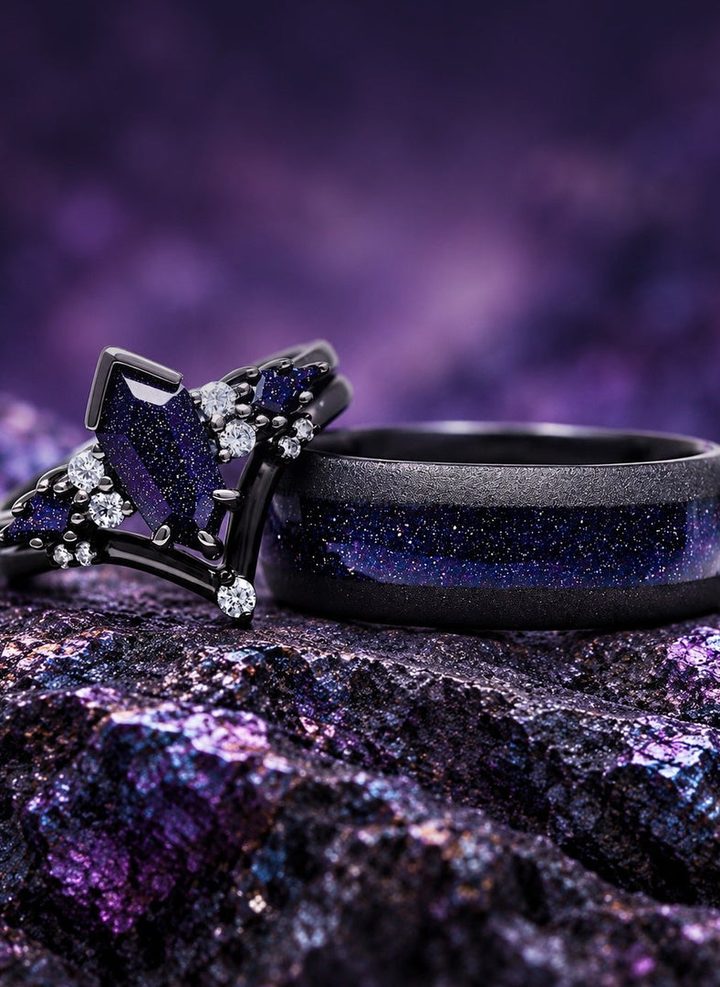


This collection brings together 30 men's wedding bands built around a deep midnight-blue sandstone inlay, most of them set into tungsten carbide in black, silver, rose gold, and yellow gold tones, alongside 925 sterling silver and solid 14K white gold.
Why Men Choose Blue Sandstone Wedding Bands
1. Engineering-grade durability
Tungsten carbide is harder than every plain gold or silver band on the market. Titanium is significantly lighter while staying durable. Both materials protect the blue sandstone inlay through impact, scratching, and chemical exposure that destroys conventional metal bands.
2. Distinctive without being decorative
The deep blue inlay does the aesthetic work. You don't need engraving, accent stones, or decorative metalwork to make this band look deliberate. The material itself is the statement.
3. Same audience as our meteorite men's wedding bands
If you appreciate the alternative-bridal aesthetic that drives meteorite men's wedding bands, blue sandstone hits the same register through a different material.
For complete background on the stone, see our blue sandstone jewelry collection.
Pick Your Base Metal
Tungsten carbide
the hardest commonly available wedding band material. Mohs 8.5-9 hardness. Holds polish indefinitely. Survives impacts that destroy gold or silver bands.
Titanium
significantly lighter than tungsten (about 60% lighter for the same band size). Hypoallergenic, well-suited to metal sensitivities. Mohs 6 hardness — softer than tungsten but still very durable.
Damascus steel
combines the dramatic layered pattern of historic Damascus forging with the durability of modern steel construction. The most visually distinctive base metal option.
For broader men's wedding band options across all materials, see men's wedding bands, men's solid gold wedding bands, and men's rings.
Pick Your Band Style
Single center inlay — one continuous strip of blue sandstone running around the center of the band. The most popular configuration and the most versatile.
Off-center inlay — blue sandstone positioned closer to one edge for a more asymmetric modern aesthetic.
Multi-strip inlay — two or more parallel blue sandstone strips with base metal between, perfect for wider bands where the pattern has room to read clearly.
Beveled inlay — angled inlay surface that catches additional light angles as you move your hand.
Hammered base metal — textured tungsten or titanium with smooth blue sandstone inlay. The textural contrast is dramatic.
Brushed finish — matte base metal that makes the blue inlay the visual focal point.
Pick Your Width
6mm — most popular middle width. Substantial without being aggressive. Suits most hand sizes.
7-8mm — the most common width for blue sandstone men's bands specifically. The inlay reads most dramatically at this width.
9-10mm — statement-width territory. Maximum visual presence.
Below 6mm, the inlay narrows too much to display properly. Above 10mm, you're moving into fashion-band territory.
Pairing with Your Partner's Wedding Band
Most couples coordinate blue sandstone across both partners' wedding bands while choosing distinct widths and base metals. Her band (our blue sandstone wedding bands collection) features narrower widths, sterling silver and gold base metals, and accent or eternity configurations. Your band features wider widths, tungsten or titanium base metals, and inlay configurations. The blue sandstone material is the visual link.
For broader couples coordination, couples engagement ring sets and wedding ring sets for women.
Men's Blue Sandstone Wedding Bands FAQs
“Stunning ring. I wanted something that tied the design of his engagement ring to his wedding band.”
“The ring is perfect! It looks exactly like the photo.”
“The ring looked so beautiful! The pictures online don't do it justice.”
“It is stunning and very comfortable on the hand as well.”