


Rutilated Quartz Meaning, Properties, Colors and Value
What rutilated quartz is, why its needles are golden, red, silver or black, how it differs from tourmalinated quartz, what the old names mean, and how it wears.

Rutilated quartz is clear or smoky quartz (SiO2) shot through with needle-shaped crystals of rutile (TiO2). The needles are usually golden, sometimes red, copper, silvery gray or green; black needle stones are more often tourmalinated quartz. Modern crystal practice reads it as a stone of clarity and energy, and its older names, Venus' hair stone and flèches d'amour, are romantic rather than mystical. It rates 7 on the Mohs scale.
Rutilated Quartz at a Glance
- What it is: quartz (silicon dioxide) enclosing needles of rutile (titanium dioxide) that crystallized before the quartz grew around them.
- Needle colors: golden is typical; reddish brown, copper, green and silvery gray occur. Black needles are usually schorl tourmaline.
- Traditional meaning: clarity, energy and focus in modern crystal practice. Venus' hair stone and flèches d'amour are nineteenth-century collectors' names.
- Hardness: 7 for the quartz, 6 to 6.5 for the rutile; no cleavage.
- Sources: Brazil (Bahia, Minas Gerais) and Madagascar today; historic finds in Switzerland and the eastern United States.
- Care: warm, soapy water and a soft brush. No steam; skip the ultrasonic cleaner.
What Rutilated Quartz Is
Two minerals in one stone: a quartz host, and the needles that grew before it.
Rutilated quartz is quartz (silicon dioxide, SiO2) that encloses needle-shaped crystals of rutile (titanium dioxide, TiO2). The quartz is usually colorless rock crystal or lightly smoky. The rutile runs through it as single hairs, straight rods, tangled mats or radiating sprays. Mineralogists call that needle habit acicular.
The needles came first. Rutile is a common accessory mineral of high-temperature igneous and metamorphic rocks, and in rutilated quartz it crystallized before its host; gemologists call such an inclusion protogenetic. The quartz then grew around the rutile and sealed it in. Rutile's very high refractive index and adamantine luster make even hair-thin needles read as bright metallic threads. Rutile itself is an ore of titanium, neither rare nor precious; what makes rutilated quartz collectible is the accident of arrangement.
- Host. Quartz: Mohs 7, specific gravity 2.65, refractive index 1.544 to 1.553, no usable cleavage, conchoidal fracture.
- Inclusion. Rutile: Mohs 6 to 6.5, refractive index about 2.6 to 2.9. Reddish brown to red in hand, red to pale yellow in thin transmitted light, black when rich in niobium and tantalum.
- Other names. Rutile quartz, golden rutilated quartz, Venus' hair stone, flèches d'amour, sagenite. "Angel hair" is a retail name with no older source we could find.

Golden, Red, Copper, Silver and Green Needles
One mineral, several colors. The differences are chemistry and thickness.
GIA's Micro-World column states it plainly: rutile in quartz "typically occurs as golden needles, but it can occasionally be found as reddish brown, green, or silvery gray needles." George Frederick Kunz, cataloging North Carolina finds in 1890, listed the rutile as "usually brown, red, golden, and black."
Rutile in hand is reddish brown to red; first described by Abraham Gottlob Werner in 1803, it is named from the Latin rutilus, red. The Handbook of Mineralogy adds that the mineral is opaque in mass but transparent in thin fragments, where it transmits red to brownish red or pale yellow, and that it turns black when it carries much niobium and tantalum. Fine needles are the pale yellow case and read as gold; thick ones stay red to copper.
- Golden. The classic form, and what the trade means by "rutile quartz" with no qualifier. Dense bright gold in water-clear quartz is the most sought-after material, and its best-known source today is Bahia, Brazil.
- Red and copper. Thicker or more deeply colored rutile, scarcer than gold. Kunz recorded Virginia quartz "containing acicular rutile of a rich red color."
- Silver. Genuine: GIA reported a pocket in El Dorado County, California, that yielded more than 1,000 quartz crystals, nearly half holding "silvery gray tufts" of rutile confirmed by Raman spectroscopy.
- Green. GIA lists green as an occasional rutile color, but most green needle quartz is another mineral. Kunz described Rhode Island's "Thetis' hair stone" as quartz "so completely filled with acicular crystals of green actinolite as to make it quite opaque."
Black Rutilated Quartz vs Tourmalinated Quartz
Black needles in clear quartz are sold under both names. They are usually not the same mineral.
Tourmalinated quartz is quartz that encloses needles of tourmaline, almost always schorl, the black iron-rich species that makes up 95 percent or more of all tourmaline in nature. Schorl rates 7 to 7.5 on the Mohs scale and grows as elongated prisms with a triangular cross section and striated faces. GIA notes tourmaline inclusions in pegmatite minerals, quartz among them.
Black rutile exists. Kunz described jet-black rutile from the Pike's Peak region and cut black rutile from Alexander County, North Carolina, "more closely approaching the black diamond in appearance than any other gem," and the Handbook of Mineralogy gives the cause: rutile is black when rich in niobium and tantalum. So a black needle can be rutile, but the odds favor tourmaline: schorl is the ordinary black needle mineral in quartz, black rutile a chemical special case. Read an untested stone as black needle quartz, whatever the tag says.
How to tell them apart
- Luster. Rutile is adamantine to submetallic and shows white, yellow or red internal reflections where a needle catches the light. Schorl stays flat black.
- Shape. Rutile forms slender hairs and rods, sometimes meeting in elbow-shaped or net-like twins. Tourmaline prisms are usually thicker, with a triangular cross section and lengthwise striations where one breaks the surface.
- Certainty. Only a laboratory settles it. GIA identifies needle inclusions by Raman spectroscopy; a loupe gives a good guess, not a verdict.
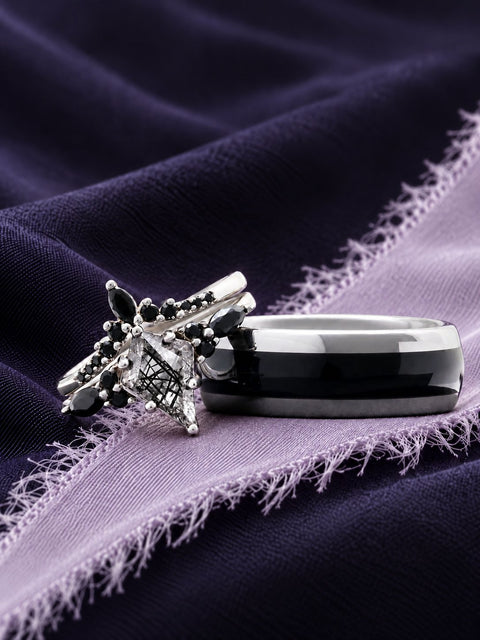
At Aquamarise, the rutilated quartz we set is the black needle kind: natural quartz, clear to lightly smoky, crossed by fine dark needles, in kite, hexagon, coffin, pear, oval, emerald and princess cuts. For the wider family of dark stones, read our black gemstones guide and black onyx meaning, or browse black gemstone jewelry.

Rutilated Quartz Meaning and Symbolism
The names are old. The healing lore is recent.
What the record supports. The romantic names are at least nineteenth-century. In 1890 Kunz captioned a heart-shaped North Carolina stone "Rutile in Quartz (Venus' hair-stone, Fleche d'Amour, Sagenite)." Flèches d'amour, arrows of love, was the collectors' name for the rutile-pierced quartz of Graubünden, Switzerland. Sagenite is older: Horace Bénédict de Saussure coined it in 1796, from sagena, a net, for rutile twinned into net-like meshes, and by Kunz's time it covered any quartz "penetrated with acicular crystals of other minerals."
What it does not support. Pages that rank for this stone say the Romans called it Venus' hair, the Greeks Aphrodite's hair and the Vikings a gift of Freya; none cites a source, and we could find none. Kunz's 1913 Curious Lore of Precious Stones, a standard survey of gem folklore, gives rutilated quartz no entry; its only appearance is a photograph of a Madagascar crystal ball "penetrated by crystals of rutile." Until an older text turns up, rutilated quartz carries no documented ancient lore. Our history of gemstone symbolism covers the stones that do.
Modern crystal practice. Contemporary crystal handbooks link rutilated quartz to illumination, clarity of thought, energy, focus and the amplifying of intention. Black needle stones are read as grounding or protective, borrowing black tourmaline's reputation. These are beliefs, reported as such. No gemstone has a measured effect on mood, luck, health or wealth.
What it can honestly stand for. The needles formed first and the quartz grew around them, so every stone holds something that was already there, intact, in something clear, and no two are alike. Those are facts, and reason enough. Couples drawn to that often also look at moss agate, another quartz with a story in its inclusions.
Birthstone and zodiac. Rutilated quartz is on no birthstone list, old or new. The quartz varieties that are include amethyst for February and citrine for November; see amethyst meaning, citrine meaning and amethyst engagement rings. Zodiac assignments on crystal sites are recent and disagree with one another.
Where Rutilated Quartz Comes From
Brazil above all, then Madagascar, with historic finds in the Alps and the eastern United States.
Brazil. The Handbook of Mineralogy records quartz "in large amounts" from Minas Gerais, Bahia and two other states, and lists Ibitiara in Bahia among the world's localities for fine rutile. Most golden rutilated quartz sold today is Brazilian, from Bahia and Minas Gerais. Madagascar has long produced quartz, and the rutile-shot crystal ball Kunz photographed in 1913 shows its material was already reaching collectors then. Switzerland's Graubünden gave the trade its flèches d'amour and remains a classic rutile locality.
United States. Kunz's 1890 survey lists a pocket cut in 1848 by the Central Vermont Railroad at Waterbury, "rutilated quartz of unexcelled beauty" from five North Carolina counties, 1888 Stony Point crystals "filled with rutile the thickness of a pin," and red rutile in quartz from Virginia. GIA's 2017 report adds El Dorado County, California, for the silvery kind.
Star rutile
The most prized arrangement is not a tangle but a star. GIA describes a stone in which "acicular crystals of rutile formed around a hematite core as a protogenetic mineral to the quartz host," with "a large quantity of rutile needles" radiating outward "to form a six-rayed 'star' inclusion." Stars are prized by collectors and rarely seen in ring stones.

Is Rutilated Quartz Rare or Expensive?
The material is common. Fine pieces are not.
Quartz makes up about 12 percent of the Earth's lithosphere by mass, second only to the feldspars, and rutile is a common accessory mineral. Rutilated quartz is therefore not rare, and ordinary grades are among the more affordable natural gems; the top of the market is another matter. Dense, bright gold needles in water-clear quartz, large stones that are clean apart from their needles, matched pairs and well-formed stars are all uncommon, and needles that reach the surface limit where a cutter can place facets, so clean large stones are costly to cut.
What sets the value
- Needle color and brightness. Vivid gold or red that flashes in the light outranks dull brown or gray.
- Density and arrangement. Enough needles to fill the stone without turning it opaque; sheaves, sprays and stars beat a tangle.
- Clarity of the host. Colorless or evenly smoky quartz with no milky clouds or fractures around the needles.
- Needles below the surface. Inclusions wholly inside the stone polish cleanly and wear better than needles that break the surface.
- Cut and size. A broad table that frames the needles, clean symmetry, and size; large clean stones carry a premium out of proportion to their weight.
Real or fake
GIA calls manufactured glass "an age-old gem imitation that is still used today," and assembled stones, pieces glued or fused into one, are another route. Three checks catch most of them. Natural needles vary in thickness, cross at random angles and sometimes reach the surface; manufactured fibers are uniform. A join in an assembled stone shows as a flat plane from the side. And quartz has a refractive index of 1.544 to 1.553, which a refractometer reads in seconds, while Raman spectroscopy identifies the needles themselves. We know of no commercial synthetic rutilated quartz.
Hardness, Durability and How to Clean It
A 7 with a caveat: the needles.
Quartz is the mineral that defines 7 on the Mohs scale. GIA rates quartz gems such as citrine and amethyst as having good toughness and suitable for all jewelry types, rings included, "as long as the wearer understands its limited hardness." The limit is dust: household dust and sand are mostly quartz, so a quartz ring worn for years picks up fine scratches a sapphire would not. With no cleavage, a hard knock chips it rather than splitting it.
Rutilated quartz adds one consideration. Rutile is softer than its host at 6 to 6.5, and the boundary between needle and quartz is a line of weakness. Where a needle breaks the surface it polishes a little lower than the quartz around it, can catch a fingernail, and is the likeliest place for a chip to start. Stones with their needles fully enclosed wear like plain quartz; stones bristling with surface needles want a protective setting and gentler treatment.

Abrupt temperature changes can fracture quartz, and GIA advises against subjecting it to heat, which rules out steam cleaners. GIA calls ultrasonic cleaners usually safe for citrine and amethyst unless a stone is dyed or fracture-filled, and its ultrasonic guide warns against them for gems with filled surface-reaching breaks; a stone full of surface-reaching needles is a close cousin of that case, so skip the ultrasonic.
- Take it off for hard work. Weights, gardening, anything with grit or impact.
- Clean with warm, soapy water. A soft brush around the prongs or bezel, a rinse, and a dry with a lint-free cloth. No steam, no ultrasonic, no harsh chemicals.
- Check the setting twice a year. A loose prong on a surface-needled stone is how chips happen.
- Store it apart. Quartz scratches softer stones and is scratched by sapphire, moissanite and diamond.
Setting care follows the metal: see how to clean sterling silver, what gold vermeil is, our jewelry care page and the guide to caring for an engagement ring.
Rutilated Quartz vs Tourmalinated, Herkimer, Moss Agate and Clear Quartz
Five stones that are all quartz, told apart by what grew inside them.
| Stone | What it is | The inclusion | Mohs | The look |
|---|---|---|---|---|
| Rutilated quartz | Quartz with rutile needles | Rutile, TiO2, Mohs 6–6.5 | 7 | Golden, red, copper or silvery metallic threads |
| Tourmalinated quartz | Quartz with tourmaline needles | Schorl, black tourmaline, Mohs 7–7.5 | 7 | Opaque black rods and hairs, no metallic flash |
| Herkimer diamond | Double-terminated quartz crystal from Herkimer County, New York; not a diamond | None by definition | 7 | Water-clear, glassy, sharp natural faces |
| Moss agate | Chalcedony, microcrystalline quartz, with branching inclusions | Manganese and iron oxides in fern-like dendrites | About 7 | Green or black "moss" in milky chalcedony; not a banded agate |
| Clear quartz | Rock crystal with no visible inclusions | None | 7 | Colorless and glassy |
Each included stone has its own guide: what a Herkimer diamond is, whether Herkimer rings are durable, moss agate meaning and the moss agate engagement ring guide.
Rutilated Quartz for a Ring or a Pendant
Fine for daily wear in the right setting. Safest where it is seen and not knocked.
For a ring, choose a stone whose needles are mostly enclosed and favor a bezel or a low prong setting that shields the girdle: see bezel-set engagement rings and our guide to setting types. Broad-tabled shapes show the needles best: browse kite cut and pear-shaped engagement rings. A pendant or earring meets almost nothing hard, so a stone with many surface needles is safest there; ours is currently set in rings, with other included stones in gemstone necklaces and gemstone earrings.

Our designs set the black needle stone with black onyx, black moissanite or white accents, in sterling silver with a rhodium finish, 14K rose gold vermeil, and solid 10K, 14K or 18K gold or platinum made to order; many come as two-piece sets with a matching band. Start with rutilated quartz engagement rings, then widen to black onyx engagement rings, gothic engagement rings, alternative engagement rings and nature-inspired engagement rings.

Rutilated Quartz Engagement Rings
Black needle quartz in kite, hexagon, coffin, pear and oval cuts, handcrafted in sterling silver, 14K rose gold vermeil and solid gold.
Shop Rutilated QuartzReady-to-ship pieces leave in 1–4 business days; solid gold and platinum are made to order in 3–6 weeks. A free one-time size exchange is included and engraving is available.
Sources for the gemology and history in this guide: GIA's Gems & Gemology Micro-World note on silvery rutile in quartz (Fall 2017), and George Frederick Kunz, Gems and Precious Stones of North America (1890), pages 107 to 126 and 192 to 193.
Rutilated Quartz FAQ
What is rutilated quartz?
What is the spiritual meaning of rutilated quartz?
What is rutilated quartz good for?
Why is rutilated quartz so expensive?
How rare is rutile quartz?
Is rutile quartz real or fake?
What is quartz with golden rutile called?
Who can wear golden rutilated quartz?
Is black rutilated quartz the same as tourmalinated quartz?
How do you clean rutilated quartz, and is an ultrasonic cleaner safe?
Needles No Other Stone Shares
Black needle rutilated quartz in kite, hexagon, coffin, pear and oval cuts, handcrafted in sterling silver with a rhodium finish, 14K rose gold vermeil and solid gold. Free US shipping, a free one-time size exchange, engraving available and 30-day returns.
Shop Rutilated Quartz Engagement Rings

