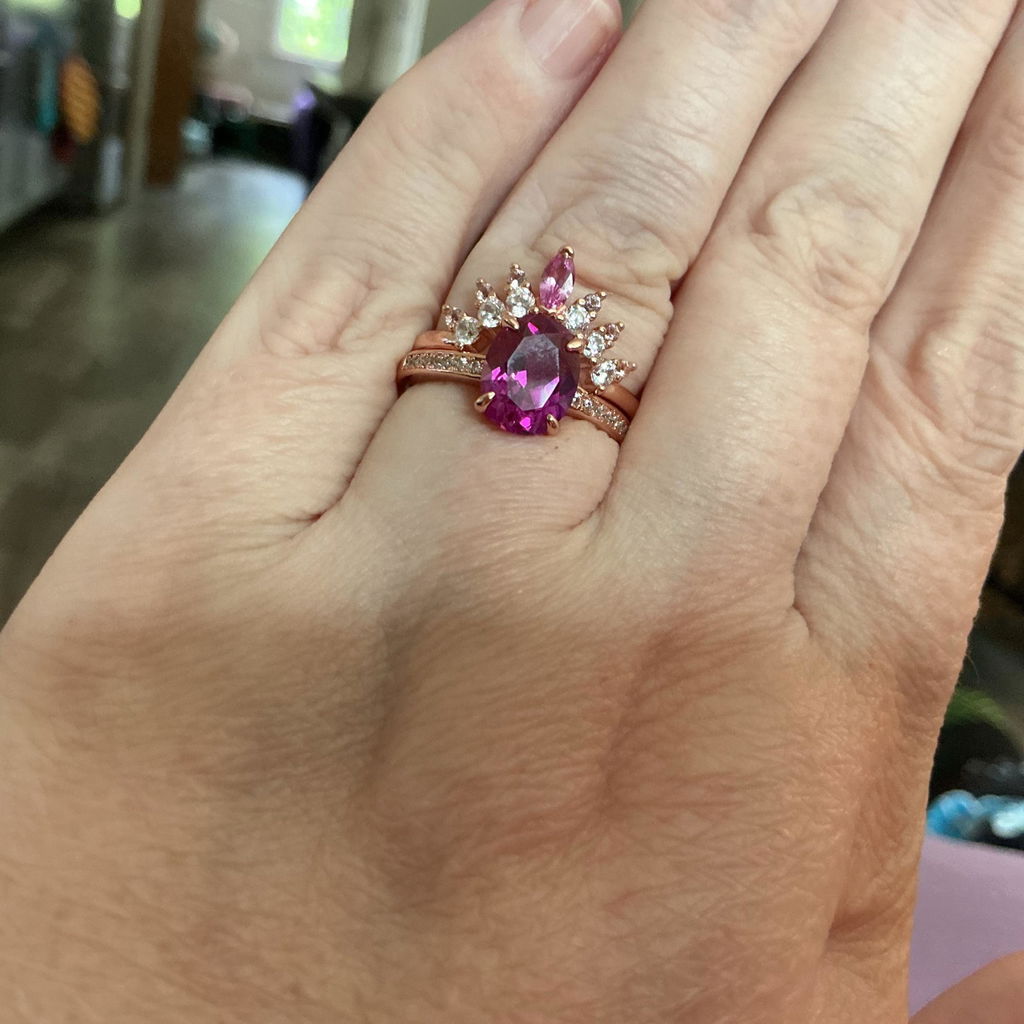
Color worn out loud. The Ava pink tourmaline engagement ring centers a vivid magenta-pink oval on a clean four-prong solitaire, with simulated-diamond pave gliding partway down each shoulder. Crafted in 14K rose gold vermeil over sterling silver 925, the warm blush metal deepens the stone’s saturated pink into a single, joyful glow — a ring for anyone who wants their forever piece to be unmistakably colorful.
Vivid magenta-pink tourmaline Oval cut · 7 × 9 mm Four-prong solitaire Simulated-diamond pave shoulders 14K rose gold vermeil Free velvet gift box
A color-forward solitaire
The design is intentionally minimal, so nothing competes with the stone. A single oval sits high in a four-prong claw setting, its compass-point prongs holding the gem securely while leaving the maximum face open to the light. Slim rows of pave taper down the shoulders and stop short of the back of the band, framing the center without tipping the silhouette into a halo or cluster. It is a clean, modern take on the classic solitaire — the kind of piece that reads as a bold statement among gemstone engagement rings and sits just as easily in a collection of unique engagement rings.
The magenta-pink tourmaline
The center is a lab-grown tourmaline — a genuine tourmaline created in controlled conditions, which is exactly what makes this intense, even color saturation possible at a friendly price. The tone sits between hot pink and magenta, in the vivid range the gem trade calls rubellite, and it reads as electric rather than pastel: bolder than pink sapphire, deeper than morganite. The oval cut spreads that saturated color across the full face of the stone while keeping it lively with light movement. At 7 × 9 mm it has real presence on the hand. If a joyful pop of color is the point, this stone delivers it in a way few pink gems can — a natural fit for the mood of our women’s engagement rings line.
Simulated-diamond pave shoulders
Small round simulated diamonds are bead-set into the shoulders, adding a crisp ribbon of sparkle on either side of the tourmaline. It is a bright, budget-friendly way to frame the center and lift the whole design, echoing the finish you’d expect from classic nature-inspired engagement rings without pulling focus from the color. Prefer moissanite or lab-grown diamond accents instead? Message us before ordering and we’ll tailor it.
14K rose gold vermeil
The band is 14K rose gold vermeil — real 14K rose gold over sterling silver 925. The warm, blush-pink metal is central to this ring’s color story: where a cool white metal would hold the stone at arm’s length, rose gold picks up and amplifies the magenta-pink, wrapping the whole design in one continuous warm tone. It is hypoallergenic and nickel-free, so it stays comfortable for everyday wear.
What pink tourmaline symbolizes
Pink tourmaline has long been tied to love, compassion and matters of the heart — fitting symbolism for a ring meant to mark a promise. It is also one of October’s birthstones and the traditional eighth-anniversary gem, so the piece carries built-in meaning for autumn birthdays and milestone celebrations. Not sure which stone is yours? Our guide to what is my birthstone helps you find out, and our history of gemstones shows where tourmaline sits among the world’s colored stones.
Specifications
- Ring type Engagement / promise / statement ring
- Center stone Lab-grown tourmaline (vivid magenta-pink)
- Cut & size Oval brilliant, 7 × 9 mm
- Hardness 7–7.5 on the Mohs scale
- Setting Four-prong claw solitaire
- Accents Simulated diamond (CZ) pave shoulders
- Metal 14K rose gold vermeil over sterling silver 925
- Band Comfort fit
- Properties Hypoallergenic · nickel-free
- Birthstone October (tourmaline)
- Sourcing Ethically sourced, conflict-free stones
- Included Free luxury velvet gift box
Aquamarise vermeil is real gold over sterling silver 925 — the rich, golden look you love, at a price that makes it easy to say yes. Keep it luminous with a little care: remove before showering, swimming, or exercise, avoid contact with lotions and fragrance, and store dry between wears. Want gold all the way through? The same design is also available in solid gold.
Sizing & care
The ring runs true to size in a comfort fit. If you’re unsure or between sizes, message us before ordering and we can send a complimentary ring sizer. Tourmaline suits daily wear with reasonable care: avoid hard knocks, harsh chemicals, ultrasonic and steam cleaners, and clean gently with warm water and a soft cloth. Store the ring on its own so the prongs and pave don’t catch on other pieces.
Frequently asked questions
Is the tourmaline real?
Yes. The center is a lab-grown tourmaline — a genuine tourmaline grown in controlled conditions rather than mined. That is what delivers the vivid, even magenta-pink saturation at an accessible price. It is not glass or a different material; it is real tourmaline in a bold pink tone.
What color is the stone?
A vivid magenta-pink that sits between hot pink and magenta, in the range the trade calls rubellite. It reads bold and saturated rather than pale or pastel, and the rose gold setting warms it further for one continuous pink glow.
How big is the center stone?
The oval measures 7 × 9 mm. The shape spreads the color across the full face of the stone and gently elongates the finger, giving the ring genuine presence on the hand.
Are the side stones real diamonds?
No — the pave shoulders are simulated diamond (cubic zirconia), chosen for bright, crisp sparkle that frames the tourmaline while keeping the ring affordable. If you’d prefer moissanite or lab-grown diamond accents, message us before ordering.
What is rose gold vermeil?
Rose gold vermeil is real gold over sterling silver 925 — here, 14K rose gold over a solid sterling base. You get the warm, golden rose-pink look at an easier price than a piece made of gold throughout. If you’d like gold all the way through, the same design is also available in solid gold.
Why rose gold rather than white or yellow?
Rose gold is part of this ring’s color story. The warm pink-gold metal amplifies the magenta-pink tourmaline for a unified, warm-toned piece, where white metal would cool the stone and yellow would compete with it. Prefer another shade of vermeil? Message us before ordering.
How durable is tourmaline for daily wear?
Tourmaline sits at 7–7.5 on the Mohs scale, comparable to many popular colored center stones and well suited to daily wear with reasonable care. The oval cut has no sharp points, making it one of the more resilient shapes for a colored-stone ring.
Is this a good October birthstone gift?
Beautifully so. Tourmaline is one of October’s two birthstones, and the joyful pink makes it a warm, personal choice for an autumn birthday, an anniversary, or any celebration that calls for color.
Can I wear it as an engagement or promise ring?
Absolutely. The substantial oval and clean solitaire setting give it the weight of a true commitment piece, for anyone who wants a bold, colorful alternative to a traditional white-diamond solitaire.
Will it stack with a wedding band?
Yes. The clean solitaire profile stacks neatly with a plain or pave band. Match in rose gold vermeil for a unified warm-toned stack, or contrast with a white-metal band for a two-tone look.
Is it hypoallergenic?
Yes. The 14K rose gold vermeil over sterling silver 925 is hypoallergenic and nickel-free, so it stays comfortable for sensitive skin and everyday wear.
Are the stones ethically sourced?
Yes. Our stones are ethically sourced and conflict-free, and the lab-grown tourmaline has no mining footprint, so you can wear it with complete peace of mind.
What’s included?
Every order ships in a free luxury velvet gift box with a care card — ready to gift or propose the moment it arrives.