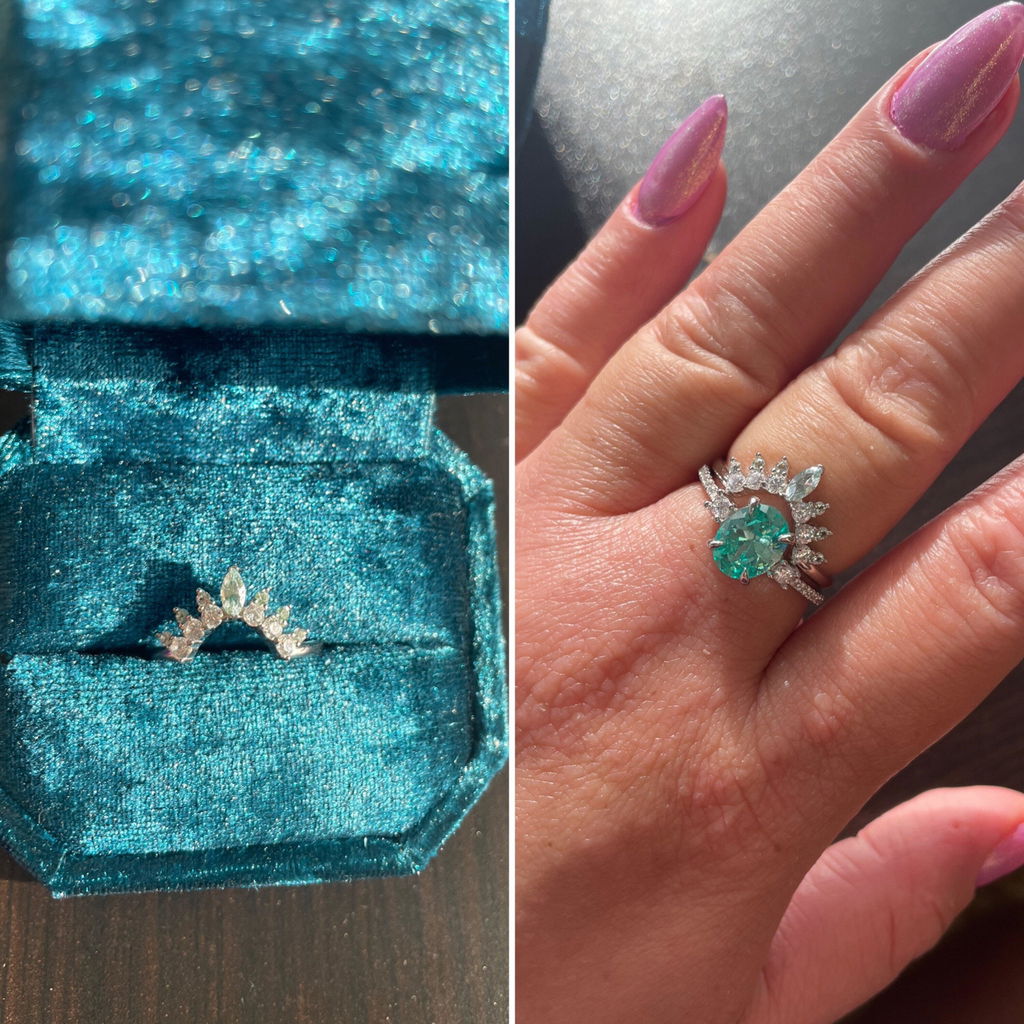
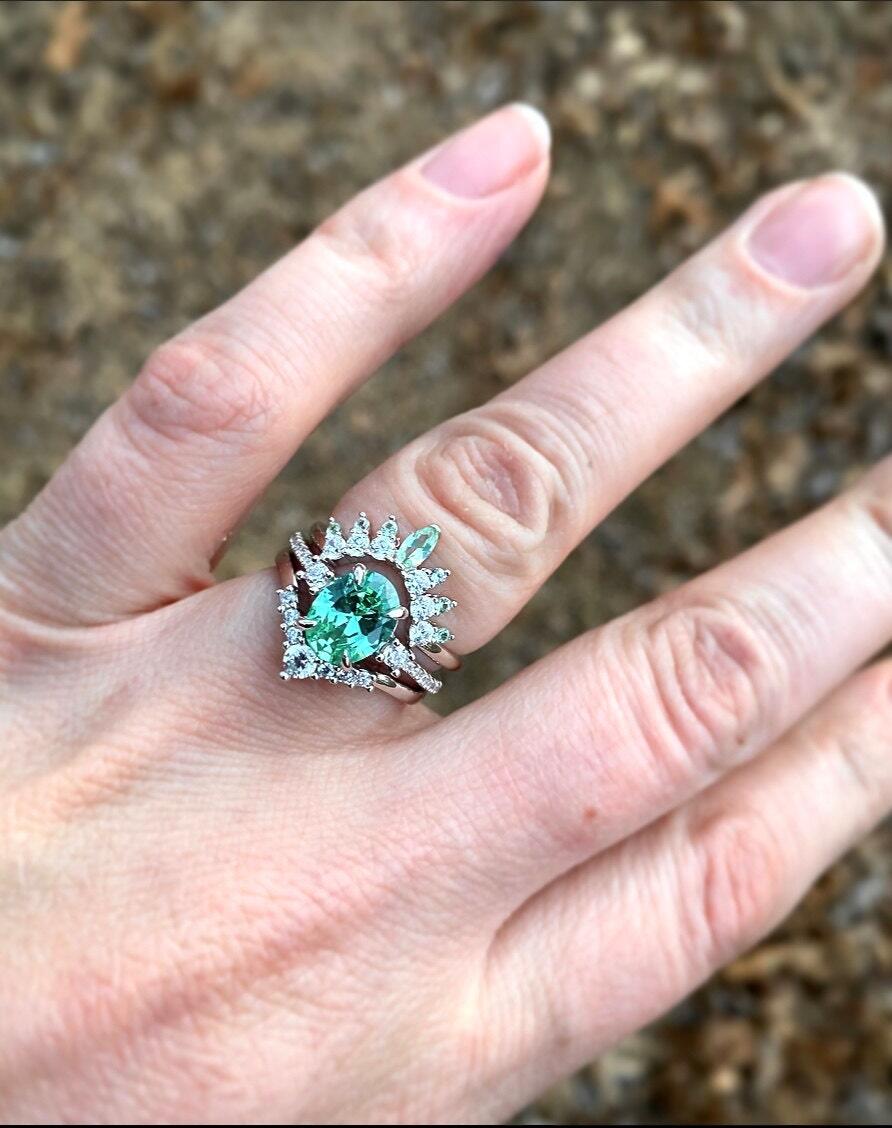
A curved wedding band built as a tiara — a marquise-cut lab-grown green sapphire at the apex, flanked by a graduated arc of round mint sapphires and CZ accents that sweep down each side in a V-shaped curve. The contour is designed to nest beneath an engagement ring, framing the center stone like a coronet sits beneath a portrait. Slim at 1.4mm, it reads as architectural rather than ornamental — equally at home as a wedding band, a curved anniversary ring, or a stacker.
Marquise Lab-Grown Green Sapphire Curved Contour Silhouette Tiara / Crown Design Chevron V-Shape 1.4mm · Comfort Fit Solid 925 Sterling Silver
About the curved wedding band silhouette
This band sits in a family that goes by many names — curved wedding band, contour wedding band, chevron band, V-shaped band, wishbone band, tiara band, crown band, nesting band. They all describe the same fundamental design: a ring with a deliberate curve, dip, or peak built into the silhouette so that it fits flush against the bottom edge of an engagement ring instead of sitting at a gap.
This particular version is the crown / tiara variant — an arched apex rises from the band with a marquise center stone at the peak, and the graduated accent stones sweep down each side in a V-shape (chevron) that nests over the engagement ring rather than under it. The result is unmistakably bridal: it frames the engagement ring's center stone from above like a coronet, rather than tucking under it like a contour band.
About the marquise green sapphire and accents
The marquise (or navette) cut at the apex is one of the most graceful stone shapes in jewelry — an elongated oval with pointed ends, set vertically here to emphasize the height of the tiara. The center stone is a lab-grown green sapphire in a soft, pale mint-seafoam tone. Around it, four small round lab-grown green sapphires curve down each side of the band — two per side — alternating with five round CZ accents that pick up the brightness.
The mint-green sapphire tone is what makes this band different from a standard white-stone contour. It's subtle enough to read as a near-neutral against most engagement ring center stones, but distinct enough to add a quiet color story to the stack — a deliberate departure from "matching diamonds all the way down."
About the lab-grown green sapphire
Lab-grown sapphire is genuine sapphire — same chemical composition (corundum, the same mineral as natural sapphire), same hardness (9 on the Mohs scale, second only to diamond), same optical properties. The only difference between lab-grown and natural sapphire is where the crystal grew: in a controlled laboratory environment rather than over millions of years in the earth. Lab-grown sapphire is the responsible choice for buyers who want a real, durable, genuine sapphire without the mining footprint or the price premium of natural origin.
Important distinction: lab-grown is not the same as simulated. A simulated sapphire (or simulated diamond) is a different stone entirely — usually cubic zirconia or glass — that just looks like the real thing. Lab-grown sapphire is the real thing, grown under controlled conditions.
About the accent stones (CZ)
The smaller round white accents on the band are simulated diamond (cubic zirconia, often called CZ) — chosen for their bright, clean white that picks up sparkle without competing with the mint sapphire. We're explicit about the distinction so you know exactly what you're buying: the four flanking round sapphires and the marquise apex are real lab-grown sapphire; the smaller round accents are CZ. If you'd prefer the same design with lab-grown diamond accents on a solid 14K gold version, message us before ordering — we can quote a custom upgrade.
How it pairs with an engagement ring
The engagement ring is sold separately. This band is designed to nest with a wide range of engagement ring styles:
-
Solitaire engagement rings — the tiara apex rises above and frames the solitaire center stone
-
Halo engagement rings — the curved chevron tucks just outside the halo, with the marquise apex pointing up the center
-
Pear or marquise-cut engagement rings — the marquise apex echoes the engagement ring's stone shape for a deliberately matched look
-
Cathedral settings — the curved silhouette fits around the cathedral arch without leaving a gap
It also works as a standalone band. Worn solo on the right hand, it reads as a statement curved ring. Stacked between two other bands, the chevron geometry breaks up flat stacks with a deliberate architectural note.
About the 925 sterling silver and rhodium finish
The band is solid 925 sterling silver — 92.5% pure silver throughout, not plated base metal. A rhodium finish over the silver gives it the bright white-gold-style luster you see in the photographs and adds scratch and tarnish resistance. Genuine sterling silver does not turn skin green; that reaction is associated with low-quality alloys, not real 925.
Specifications
-
Ring type: Curved wedding band / contour band / chevron band / tiara band / nesting band
-
Sold: Solo (engagement ring sold separately)
-
Apex stone: Marquise-cut lab-grown green sapphire (real sapphire, controlled origin)
-
Side accents: 4 round lab-grown green sapphires (2 per side, mint tone)
-
Additional accents: 5 round simulated diamond (CZ)
-
Setting: Prong-set apex stone, prong-set accents
-
Band width: 1.4 mm
-
Band profile: Comfort fit
-
Metal: Solid 925 sterling silver with rhodium finish
-
Properties: Nickel-free
-
Sapphire hardness: 9 (Mohs scale)
-
Origin: Ethically sourced — lab-grown sapphire requires no mining
-
Packaging: Free luxury velvet jewelry box with every order
-
Shipping: Free USA shipping
Sizing & care
The band is true to size and comfort-fit. If you stack rings, the comfort-fit profile tends to sit more naturally against an engagement ring than flat profiles. If you don't know your size, message us before ordering and we can send a complimentary ring sizer.
To care for the band, treat it like fine jewelry: remove before swimming, cleaning, gardening, weightlifting, or applying lotions and perfumes. Avoid impact on hard surfaces — the marquise apex is the most vulnerable part of the band because of its raised position. Clean with warm water and a soft brush; skip ultrasonic cleaners on the prong settings. A soft jewelry cloth keeps the rhodium finish bright.
Frequently asked questions
Are the green sapphires real?
Yes — the marquise apex stone and the four flanking round green stones are all genuine lab-grown sapphire. Lab-grown sapphire is real sapphire (same corundum mineral, same hardness, same optical properties as natural sapphire) — the only difference is that the crystal was grown under controlled laboratory conditions rather than mined from the earth. It is not a simulated stone.
What's the difference between lab-grown and simulated sapphire?
A simulated sapphire is a different stone entirely (usually cubic zirconia or glass) that just looks like sapphire. A lab-grown sapphire is sapphire — same chemistry, same hardness, same optics. The smaller round white accents on this band are simulated diamond (CZ); the green stones are genuine lab-grown sapphire.
What does "curved wedding band" mean?
A curved wedding band — also called contour band, chevron band, V-shaped band, wishbone band, tiara band, crown band, or nesting band — is a ring with a deliberate curve built into the silhouette so it fits flush against an engagement ring rather than sitting at a gap. This particular version is a tiara/crown variant, with an arched apex and graduated accents sweeping down each side.
Will this band fit my engagement ring?
The curved tiara silhouette is built to nest with most engagement ring shapes — solitaires, halo settings, pear- or marquise-center rings, and cathedral settings all work well. If your engagement ring has an unusually wide setting or a very specific shape, message us with a photo before ordering and we'll confirm fit.
Is it a wedding band, a stacker, or both?
Both. As a wedding band, it nests with the engagement ring as a deliberate pair. On its own, it reads as a statement curved ring suitable for the right hand. Stacked between two other bands, the chevron geometry breaks up flat stacks with an architectural note. Many customers wear it all three ways at different times.
Why mint/pale green sapphire instead of the deep teal you sometimes see?
Green sapphire occurs across a wide tonal range, from very pale mint-seafoam to deep teal-forest. The pale mint tone in this band was chosen deliberately for bridal pairing — it reads as a near-neutral against most engagement ring center stones, adding a quiet color story without competing for attention. Deeper green sapphire reads more dramatic and tends to stand alone better than it pairs.
Will sterling silver turn my finger green?
No. Genuine 925 sterling silver does not turn skin green. The band is solid sterling silver throughout, finished with rhodium for added brightness and tarnish resistance. Skin reactions are caused by low-quality base metals, not real 925.
What is rhodium finish?
Rhodium is a platinum-family metal applied over sterling silver as a thin finishing layer. It gives the band added scratch and tarnish resistance and preserves a bright white-metal tone that pairs especially well with white gold or platinum engagement rings.
Is this band comfort fit?
Yes. The interior of the band is rounded rather than flat, which lets it slide on and off more easily and feel less constricting during daily wear. Comfort-fit bands often feel about a half-size larger than flat-profile bands at the same nominal size.
How durable is sapphire for daily wear?
Sapphire sits at 9 on the Mohs hardness scale — second only to diamond, harder than any other commonly used gemstone. It's an excellent choice for a daily-wear ring. The marquise apex is the most vulnerable part of this band because of its raised position, so avoid impact on hard surfaces and remove the ring for activities that risk knocks.
Is the band nickel-free and safe for sensitive skin?
Yes. The band is nickel-free, suitable for sensitive skin.
Do you offer this band in solid 14K gold?
Yes — message us before ordering and we can quote a solid 14K white, yellow, or rose gold version of the same design with your choice of lab-grown green sapphire (this design) or lab-grown white sapphire, lab-grown diamond, or moissanite accents. Solid gold is recommended if you want a lifetime/heirloom piece.
Will this pair with a yellow gold or rose gold engagement ring?
Yes — mixed-metal stacks are very on-trend, and rhodium-finished silver next to yellow or rose gold creates a deliberate two-tone contrast common in modern bridal sets. If you'd prefer a metal-matched version, message us about a solid 14K gold custom build.
Are the stones ethically sourced?
Yes. The lab-grown sapphires are inherently ethical — no mining required, fully traceable origin. The CZ accents are also ethically sourced.
What's included in the box?
The ring, a free luxury velvet jewelry box, and a care card. Free USA shipping.