


Unique Men's Wedding Bands: Materials, Styles and How to Choose
Every material from gold and platinum to tungsten, Damascus steel and meteorite, the profiles and finishes that stand out, what bands really cost, and how to choose one you will actually want to wear every day.
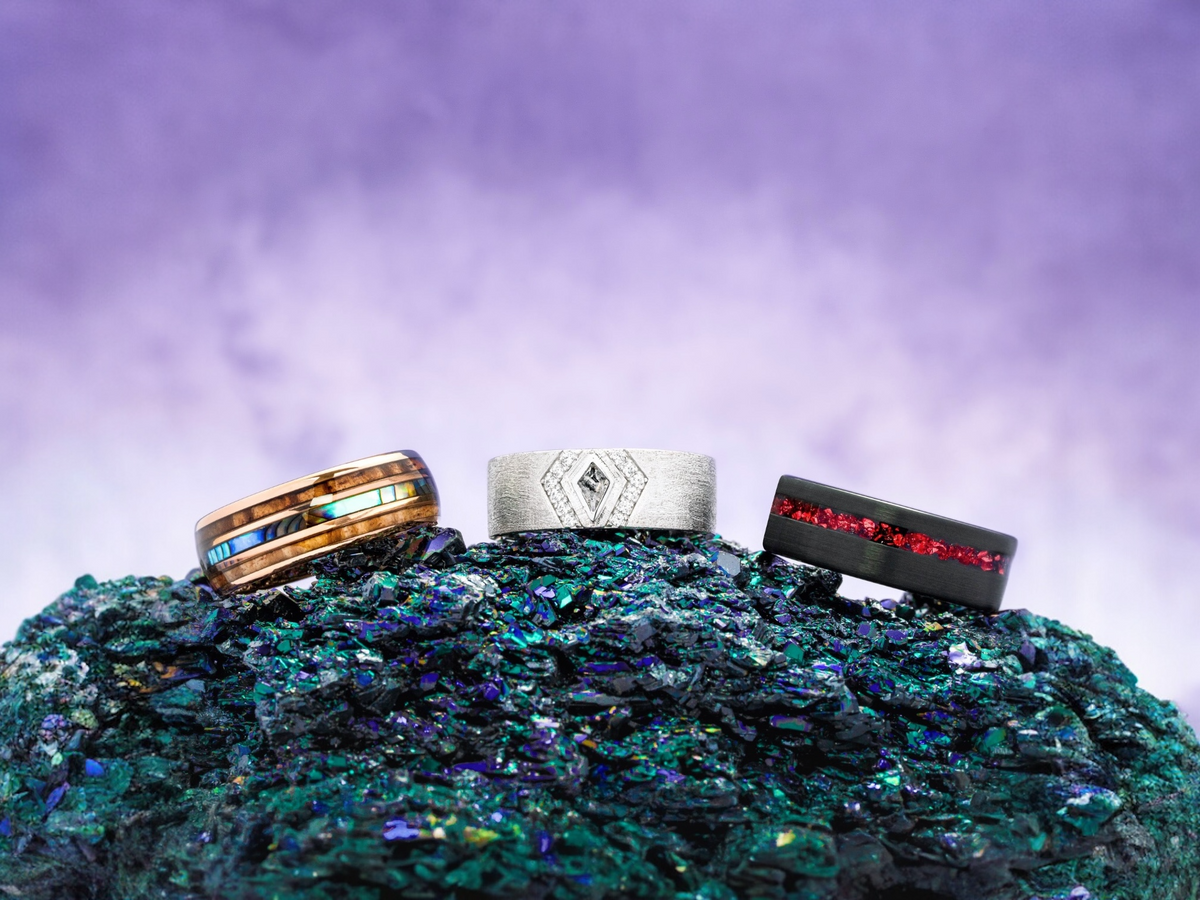
Men's wedding bands used to be an afterthought: a plain gold circle, simple, safe, and easy to forget. That has changed dramatically. Polaris Market Research valued the global men's jewelry market at $48.56 billion in 2024 and projects 9.9% annual growth through 2034. Today a man's band can be forged from layered Damascus steel, cut from a meteorite, inlaid with wood or crushed gemstones, or built from scratch around his story. This guide walks through the materials, styles, prices, and trends so you can choose a band you will love wearing for the rest of your life.
Unique Men's Bands at a Glance
- Hardest material: tungsten carbide, Mohs 8.5–9; the most scratch-resistant band you can buy.
- Most resizable: gold, platinum, palladium, and tantalum; tungsten, titanium, and cobalt cannot be resized.
- Most distinctive: Damascus steel, meteorite, and crushed-stone inlays; no two are alike.
- Typical spend: about $510 on average, with alternative metals from $100 and custom precious-metal work above $1,500.
- Custom timelines: solid gold and platinum are made to order in 3–6 weeks; custom tungsten takes about 3–8 weeks.
Precious Metals: Gold, Platinum and Palladium
The traditional choices, and why they still work.
Gold jewelry accounts for the largest share of industry revenue, and there is a reason: it has been the go-to for centuries and it still works. Your band's material shapes how the ring feels on your hand, how it holds up to your life, and whether you will actually want to wear it every day.
Yellow gold
Classic, warm, and timeless. Men's solid gold wedding bands come in 14k (more durable, better for everyday wear) and 18k (richer color, softer feel). It is the most traditional choice for men's gold rings, and it can be resized easily if your fingers change over time. A basic band typically runs $500 to $1,500: not cheap, but not outrageous either. Our karat comparison guide explains the difference between 10k, 14k, and 18k.
White gold
White gold is modern and sleek, with a silvery look that resembles platinum. It is finished with rhodium to reach that bright white, and the rhodium finish is refreshed every few years to keep it. White gold alloys often contain nickel, which can bother sensitive skin. If you love the look but not the upkeep, platinum may be the better choice.
Rose gold
That distinctive warm pink hue comes from copper alloyed with the gold. Rose gold flatters nearly every skin tone and feels unique without being loud, perfect for a man who wants something a little different but still rooted in tradition.
Platinum
Platinum is the heavyweight champion, literally: it is the densest precious metal used in jewelry, which gives it a substantial, luxurious feel. It scores 4–4.5 on the Mohs hardness scale and is naturally hypoallergenic. When platinum scratches, the metal displaces rather than being lost, so the ring develops a soft patina over time instead of wearing away. Some men love that lived-in look; others polish it back to a mirror shine.
Palladium
Think of palladium as platinum's lighter, more affordable cousin. It measures about 4.75–5 on the Mohs scale, a touch harder than platinum, and it is hypoallergenic, naturally white, and about half the weight. If you want the platinum look without the platinum price or heft, this is it. Compare all of them in our precious metal guide.
Alternative Metals: Tungsten, Titanium, Cobalt and Tantalum
Modern, durable, and budget-friendly; most cannot be resized.
If you live an active life or simply want a ring that laughs at scratches, alternative metals are where to look. The trade-off is that most of them cannot be resized, so sizing has to be right the first time.
Tungsten carbide
Tungsten rings are tough. Scrape one against concrete and it will barely show a mark, which is why mechanics, tradespeople, and anyone hard on their hands gravitate to them. Tungsten carbide rates 8.5–9 on the Mohs scale, second only to a handful of materials such as diamond. It has a heavier, substantial feel, comes in gray, black, and gunmetal finishes, and cannot be resized. Our tungsten wedding bands guide covers the honest pros and cons.
Titanium
Titanium rings feel like you are barely wearing anything. Some men love that; others prefer the weight of tungsten or gold. Titanium sits at Mohs 6, offers aerospace-grade strength at a featherlight weight, is hypoallergenic, and generally cannot be resized. See titanium vs tungsten for a head-to-head.
Cobalt chrome
Cobalt gives you the platinum look without the platinum price: a bright white finish, good scratch resistance, and low maintenance. Like tungsten and titanium, it cannot be resized.
Tantalum
Tantalum is rare among alternative metals because it can be resized. It is a dark grayish metal with a subtle, sophisticated finish, shatterproof and hypoallergenic. If you are not completely sure of your size, or think your fingers might change, tantalum offers flexibility the others do not.
Exotic and Inlay Materials
Where unique men's wedding bands get really interesting.
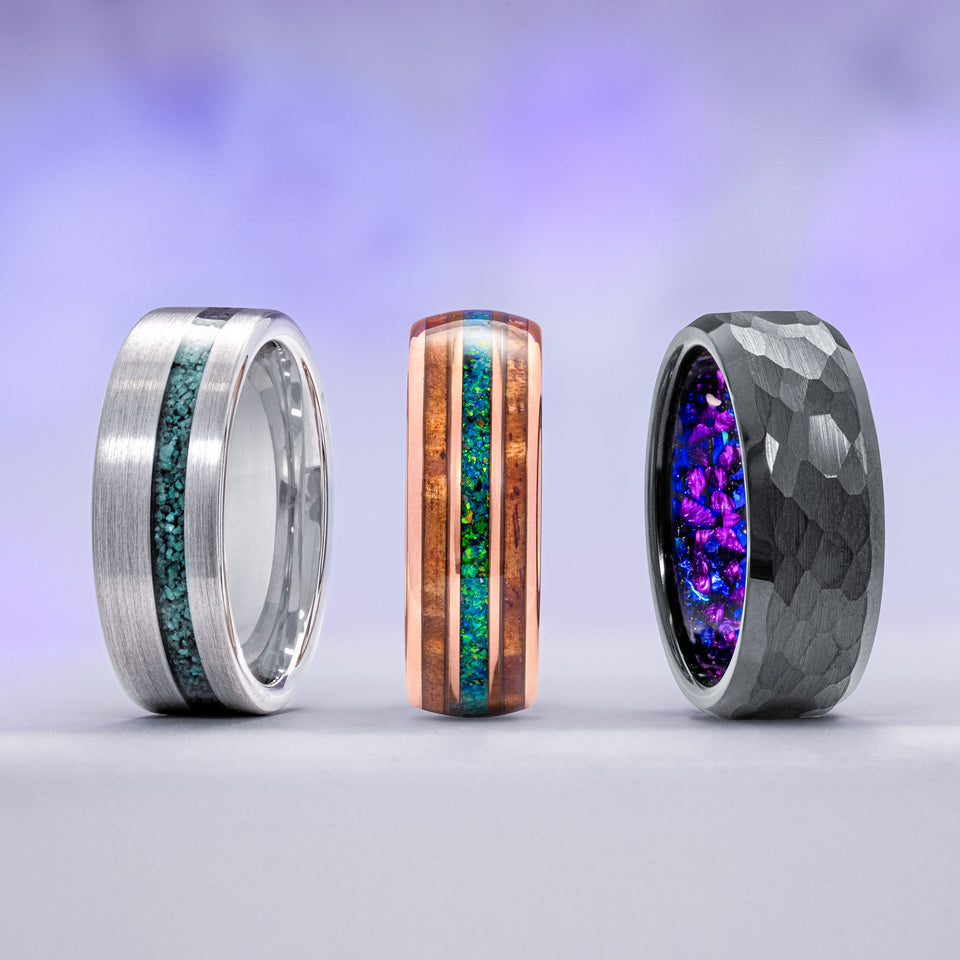
These materials do not just look different; they tell stories. A meteorite ring carries a piece of outer space. Damascus steel patterns never repeat. Crushed-stone inlays add color that feels personal rather than mass-produced.
Damascus steel
Damascus steel is not stamped out by a machine. Two types of steel are forged together, folded, hammered, and heat-treated until flowing wave patterns emerge across the surface, a technique that traces back to ancient bladesmithing traditions in the Middle East and South Asia. Line up a hundred Damascus steel rings and no two will match. Our Damascus steel rings guide explains the forging and the care.
Meteorite (Gibeon and Muonionalusta)
Meteorite bands show Widmanstätten patterns that formed as the iron cooled over millions of years in space. The geometric etchings are natural, ancient, and unrepeatable, because every fragment cooled differently. The one caveat: meteorite can oxidize with repeated moisture, so take it off before swimming or showering and store it dry. Read the full meteorite wedding bands guide.
Wood inlays
Wood adds an organic warmth metal alone cannot match. Popular choices include whiskey-barrel wood, reclaimed and full of character, along with ironwood and sustainable maple. Pairing whiskey barrel with a crushed gemstone creates a rugged-meets-refined look; browse men's inlay wedding rings to see the combinations.
Carbon fiber
Carbon fiber is the material of supercars and aerospace engineering, scaled down to ring size. It is often combined with metal for contrast: black carbon fiber with rose gold edges, or titanium bands with carbon fiber inlays. If your style leans minimalist or tech-forward, it feels futuristic without trying too hard.
Crushed stone inlays
Opal, turquoise, amethyst, moss agate, and aquamarine are crushed into fine pieces and inlaid into metal bands for vibrant pops of color. Demand is surging: the same younger buyers who have pushed lab-grown diamonds to 61% of US engagement ring center stones, per The Knot's 2025 data, are embracing colored-gemstone alternatives, including crushed-stone inlays, for men's bands.
Quick Material Comparison
How each material stacks up at a glance.
| Material | Mohs hardness | Resizable | Hypoallergenic | Weight feel |
|---|---|---|---|---|
| Gold | 2.5–3 | Yes | Usually | Medium |
| Platinum | 4–4.5 | Yes | Yes | Heavy |
| Palladium | 4.75–5 | Yes | Yes | Light |
| Tungsten carbide | 8.5–9 | No | Yes (nickel binder) | Heavy |
| Titanium | 6 | No | Yes | Ultra-light |
| Cobalt chrome | 5 | No | No | Medium |
| Tantalum | 6.5 | Yes | Yes | Medium-heavy |
| Damascus steel | 5.5–6.5 | No | Varies | Medium |
| Meteorite | 4–5 | No | Yes | Medium |
| Wood inlay | Varies | No | Yes | Light |
| Carbon fiber | 5–6 | No | Yes | Ultra-light |
| Crushed stone inlay | 5–6 | No | Yes | Medium |
The U.S. Geological Survey notes that tungsten carbide's hardness is what makes it the standard for cutting tools, which is exactly why it shrugs off the scratches that mark softer metals.
Band Shapes and Profiles
The cross-section is where classic becomes sculptural.
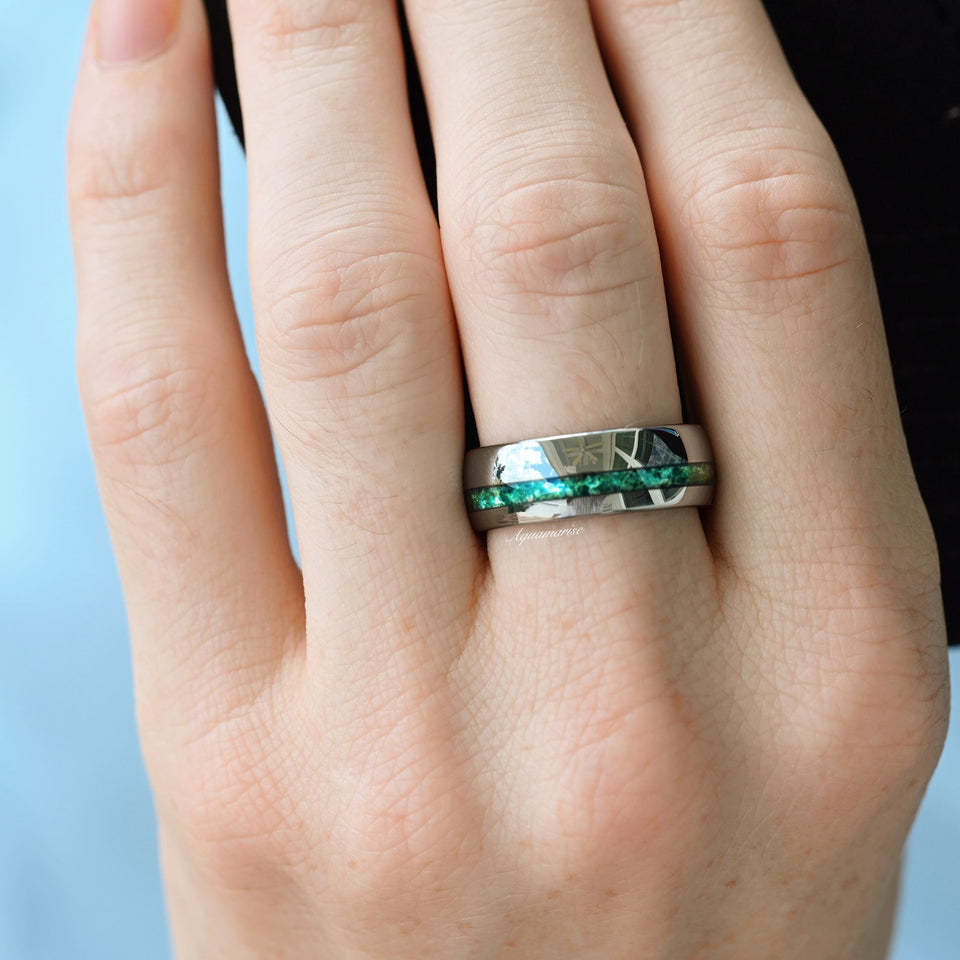
- Domed (D-shape): rounded exterior, flat interior. The most traditional choice: timeless, comfortable, quietly confident.
- Flat: straight top, crisp sides. Modern and clean; matte looks understated, polished looks dressy without being formal. See flat men's wedding bands.
- Beveled: angled edges that catch the light. A middle ground between domed and flat.
- Concave: an inward curve across the top. Sculptural and conversation-starting, for men who want their ring to feel like architecture.
- Knife edge: a pointed "V" exterior. Contemporary and distinctive; not for everyone, but those who choose it love it.
- Coin edge: a grooved rim like the edge of a coin, adding texture you can feel when you twist the ring.
Finishes and Textures
What your fingers touch and how the light hits it.
- High polish: mirror-like shine, classic and formal. Shows scratches more easily, so it may not age well if you are hard on your hands.
- Matte / satin: smooth but non-reflective. Modern, understated, and better at hiding daily wear; browse matte wedding bands.
- Brushed: directional texture from fine abrasion. Industrial-chic; looks like it has been through something, in a good way.
- Hammered: an organic dimpled texture with a handcrafted look. Ideal for men who work with their hands, because scratches blend into the design; see hammered men's wedding bands and our hammered bands guide.
- Sandblasted: a grainy, tactile surface that is rugged and intentional.
- Engraved / etched: Celtic knots, nature motifs, or personalized text. Surface detail that tells a story only you know; see engraved men's wedding bands.
Themed Designs: Nature, Celestial and Fantasy
Where a band stops being an accessory and becomes a statement.
- Nature-inspired: leaf motifs, wood grain, mountain silhouettes, and wave textures for the outdoorsman who wants his ring to reflect where he feels most alive. Browse nature-inspired men's wedding bands.
- Celestial: star-pattern inlays, galaxy-themed designs, and nebula-inspired stones such as the Orion Nebula collection, for couples who love stargazing or the idea that their love is written in the stars. The Starry Night rings feel cosmic without being over the top.
- Fantasy-themed: readers of fantasy fiction are driving demand for rings that evoke beloved fictional worlds. If you grew up on Tolkien or tabletop campaigns, explore fantasy-inspired men's wedding bands and ACOTAR-inspired designs with gothic details and mythological engravings.
- Dark and gothic: black finishes, skull and cross motifs, and blackened metals; see men's black rings and our guide to gothic rings for men.

Men's Wedding Bands
Tungsten, titanium, Damascus steel, meteorite, inlays, and solid gold, handcrafted and made to order.
Browse Men's BandsHow to Choose the Right Unique Men's Wedding Band
You know what you like. Now match it to your life.
Match your band to your lifestyle
- Desk job or minimal hand use? Any material works. Precious metals offer classic elegance that ages beautifully, and wider 6–8mm bands make a statement.
- Manual labor or trades? Tungsten or titanium for scratch resistance, with a hammered finish that hides wear. If you work with machinery or electrical systems, keep a silicone backup band for safety.
- Active or outdoors? Titanium is light and strong, so it will not weigh you down on long hikes or climbs. Avoid softer precious metals.
- Creative or fashion-forward? Damascus steel, meteorite, crushed-stone inlays, or mixed-material designs become conversation pieces. If your style leans bold, lean into it.
Getting the right fit: width, sizing and comfort
- Pick a width. Standard bands run 4–6mm; the current trend leans toward wider 6–8mm bands. Wider bands feel tighter, so size up a half size for 8mm and above. Our band width guide shows each width on the hand.
- Choose comfort fit for a rounded interior that slides over knuckles more easily; it is recommended for wider bands and for fingers that swell.
- Measure at the end of the day, when fingers are largest, and use a proper sizer rather than string. Aquamarise's ring size guide and ring size chart walk through it.
- Confirm before ordering a non-resizable metal. Tungsten, titanium, and cobalt cannot be resized, so the size you buy is the size you keep.
Should your wedding bands match?
Only if you want them to. Modern couples choose coordinated over identical, which makes sense because your hands and styles differ. Coordination that works: a shared metal tone, a matching inlay material, complementary engraving with a phrase split across both rings, or the same gemstone theme in different settings. Aquamarise couples ring sets feel connected without being clones; our guide to matching rings for couples has more.
How Much Do Men's Wedding Bands Cost?
From about $100 to $3,500 and up, depending on what you are buying.
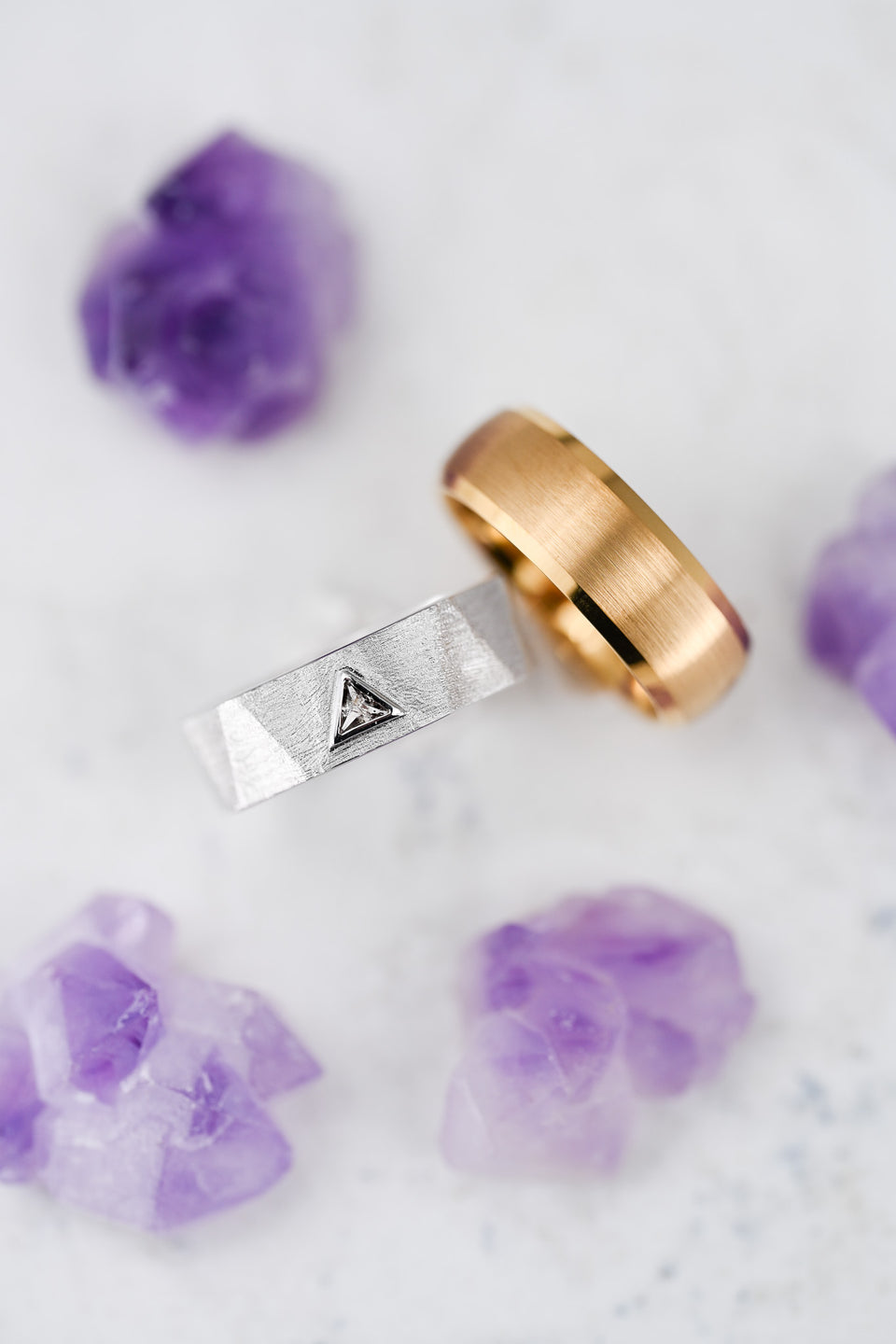
The average men's wedding band costs about $510, according to The Knot. Averages do not tell you much, though; what matters is what fits your budget and what you actually want to wear.
| Tier | Range | What you get |
|---|---|---|
| Budget-friendly | $100–$500 | Tungsten, titanium, carbon fiber, and most alternative-material bands; unique inlay bands average around $300 |
| Mid-range | $500–$1,500 | 14k–18k gold bands, Damascus steel with premium inlays, meteorite bands, diamond-accented alternative metals |
| Premium | $1,500–$3,500+ | Platinum, diamond pavé, fully custom handcrafted designs, solid gold with gemstone settings |
Choosing an affordable band is not settling: most US jewelry sales are non-luxury, and tungsten and titanium deliver scratch resistance and hypoallergenic comfort at prices that make sense. Within each tier, price is driven by material first, then width (more metal costs more), design complexity such as hand engraving and custom inlays, gemstones or diamonds, and personalization. Aquamarise's unique men's wedding bands span all three tiers, so whether your budget is $200 or $2,000 there is something that fits.
Men's Wedding Band Trends Right Now
Wider, more textured, more personal.
- Wider bands (6mm and up). Substantial, bold bands are replacing the thin, understated rings of previous decades. They feel intentional.
- Textured and hammered finishes. Smooth, polished bands are losing ground to organic textures that hide daily wear while adding handcrafted character.
- Diamond accents for men. Subtle diamond rows, bezel-set stones, and black diamond accents are showing up on men's bands for refinement without flash; see men's engagement rings.
- Mixed materials. Tungsten with wood inlays, titanium with carbon fiber edges, gold with meteorite inserts. Multi-dimensional bands feel custom even when they are not.
- Crushed stone and opal inlays. Colored stones are stepping into the spotlight for engagement rings, and the same energy is fueling opal, turquoise, amethyst, and sapphire inlays for men.
- Sculptural and geometric bands. Unexpected angles, hexagonal shapes, and architectural elements for men who appreciate clean lines and bold geometry.
- Sustainability and ethical sourcing. Recycled metals, conflict-free sourcing, and transparent supply chains are dealbreakers for younger buyers. Our guide to what makes jewelry ethical explains what to ask.
For the broader shift away from plain gold, read non-traditional men's wedding bands and why men wear wedding rings.
Caring for a Men's Wedding Band
Different materials, different rules.
| Material | Routine care | Avoid |
|---|---|---|
| Gold & platinum | Mild soap and warm water, dry with a soft cloth, polish periodically; have the rhodium finish on white gold refreshed every one to two years | Harsh chemicals; skipping the rhodium refresh leaves white gold looking dull |
| Tungsten & titanium | Wipe with a soft cloth; virtually maintenance-free and never need polishing | Harsh chemicals and ultrasonic cleaners on inlay bands |
| Damascus steel | Mild soap; a patina can develop and can be polished away later | Prolonged water exposure, showering, swimming |
| Meteorite | Store dry; some jewelers apply a protective coating to slow oxidation | Swimming, showering, washing dishes with it on |
| Wood inlay | Condition occasionally with a drop of mineral oil | Prolonged water exposure and extended handwashing |
The general rule for every band: remove it during heavy manual work, exposure to harsh chemicals, or extreme temperatures, and switch to a silicone backup when lifting or handling machinery. Our jewelry care guide covers each material in detail.
Personalizing Your Ring
Engraving, custom design, and build-your-own.
A ring becomes yours when it carries something only you know: a date engraved inside the band, a design built from scratch, or a combination of materials no one else has chosen.
- Engraving. Dates, initials, coordinates of where you met, phrases split across matching bands. Most jewelers, Aquamarise included, offer it as a standard service; see engraving options.
- Custom design. If you want a ring that does not exist anywhere else, say a Damascus steel band with a meteorite inlay and crushed turquoise accents, the process runs from consultation to a 3D rendering, revisions until it feels right, then production. Solid gold and platinum pieces are made to order in 3–6 weeks; a custom tungsten band takes about 3–8 weeks. If you have a wedding date, plan early.
- Build-your-own. Choose metal, inlay, finish, and width from a framework of options through build your custom ring, a middle ground between off-the-shelf and fully bespoke.
Keep reading: if you are also choosing a ring for a proposal, our guide to men's engagement rings covers the questions that come first, and black wedding band meaning explains the most-searched dark style.
Unique Men's Wedding Bands FAQ
What is the most durable metal for a men's wedding band?
How much should you spend on a men's wedding band?
Should men's wedding bands have diamonds?
Can men's tungsten wedding bands be resized?
What is the most unique material for a men's wedding band?
How long does a custom men's wedding band take?
Find a band that tells your story
From meteorite and Damascus steel to crushed-stone inlays and solid gold, every Aquamarise men's wedding band is handcrafted and made to order, with custom design available.
Shop Men's Wedding Bands


