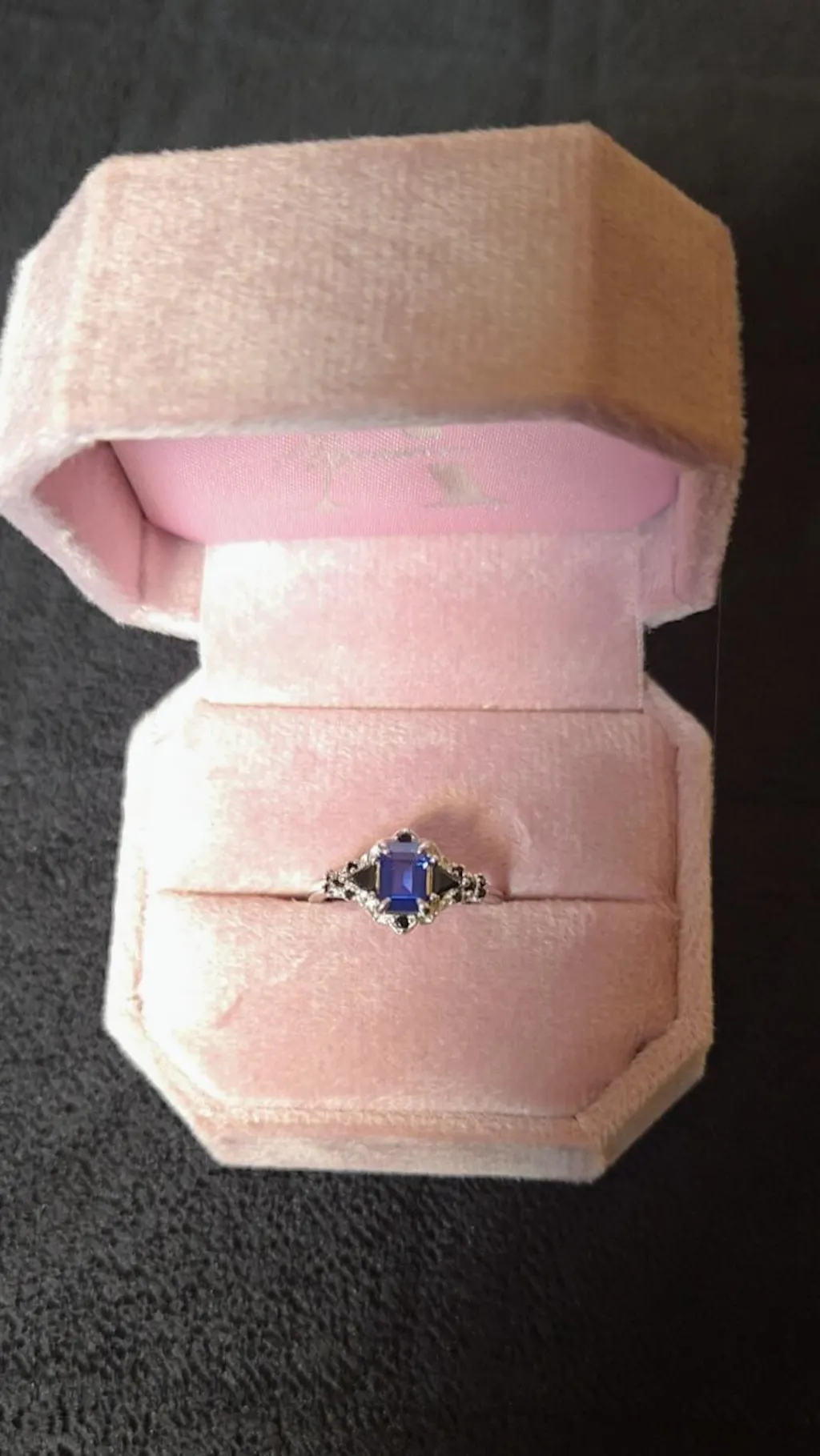
An emerald-cut blue sapphire engagement ring built on an art deco framework — a 1.4ct lab-grown blue sapphire at the center, flanked by two trillion-cut black onyx side stones, with black onyx clusters at each shoulder and round black onyx accents at the cardinal points. Set in solid 925 sterling silver with rhodium finish. Deeply saturated royal blue against true black gives the ring its signature gothic-bridal contrast — vintage in spirit, modern in execution.
Lab-Grown Blue Sapphire
Emerald Cut · 8×6mm · 1.4ct
Natural Black Onyx Accents
Art Deco Vintage Frame
Solid 925 Sterling Silver
September Birthstone
About the lab-grown blue sapphire
The center stone is a lab-grown blue sapphire — genuine sapphire (corundum, the same mineral as natural sapphire), with the same chemical composition, the same hardness of 9 on the Mohs scale, and the same optical properties. The only difference between lab-grown and mined sapphire is where the crystal grew: in a controlled laboratory environment over weeks instead of underground over millions of years. Lab-grown is the responsible choice for buyers who want a real, durable, genuine sapphire without the mining footprint or the cost premium of natural origin.
Important distinction: lab-grown is not the same as simulated. A simulated sapphire is a different stone entirely (usually cubic zirconia or glass) that just looks like the real thing. A lab-grown sapphire is sapphire — same chemistry, same hardness, same blue. The deep royal blue tone in this center stone is the classic "ceylon sapphire" shade — saturated, slightly velvety, with no green or gray undertone.
About the emerald cut
The emerald cut is a rectangular step cut with truncated corners — straight edges, parallel facets, no brilliance from faceting tricks. Cutters use it when the stone's color and clarity are the point and they don't want sparkle competing with them. For a sapphire of this saturation, that's exactly right: the deep royal blue reads cleanest in a long, open rectangle. At 8.0 × 6.0 mm and approximately 1.4 carats, the center stone reads substantially larger than a 1ct round on the finger because emerald cuts spread wider than they are deep.
About the natural black onyx accents
Surrounding the center stone is a deliberate arrangement of natural black onyx in multiple cuts:
-
Two trillion cuts at the 3 and 9 o'clock positions, flanking the center stone — pointed triangular shapes that mirror the angled corners of the emerald cut
-
Two round accents at the cardinal points (12 and 6 o'clock), each set within a small leaf-shaped silver bezel — the art deco lotus detail at the crown and base of the setting
-
Cluster of six round accents at the shoulders (three on each side), prong-set in graduated formation that flows from the center setting down toward the band
All onyx is genuine, naturally mined black onyx — not dyed, not simulated. The total black-stone count surrounding the center sapphire creates the distinctly gothic-bridal aesthetic this ring is built around: blue and black, no white-stone halo, no diamond pavé. The contrast is the point.
About the art deco framework
The setting is built on an art deco aesthetic — the 1920s style defined by geometry, symmetry, and small architectural details rather than decorative ornament. You see it in three places: the rectangular emerald cut as the centerpiece, the symmetrical placement of accent stones across the four cardinal points and shoulders, and the small leaf-shaped silver flourishes at the top and bottom of the head that read as fleur-de-lis or lotus details rather than freeform Victorian curves. The overall silhouette reads vintage without crossing into costume — modern enough to wear daily, period-correct enough to feel heirloom from the moment you put it on.
About the 925 sterling silver and rhodium finish
The ring is solid 925 sterling silver — 92.5% pure silver throughout, not plated base metal. A rhodium finish over the silver gives it the bright white-gold-style luster you see in the photographs and adds scratch and tarnish resistance. The white-metal tone is the right backdrop for both the royal blue and the deep black, letting the contrast read as cleanly as possible. Genuine sterling silver does not turn skin green; that reaction is associated with low-quality base metals, not real 925.
How to wear it
This ring was built as an engagement ring, but its versatility extends beyond that:
-
Engagement ring — a gothic-bridal alternative to the standard white-diamond solitaire, especially for buyers drawn to "something blue" with a darker edge
-
Promise ring — the substantial center stone and deliberate construction give it the weight of a serious commitment piece
-
September birthstone ring — sapphire is the traditional September birthstone, making this a natural anniversary or birthday piece for a September birthday or 5th/45th wedding anniversary
-
Right-hand statement ring — for buyers who already have an engagement ring but want a gothic-bridal piece for the right hand
For an engagement ring pairing, the ring stacks beautifully with a curved or chevron contour wedding band — the cardinal-point onyx accents at the base of the setting give the contour band a natural nesting line below the center stone.
Specifications
-
Ring type: Engagement ring / promise ring / September birthstone ring
-
Center stone: Lab-grown blue sapphire (genuine sapphire, lab-controlled origin)
-
Center stone cut: Emerald cut (rectangular step cut)
-
Center stone size: 8.0 × 6.0 mm (approx. 1.4 ct)
-
Center stone hardness: 9 (Mohs scale)
-
Center stone color: Deep royal blue (ceylon tone, no green or gray undertone)
-
Setting: Four double-prong claws on the center stone
-
Side accents: 2 trillion-cut natural black onyx (flanking center)
-
Cardinal accents: 2 round natural black onyx (12 and 6 o'clock, leaf-bezel setting)
-
Shoulder accents: 6 round natural black onyx (3 per side, prong-set cluster)
-
Total accent stones: 10 natural black onyx
-
Metal: Solid 925 sterling silver with rhodium finish
-
Audience: Women's engagement ring
-
Birthstone: September
-
Anniversary: 5th and 45th wedding anniversaries
-
Origin: Ethically sourced — lab-grown sapphire requires no mining, natural onyx ethically sourced and conflict-free
-
Packaging: Free luxury velvet jewelry box with every order
Sizing & care
True to size. If you don't know your size, message us before ordering and we can send a complimentary ring sizer.
For care, treat the ring like fine jewelry: remove before swimming, cleaning, gardening, weightlifting, or applying lotions and perfumes. Avoid impact on hard surfaces — the corners of the emerald cut are the most vulnerable part of the center stone, and the trillion cuts have pointed tips that can chip on a sharp knock. Clean with warm water and a soft brush; skip ultrasonic cleaners on the prong settings. A soft jewelry cloth keeps the rhodium finish bright and helps preserve the contrast between the polished metal, the royal blue sapphire, and the deep black onyx.
Frequently asked questions
Is the blue sapphire real?
Yes — it's a genuine lab-grown blue sapphire. Lab-grown sapphire is real sapphire (same corundum mineral, same hardness of 9 on the Mohs scale, same optical properties as natural sapphire) — the only difference is that the crystal was grown under controlled laboratory conditions rather than mined from the earth. It is not a simulated stone or a synthetic substitute. Lab-grown sapphire is the ethical choice and offers identical durability and beauty to natural origin.
What's the difference between lab-grown sapphire and simulated sapphire?
A simulated sapphire is a different stone entirely (usually cubic zirconia, glass, or spinel) that just looks like sapphire. A lab-grown sapphire is sapphire — same chemistry, same hardness, same optics, same color saturation. The two terms are sometimes used loosely in the industry, but they mean very different things. This ring uses real lab-grown sapphire for the center.
Are the black accent stones natural?
Yes. All ten black accent stones — two trillion cuts, two round cardinal accents, and six round shoulder cluster stones — are natural black onyx. Not simulated, not lab-grown. The onyx is naturally mined and ethically sourced.
Are the black accents black diamonds?
No — the black accents are natural black onyx, not black diamond. We're explicit about this so the listing is honest. Some competing listings mislabel onyx as "black diamond"; we don't. If you'd prefer the same design with real black diamond accents on a solid 14K gold version, message us before ordering and we can quote it.
How big is the center sapphire?
8.0 × 6.0 mm emerald cut, approximately 1.4 carats. Emerald cuts spread wider than they are deep, so the stone reads larger on the finger than a 1.4ct round brilliant would. The rectangular silhouette also visually elongates the finger.
How durable is sapphire for daily wear?
Sapphire is one of the most durable gemstones available — 9 on the Mohs hardness scale, second only to diamond, harder than any other commonly used colored gemstone. It's an excellent choice for a daily-wear engagement ring. The main caution is impact on the corners of the emerald cut, which can chip on a sharp knock, and the points of the trillion-cut onyx accents which are more vulnerable.
Will sterling silver turn my finger green?
No. Genuine 925 sterling silver does not turn skin green. The ring is solid sterling silver throughout, finished with rhodium for added brightness and tarnish resistance. Skin reactions are caused by low-quality base metals, not real 925.
What is rhodium finish?
Rhodium is a platinum-family metal applied over sterling silver as a thin finishing layer. It gives the band added scratch and tarnish resistance and preserves a bright white-metal tone — the right backdrop for the royal blue sapphire and deep black onyx contrast.
What does the art deco style mean here?
Art deco is a 1920s design aesthetic defined by geometry, symmetry, and small architectural detail rather than freeform ornament. You see it here in the rectangular emerald cut, the symmetrical placement of accent stones across the cardinal points and shoulders, and the small leaf-shaped silver flourishes that read as fleur-de-lis or lotus details. The result is vintage in spirit without crossing into costume.
Will this ring stack with a curved or contour wedding band?
Yes. The cardinal-point onyx accent at the base of the setting (6 o'clock) gives a curved or chevron contour band a natural nesting line below the center stone. Pair it with a curved wedding band in matching sterling silver with rhodium, or contrast it with a 14K rose gold or yellow gold contour band for a deliberate two-tone bridal stack.
Can I wear this as a promise ring or right-hand ring?
Absolutely. The 1.4ct center stone and deliberate gothic-bridal construction give the ring the weight of a serious commitment piece, but it also works as a statement right-hand ring for buyers who already have an engagement ring.
Is sapphire a meaningful engagement ring stone?
Very. Sapphires have been used in engagement rings for centuries, long predating the "diamond is forever" marketing era. Princess Diana's (and now Princess Catherine's) engagement ring is a blue sapphire, which has driven significant modern demand for sapphire engagement rings. Sapphire is traditionally associated with wisdom, loyalty, and faithfulness, which makes it a meaningful symbolic choice in addition to its visual beauty.
Do you offer this design in solid 14K gold?
Yes — message us before ordering and we can quote a solid 14K white, yellow, or rose gold version of the same design with lab-grown blue sapphire (or natural sapphire as an upgrade), and your choice of natural black onyx or real black diamond accents. Solid gold is recommended if you want a lifetime/heirloom piece.
Are the stones ethically sourced?
Yes. The lab-grown sapphire is inherently ethical — no mining required, fully traceable origin. The natural black onyx accents are ethically sourced and conflict-free.
What's included in the box?
The ring, a free luxury velvet jewelry box, and a care card. Free USA shipping.