


Couple Rings - What They Mean, Where They Come From, and How to Choose
Commitment rings are one of those things that look simple from the outside — two people, two rings, a shared symbol — and turn out to carry a surprising amount of cultural and personal variation the closer you look. The tradition means different things in different countries. The rings can signify different stages of a relationship. And the question of which finger to wear them on, what style suits both people, and how a commitment ring differs from a promise ring or a pre-engagement ring comes up constantly for people who are encountering the concept for the first time or who want to choose deliberately rather than by default.
This guide covers all of it. For styles, browse couples rings at Aquamarise®.
Popular Couple Ring Types
Different relationships call for different kinds of rings. Browse by ring type below to find the style that fits where you are and what you want the ring to say.
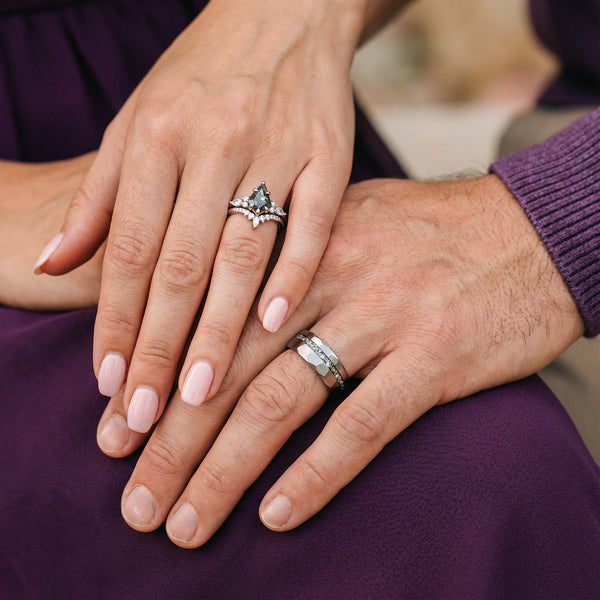
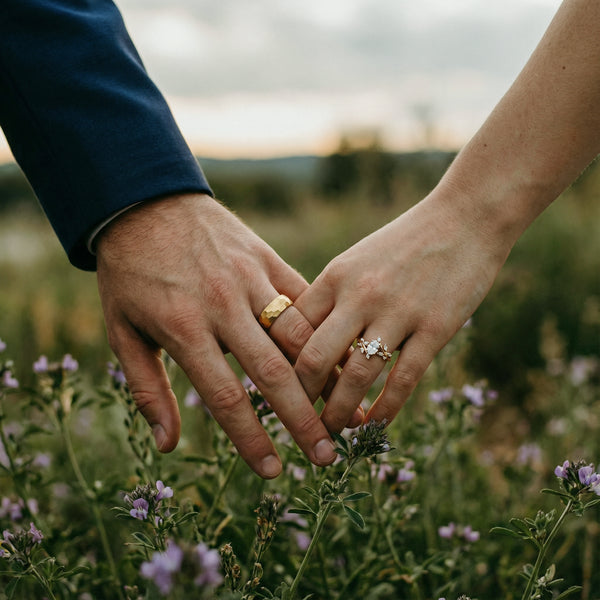

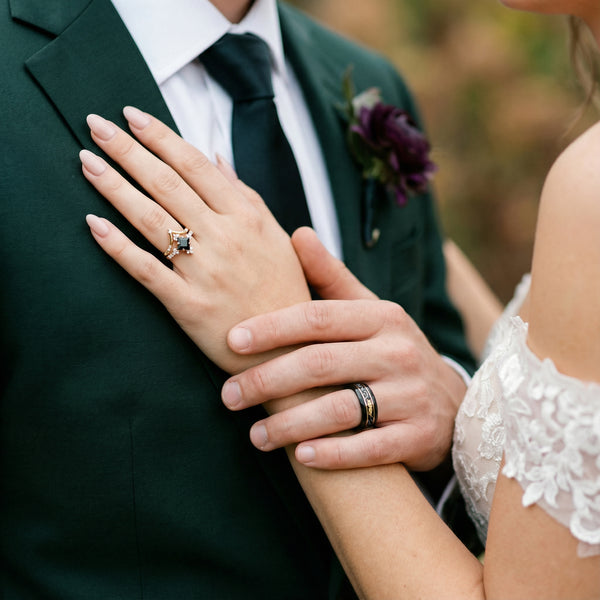

What Are Couple Rings?
A commitment ring worn by both partners is a ring shared between two people to signify something specific to their relationship — not a legal status, not a formal proposal, but a chosen symbol that belongs to both of them simultaneously. Unlike a wedding ring, which marks a legal marriage, or an engagement ring, which marks a specific intention to marry, this kind of ring is more broadly defined. It can mark any meaningful stage of a relationship the two people want to commemorate with a shared symbol.
The defining quality is mutuality. Both people wear a ring. The rings are connected — through shared design, shared stone, shared metal, or shared meaning — in a way that makes visible the fact that these two objects belong to the same relationship. They are worn simultaneously by two different people on two different bodies, and the connection between them is the point.
What the rings actually signify depends entirely on the people wearing them. Some use them as promise rings, marking a commitment that falls short of engagement. Others use them as pre-engagement rings — a signal of serious intention without a formal proposal. Others wear them as commitment rings in relationships where marriage is not the goal. And increasingly, people choose them as wedding rings — rings that bypass the traditional engagement-then-band sequence entirely and simply mark the commitment itself.
Popular Gemstones for Couple Rings


The History and Cultural Traditions of Commitment Rings
Ring exchange as a symbol of commitment has a more varied cultural history than most people realize. In the Western tradition, exchanging rings as tokens of commitment dates to ancient Rome, where rings were exchanged as symbols of contract. The modern wedding ring as we understand it — worn on the left ring finger because of a belief in the vena amoris, a vein running directly from that finger to the heart — emerged from Roman tradition and was codified in Christian marriage ceremonies over the following centuries.
The concept of both partners wearing coordinated rings, rather than just a ring given by one to the other, is considerably more recent in Western culture. Men's wedding rings only became common in the United States during and after the Second World War, when servicemen began wearing rings to maintain connection with their wives during deployment. Before this, exchanging rings between both partners was relatively uncommon in American and European wedding traditions.
In East Asian cultures, commitment rings have a distinct and parallel tradition. In South Korea, rings exchanged between partners are a normalized element of romantic relationships, worn by dating couples who are not necessarily engaged or married. The 100-day anniversary of a relationship is a common occasion for exchanging them in Korean culture. Many Korean jewelry brands design specifically for this tradition, producing coordinated sets intended for couples at early stages of a relationship. The practice has spread beyond Korea through K-pop and Korean media and is now familiar to younger couples in many countries.
In Japan, a similar tradition exists, where pair rings are exchanged by couples as markers of serious dating commitment rather than engagement or marriage specifically.

Commitment Rings vs. Promise Rings vs. Engagement Rings - What's the Difference?
The three terms overlap enough to cause genuine confusion, so it is worth separating them clearly.
Commitment rings are the broadest category. They mark a shared intention between two people at whatever stage of a relationship the couple defines. They can be promise rings. They can be pre-engagement rings. They can serve as wedding rings. The term describes the format — two connected rings worn simultaneously by two partners — rather than a specific relationship milestone.
Promise rings are a subset with a more specific intention: a promise. The promise can be anything the couple defines — a commitment to fidelity, a statement of serious romantic intent, a marker of a long-distance relationship, or an explicit promise of future engagement. Promise rings are typically exchanged before engagement and are worn as a signal that the relationship is serious without constituting a formal proposal. Read our full promise ring vs. engagement ring guide for a detailed comparison.
Engagement rings mark a specific, public commitment to marry. Unlike a commitment ring or promise ring, an engagement ring is typically given by one partner to the other as part of a proposal — it is not simultaneously exchanged, and it carries a specific social meaning that extends beyond the couple to their families and community. The person who receives an engagement ring is understood to have agreed to marry. A commitment ring or promise ring does not carry this specific weight unless the couple has explicitly defined it that way.
The practical difference in jewelry terms: engagement rings tend to feature a prominent center stone and are worn on the left ring finger in Western tradition. Promise rings and commitment rings can take any form — from simple bands to rings with gemstones — and are worn on various fingers depending on cultural tradition and personal preference.

Free Shipping
Free shipping on all domestic orders. Ships from USA.

Loved by 200K+ Couples
Trusted by thousands of partners worldwide for our fantasy-inspired, handcrafted designs.

Ethically Crafted
We prioritize recycled and sustainable materials, using energy-efficient practices to minimize our carbon footprint.

What Finger Are These Rings Worn On?
This varies by country, culture, and personal preference, and it matters more than people expect because the finger a ring is worn on communicates meaning to people who observe it.
In Western tradition, the left ring finger is associated with engagement and marriage. Wearing a commitment ring on the left ring finger signals to most observers that the wearer is either engaged or married — which may or may not be the intended message depending on the relationship stage.
Many people wearing commitment rings as promise rings or pre-engagement markers choose the right ring finger specifically to avoid this association. The right ring finger carries no fixed commitment meaning in most Western cultures and leaves the left ring finger available for an engagement ring later.
In Korean and Japanese traditions, the index or middle finger is sometimes used. In some European countries — Germany, Norway, India, and several others — the right ring finger is actually the conventional wedding ring finger, which means wearing a ring there signals marriage rather than avoiding that signal.
The simplest answer: wear the ring on whichever finger feels right, and be clear with each other about what the ring means to your relationship rather than relying on cultural convention to communicate it for you.

How to Choose Rings That Work for Two Different People
The central challenge in choosing coordinated rings is that two different people with different aesthetics, different hand shapes, and different daily activities need to find two rings that connect without forcing either person into something that does not suit them.
The approach that works most consistently is choosing one connecting element and letting each ring be itself around that element. The stone is the most natural connecting element — the same gemstone in different sizes, cuts, or settings on each ring. Moss agate on both rings, for example, with completely different settings and metals, creates an immediate visual connection through the stone's distinctive green inclusions without requiring the rings to resemble each other in any other way. Browse moss agate jewelry for stone pairing ideas.
Metal finish is the subtler connecting element. Two rings in the same metal tone — both in rose gold, both in black ruthenium, both in sterling silver — read as a coordinated pair even when the designs are entirely different. The finish unifies without the design having to match.
Before choosing, it is worth each person identifying independently what they would want in a ring without reference to the other's preferences. Then the overlap — in metal, stone, aesthetic direction — becomes the natural basis for the connecting element. The rings should suit each person individually first. Their connection is then earned rather than imposed.
For personalized rings, visit our custom ring builder or explore engraving options to add a shared phrase, date, or coordinate across both pieces.