


Free U.S. Shipping
Dispatched from the USA with care

Hustle-Free Returns & Exchanges
Simple, worry-free process

Ethically Crafted
Responsibly sourced, consciously made

Loved by 200,000+ Couples
Fantasy-inspired, handcrafted jewelry
Why Emerald for an Engagement Ring
Emerald earns its place in engagement contexts through three qualities that few other gemstones match. Color saturation— fine emerald displays the most concentrated green of any gemstone in fine jewelry, with the best stones reading as nearly luminous against any skin tone or metal pairing. Historical depth — emerald engagement rings have unbroken documented lineage from the ancient world through Roman, Mughal, Russian imperial, and modern Western traditions, making this one of the most historically supported alternatives to diamond. Distinctiveness — green is the rarest color in engagement ring stones, which means an emerald engagement ring will be noticed and remembered long after generic diamond solitaires fade into visual background.
For comprehensive background on emerald itself — the 4Cs, color grading, oiling and treatments, geographic origins, and the complete story of the stone — see our emerald jewelry collection, the dedicated hub. For the long-form buying guide covering everything couples ask before committing to an emerald engagement ring, read our emerald engagement ring buying guide.

Natural, Lab-Grown, or Simulated — Three Honest Tiers
Aquamarise offers emerald engagement rings across three transparent stone tiers, each named clearly in every product description.
Natural emerald
is mined beryl from Colombia, Zambia, Brazil, Afghanistan, or Pakistan, available across our solid 14K gold engagement rings and select gold vermeil pieces — appropriate for heirloom-grade engagement contexts.
Lab-grown emerald
is chemically identical beryl produced in controlled laboratory conditions, delivering the same chemistry and the same Mohs hardness (7.5–8) as natural emerald. Lab-grown emerald is genuine emerald — not an imitation — simply grown rather than mined. Standard across our gold vermeil engagement rings and select solid 14K gold pieces.
Simulated emerald
is a different material entirely — typically green cubic zirconia or specialized crystal — that imitates emerald's appearance at significantly more accessible price points. Standard in our sterling silver engagement rings.
Stone-tier upgrades are available on most engagement rings at additional cost. If you love a sterling silver design but want lab-grown or natural emerald instead of simulated, or a gold vermeil design with natural emerald instead of lab-grown, see Design Your Own Custom Ring. For the complete framework on the three tiers, see our emerald jewelrycollection.
Settings That Protect and Showcase Emerald
Emerald requires more thoughtful setting choice than diamond, sapphire, or moissanite — the stone is softer (Mohs 7.5–8 vs diamond's 10) and natural emeralds typically contain inclusions ("jardin," the garden) that benefit from edge protection. The right setting protects the stone while letting its color carry the ring.
Bezel settings wrap a thin metal band around the emerald's perimeter, providing the most comprehensive protection against impact and the most secure option for active wearers. See bezel set engagement rings.
Halo settings surround emerald with smaller accent stones — typically lab-grown diamonds or moissanite — creating brilliant white contrast that amplifies emerald's green saturation while adding secondary protection to the center stone's edges. The most popular configuration for emerald engagement rings. See halo engagement rings.
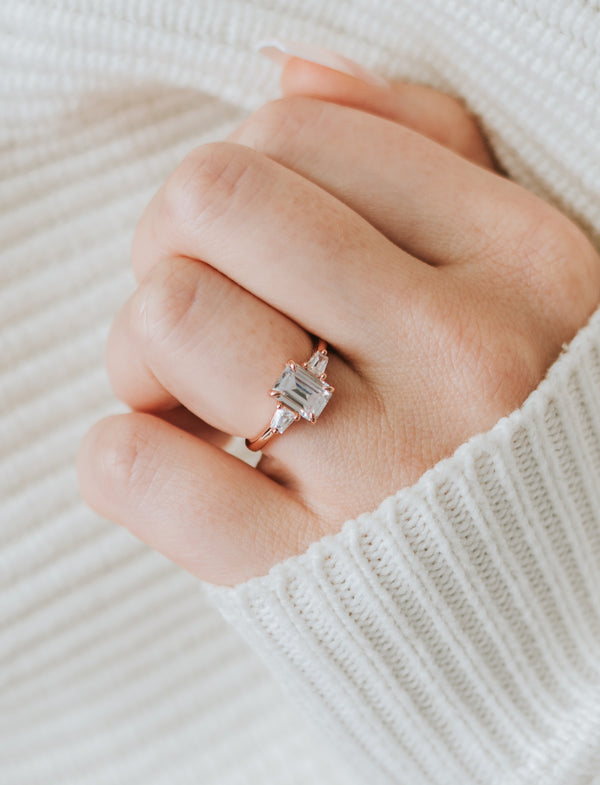
Three-stone settings flank emerald with two accent stones, traditionally interpreted as past, present, and future. White accent stones (diamond, moissanite) produce dramatic contrast against emerald's green; emerald-only three-stone designs use graduated stones for monochromatic depth.
Hidden halo settings place accent stones beneath the emerald's girdle, visible only from the side. The ring reads as a clean emerald solitaire from above while catching additional brilliance from angles. See hidden halo engagement rings.
Vintage and Art Deco settings draw on emerald's documented prominence in Edwardian, Russian imperial, and Art Deco bridal jewelry — milgrain detailing, scroll engraving, and geometric metalwork frame emerald in period-referenced settings. See vintage antique engagement rings.
Floral and nature-inspired settings echo emerald's botanical color associations — leaf, vine, and botanical metalwork that frames the stone as if growing within the ring. See floral engagement rings, leaf engagement rings, and nature-inspired engagement rings.
Solitaire settings isolate the emerald as a single stone. Best paired with bezel or protective prong configurations for daily-wear practicality. See solitaire engagement rings.

Cuts for Emerald Engagement Rings
The classic shape for emerald is — fittingly — the emerald cut, the rectangular step-cut that takes its name from the stone itself. The cut's broad open facets emphasize emerald's color and clarity rather than producing brilliant sparkle, which suits emerald's character precisely. For emerald cut engagement rings across all gemstones (not just emerald), see emerald cut engagement rings.
Other popular cuts for emerald engagement rings include oval (elongating finger lines while displaying substantial color area), cushion (soft vintage-leaning shape that emphasizes saturation), round brilliant (maximum sparkle, though less common for emerald), pear (directional shape suited to halo configurations), marquise (elongated pointed-end shape), princess (geometric square brilliant), and asscher (square step-cut with Art Deco aesthetic). Browse our broader cut categories at oval engagement rings, cushion cut engagement rings, round engagement rings, pear shaped engagement rings, and marquise engagement rings.
Stone Size and Carat Considerations
Emerald engagement rings typically use stones in the 1–3 carat center stone range. Below 0.75 carat, emerald's color reads less dramatically and inclusions become more visually noticeable; at 1 carat and above, the saturation carries the ring without requiring perfect clarity. Statement engagement rings in the 2–3 carat range push emerald into full dramatic effect.
Note that natural emerald carries different price-per-carat economics than diamond. A 2-carat natural emerald can cost significantly more than a 2-carat diamond at equivalent quality grades, particularly for Colombian origin. Lab-grown emerald removes the natural-rarity premium while preserving the visual aesthetic — making 2-3 carat lab-grown emerald engagement rings significantly more accessible than equivalent natural stones. Simulated emerald removes price as a consideration entirely.
Popular Emerald Engagement Rings Styles & Settings
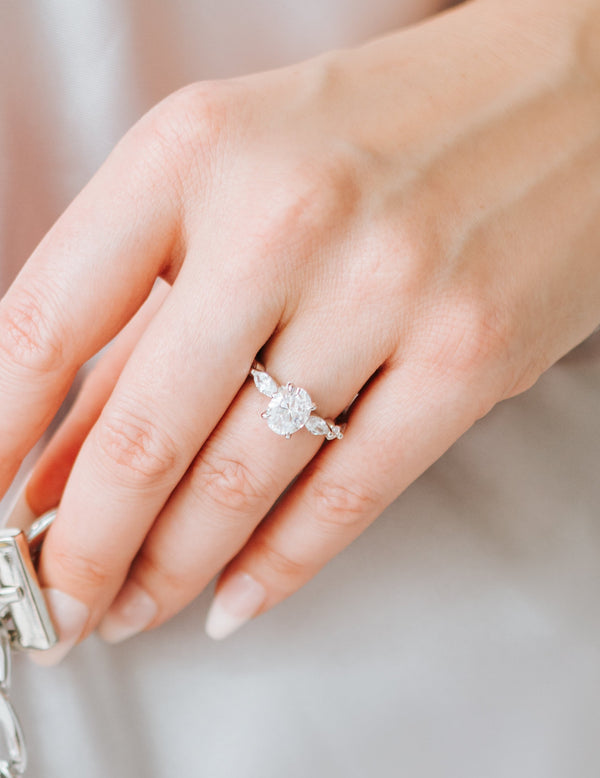
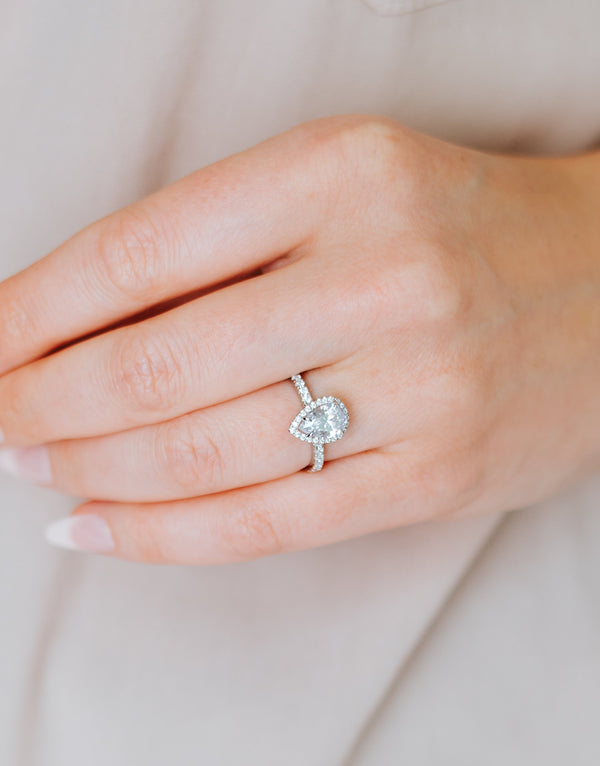
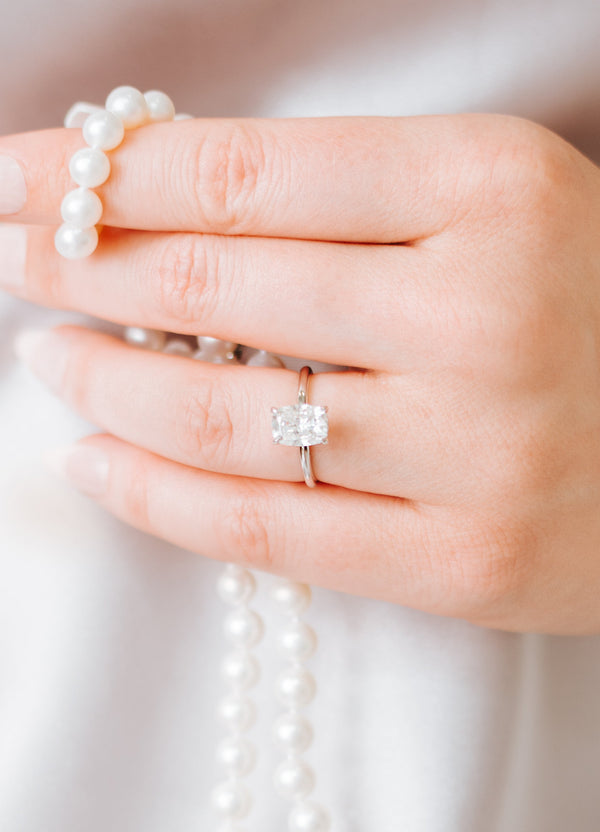
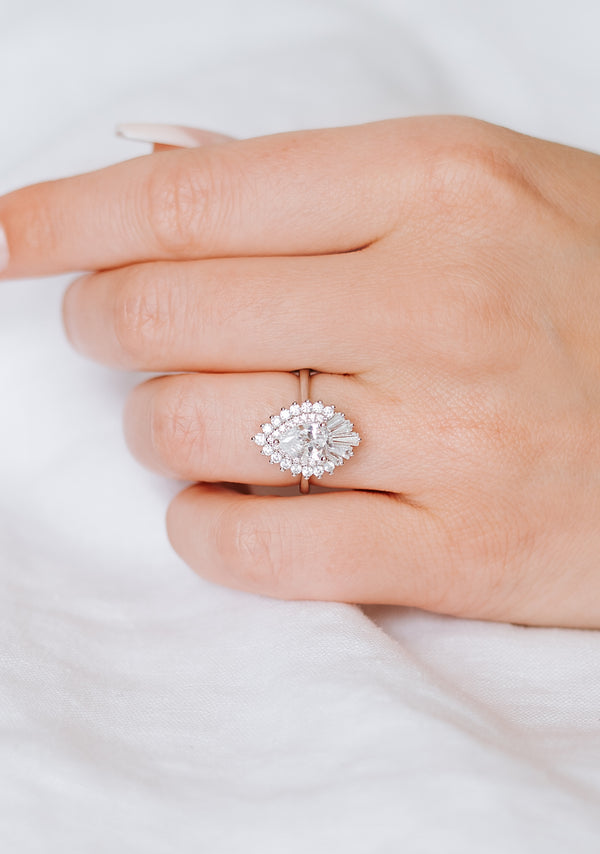
Aquamarise® emerald engagement rings are available in a range of cuts, settings, and metals. Browse below or use the filters above to shop by style or metal.
Metal Pairings for Emerald Engagement Rings
Yellow gold and 14K solid yellow gold create warm contrast against emerald's green — the most historically referenced pairing, drawing on Victorian, Edwardian, and Mughal traditions. See yellow gold vermeil jewelry.
Rose gold softens emerald's intensity with warm pink tones, particularly popular for contemporary alternative bridal aesthetics. See rose gold vermeil rings.
White gold and sterling silver preserve emerald's green at full saturation without warm metal influence — produces the cleanest pure-color presentation. See sterling silver engagement rings (paired with simulated emerald as standard) and gold vermeil jewelry.
Solid 14K gold in all three colors delivers heirloom-grade construction — fully repairable, holds material value across decades, typically paired with natural or lab-grown emerald. See solid gold rings.
For complete metal selection guidance, see our precious metal guide, how to choose the best metal guide, 14K vs 18K gold guide, and what is gold vermeil.


Emerald vs Other Engagement Stones
For couples comparing emerald to alternatives, three considerations matter most.
Emerald vs diamond. Diamond produces brilliant white sparkle at Mohs 10; emerald produces saturated green at Mohs 7.5–8 with more visible inclusions but unmatched color. For couples wanting color over sparkle, emerald. For couples wanting maximum durability and traditional brilliance, diamond — see lab-grown diamond engagement rings for accessible diamond options.
Emerald vs sapphire. Sapphire (Mohs 9) is significantly harder and available in saturated colors including blue, pink, yellow, and rare green. Sapphire requires less protective setting consideration than emerald. For couples wanting maximum durability with colored gemstone aesthetic, sapphire — see sapphire engagement rings. For couples specifically drawn to emerald's green and historical lineage, emerald.
Emerald vs moissanite. Moissanite (Mohs 9.25) is significantly more brilliant and harder. Different aesthetic registers entirely — moissanite for sparkle, emerald for color. See moissanite engagement rings.
For broader alternative comparisons, see our alternative engagement rings hub and gemstone engagement ring guides.
From the Blog

Emerald Engagement Rings - The Complete Buying Guide
Everything before buying an emerald engagement ring - meaning, stone quality, natural vs lab, settings, metals, wedding band pairing, durability, and care.

May Birthstone Jewelry - The Complete Guide to Emerald Gifts & Meaning
Everything about May birthstone jewelry - what emerald means, which pieces make the most personal gifts, how to choose by metal, natural vs lab, and care tips.

What Makes Jewelry Ethical? Materials & Sourcing Explained
The word "ethical" appears on more jewelry websites than ever. This guide explains what genuine ethical sourcing actually looks like — metal by metal, stone by stone — and gives...

Green Engagement Rings: The Complete Guide to Every Green Gemstone
Do green engagement rings hold up to daily wear? Yes — but the right green stone depends entirely on your lifestyle and setting choice. The complete breakdown of every green...
Emerald Engagement Rings FAQs
After the Proposal
For the ceremony band, anniversary ring, or any post-engagement emerald piece designed to coordinate with your engagement ring, our emerald wedding bands collection covers eternity, half-eternity, accent, channel-set, and anniversary configurations across the same stone tiers. For couples shopping the engagement and wedding pieces together, our emerald couples rings collection covers matched and coordinated sets.
For broader band selection across all stones, see women's wedding bands, solid gold wedding bands, rose gold vermeil women's wedding bands, and curved wedding bands.
Made by Hand, Built to Last
Every Aquamarise piece is handcrafted, hand-finished, and shipped with a warranty, worldwide insured shipping, a 14-day return window on non-customized work, and ethically sourced stones paired with recycled precious metals from certified refiners. 4.9 stars from 38,000+ verified reviews across aquamarise.com and our Etsy shop.